Best Spanish Podcast for Beginners: Where to Start
Last updated: March 2026
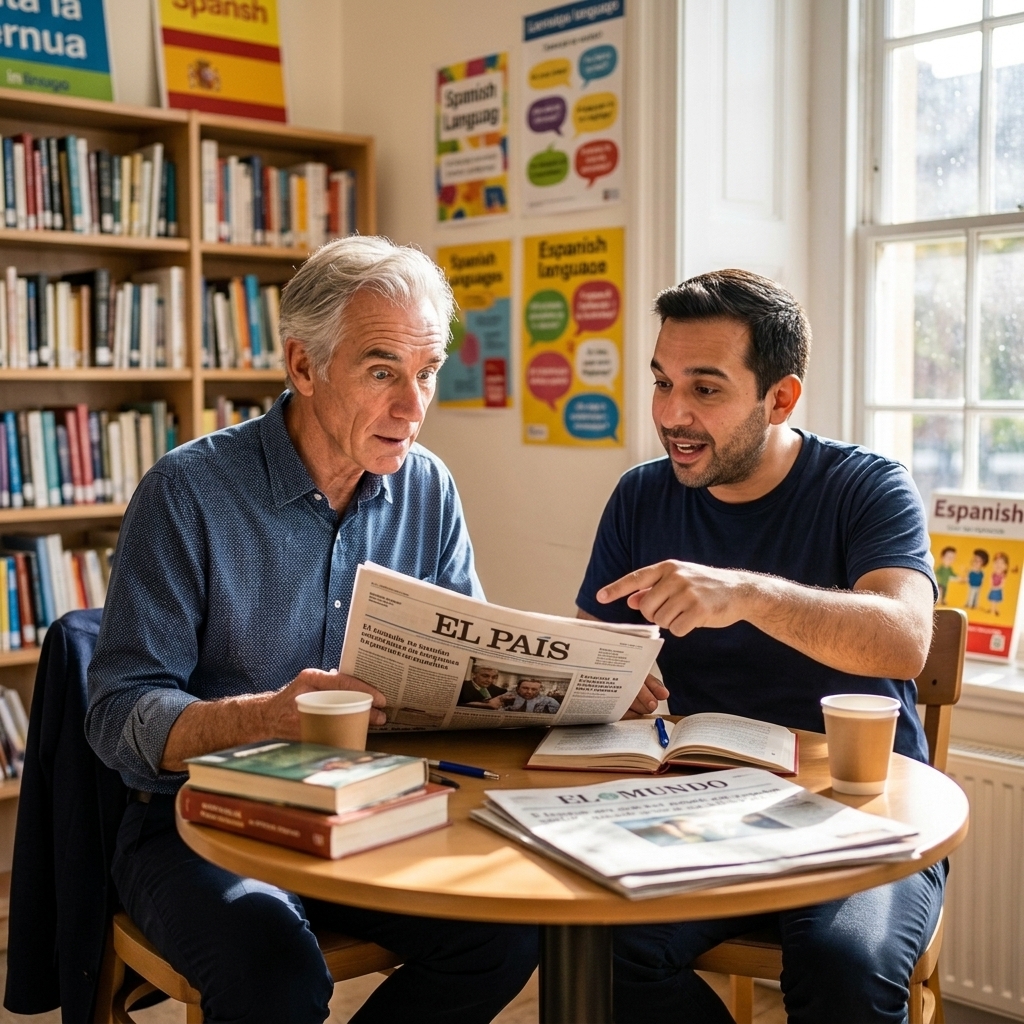
You want to learn Spanish. You have heard that podcasts are a good way to do it. You open your podcast app, search "learn Spanish," and get 400 results. Half of them are entirely in Spanish. A quarter of them are grammar lectures disguised as episodes. The rest have titles like "Episode 347: The Subjunctive in Conditional Clauses."
None of that helps if you are a beginner.
Finding a Spanish podcast for beginners is not hard because there are too few options. It is hard because most options are wrong for where you are right now. The right beginner podcast does not just teach Spanish. It teaches Spanish at a pace, level, and format that keeps you listening past episode three.
This guide covers what makes a Spanish podcast actually work for beginners, how to choose the right one, and a concrete plan for your first four weeks of listening.
Why most Spanish podcasts fail beginners
The problem is not that beginners lack motivation. It is that most podcasts are calibrated for the wrong audience.
A native Spanish podcast assumes you already understand spoken Spanish at near-fluent speed. You do not. A "slow Spanish" podcast artificially reduces the speed, but the vocabulary and grammar are still B1 or B2 level. You catch individual words but miss the meaning. A grammar-focused podcast explains the rules in English and gives you 30 seconds of actual Spanish. You learn about Spanish without ever hearing enough of it to improve.
"My first attempt at a Spanish podcast lasted exactly one commute. I pressed play, heard rapid-fire Spanish for twelve minutes, understood the words 'hola' and 'gracias,' and never went back."
"That is not a beginner podcast. That is a fluency test. And you failed."
The right Spanish podcast for beginners meets three criteria:
You understand 85% or more of what you hear. Research by Paul Nation established that incidental vocabulary acquisition requires understanding 95-98% of surrounding words. For beginners using bilingual support, the effective threshold drops to around 85% because the English context fills the gaps (Nation, 2006).
The content is interesting enough to keep you listening. Krashen's affective filter hypothesis states that boredom and anxiety block acquisition. If you are listening to a dialogue about renting a car at the airport, your brain checks out. If you are hearing about something you actually care about, it stays engaged (Krashen, 1982).
There is a system for confirming what you understood. Without feedback, you overestimate your comprehension. You think you followed the episode, but you missed the main point. A bilingual debrief or an interactive transcript closes this gap.
| What beginners need | What most podcasts offer | The gap |
|---|---|---|
| 85%+ comprehension | 40-60% comprehension | Beginners hear noise, not language |
| English context before Spanish | Spanish from the first second | No scaffolding to anchor understanding |
| Short Spanish segments (3-5 min) | 15-30 min of unbroken Spanish | Cognitive overload within minutes |
| Interesting real-world topics | Textbook dialogues about hotels | Boredom kills consistency |
| Verification of comprehension | No feedback mechanism | False confidence, undetected gaps |
What level do you actually need to start?
If you are an absolute beginner (A1), you need a basic vocabulary foundation before podcast listening becomes productive. You should know roughly 300-500 words: common verbs (ser, estar, tener, hacer, ir), everyday nouns, numbers, basic adjectives. Spend two to four weeks with a beginner course or app to build this base. Then start with podcasts.
If you are elementary level (A2), you are ready. You know 1,000-2,000 words. You can follow simple sentences about familiar topics. A bilingual podcast with English support before and after the Spanish segments will put you right in the acquisition zone.
"You do not need to know Spanish to start a Spanish podcast. You need to know enough Spanish to not drown in it."
"So like... 'hola, me llamo Fletcher, tengo un gato.' That is my entire A2 identity."
You can start listening to a Spanish podcast at A2 level (roughly 1,000 words). If you are A1, spend two to four weeks building basic vocabulary first. The goal is not perfection. The goal is understanding enough that the podcast becomes a learning tool rather than background noise.
The 7 best beginner Spanish podcasts compared
Not all beginner podcasts are equal. We evaluated the most popular options specifically for beginners, focusing on how well they serve A2 learners and absolute beginners transitioning to podcast-based learning.
| Podcast | True beginner? | Bilingual? | Transcript | A2 content | Real topics | Episode length | Price |
|---|---|---|---|---|---|---|---|
| Coffee Break Spanish | Yes (A1) | Partial | Premium only | Season 1-2 | No (textbook) | 15-20 min | Free S1, then $75-125 |
| Twilingua | A2+ | Yes (bridge method) | Yes, interactive | Yes | Yes (news, culture) | 12-15 min | Free tier, $9.99/mo |
| Dreaming Spanish | Yes (A1) | No | No | Yes | Partially | 5-15 min | Free (YouTube), $7.99/mo |
| SpanishPod101 | Yes (A1) | Heavy English | Premium only | Yes | No (scripted) | 5-15 min | $4-47/mo |
| Language Transfer | Yes (A1) | Yes | No | No (grammar) | No | 5-10 min | Free |
| News in Slow Spanish | No (B1+) | No | Yes | No | Yes (news) | 10-15 min | $22.90/mo |
| Espanol con Juan | No (B1+) | No | No | No | Yes | 10-20 min | Free |
For absolute beginners (A1): Coffee Break Spanish or Language Transfer
If you have never studied Spanish, start with Coffee Break Spanish Season 1 or Language Transfer. Both teach from zero. Coffee Break Spanish is more structured and polished. Language Transfer is free and focuses on building intuition for how Spanish works. Neither is a podcast you will listen to for years, but both give you the vocabulary foundation you need before moving to content-based listening.
For elementary learners (A2): Twilingua or Dreaming Spanish
Once you have basic vocabulary, switch to a content-based podcast. Twilingua uses a bilingual bridge format where Fletcher introduces each story in English, Octavio tells it in Spanish calibrated to your level, and Fletcher debriefs in English afterward. This keeps you above the comprehension threshold while exposing you to real Spanish about real topics. The interactive transcript lets you tap any word for a translation without breaking the flow.
Dreaming Spanish takes a pure comprehensible input approach: simple Spanish with visual support, no English at all. Excellent if you prefer full immersion from the start.
For confident beginners ready for a challenge: SpanishPod101
SpanishPod101 offers a massive library of dialogues organized by level. At the beginner tiers, each lesson walks through a short conversation line by line. The sheer volume means you can find a lesson on almost any topic. The downside is inconsistent quality and a cluttered app experience.
What makes a Spanish podcast actually work for beginners
After analyzing what separates effective beginner podcasts from ineffective ones, five features consistently matter.
1. Bilingual scaffolding
The single most important feature for a beginner Spanish podcast. Bilingual scaffolding means you hear English context before and after the Spanish content. Research on bilingual education consistently shows that strategic use of the learner's first language supports acquisition, particularly for comprehension of complex content (Cook, 2001).
"Bilingual does not mean easy mode. It means your brain can actually do its job. If I tell you the story is about a teachers' strike in Argentina before Octavio says 'huelga de maestros,' your brain connects those sounds to meaning instantly. Without context, 'huelga de maestros' is just syllables."
"And then Fletcher acts surprised when he understands it in the next episode without the English hint."
2. Level-appropriate vocabulary
A beginner Spanish podcast should use high-frequency vocabulary: the 1,000-2,000 most common words in Spanish. These words cover roughly 85% of everyday speech. At A2, every new word should be surrounded by words you already know, so you can infer its meaning from context.
3. Short Spanish segments
Beginner listening stamina is limited. Cognitive load research shows that second-language processing demands significantly more working memory than first-language processing (Paas & Sweller, 2012). For A2 learners, three to five minutes of continuous Spanish is the effective limit before comprehension degrades.
4. A transcript you can follow
A Spanish podcast with a transcript transforms listening from a memory test into a learning experience. When you see the words as you hear them, your brain creates dual-channel memory traces that are significantly stronger than audio alone (Mayer, 2009). For beginners, the transcript is the difference between hearing "elgobiernoanuncio" as one incomprehensible blob and seeing "El gobierno anuncio" as three learnable words.
5. Topics you actually care about
This is where most beginner podcasts fail. They teach you Spanish about booking hotels, ordering food, and asking for directions. These are useful phrases, but they are not interesting. The best beginner Spanish podcasts cover real topics: current events, culture, science, technology, sports. You stay engaged because you would want to know about these subjects even in English.
| Feature | Why it matters for beginners | What to look for |
|---|---|---|
| Bilingual scaffolding | Keeps you above comprehension threshold | English intro and debrief around Spanish segments |
| Level-appropriate vocabulary | Prevents cognitive overload | High-frequency words, 1,000-2,000 word range |
| Short Spanish segments | Matches beginner listening stamina | 3-5 minutes of Spanish at a time |
| Transcript | Creates dual-channel learning | Synced text, ideally interactive |
| Interesting topics | Sustains daily listening habit | Real-world content, not textbook dialogues |
How to listen to a Spanish podcast as a beginner: the step-by-step method
Pressing play is not a method. Here is a specific process designed for A2 learners who are listening to a bilingual Spanish podcast for the first time.
Before you press play
Read the episode title and description. This pre-reading activates your existing knowledge about the subject, which dramatically boosts comprehension. If the episode is about renewable energy in Chile, your brain will be primed to hear words like "energia," "solar," and "gobierno" even before they appear.
Pass 1: Listen with the transcript (15 minutes)
Play the episode and follow the transcript. During the English introduction, note the key vocabulary. When the Spanish segment begins, read along. Do not pause for every unknown word. If you understand the gist of the sentence, keep going. In Twilingua, the transcript highlights each word as it is spoken. Tap any Spanish word you do not know to see its translation.
Pass 2: Listen without the transcript (15 minutes)
Play the same episode again without the transcript. Words and phrases that were invisible on the first pass are now audible. Your brain learned what to expect, and now it can find those sounds in the stream of speech. This second pass is where real listening skill develops.
After listening: review (5 minutes)
Check your saved vocabulary. For each word, try to remember the sentence it appeared in. Do not memorize definitions. Just re-read the sentence and move on.
"The first time I did the two-pass method, I was shocked at how different the second listen felt. Same audio. Same Spanish. But I heard words that were completely invisible the first time."
"Your brain learns to expect 'acuerdo' in a certain position in the sentence because it saw it in the transcript. On the second listen, it finds it. That is acquisition."
The beginner listening cycle
| Step | Time | What you do | What your brain does |
|---|---|---|---|
| Pre-reading | 2 min | Read title, description, key words | Activates prior knowledge, primes vocabulary |
| Pass 1 with transcript | 15 min | Listen and read along, tap unknown words | Maps sounds to written words, builds word recognition |
| Pass 2 without transcript | 15 min | Listen only, no visual support | Strengthens auditory processing, tests real comprehension |
| Vocabulary review | 5 min | Scan saved words, re-read sentences | Reinforces context-based memory |
| Total | 37 min | One complete beginner acquisition cycle |
The two-pass method takes 37 minutes per episode. Pass 1 with the transcript teaches your brain what the words look like. Pass 2 without the transcript teaches your brain what they sound like. Do this five days a week and you accumulate over 160 hours of quality Spanish input in a year.
Your first four weeks: a realistic beginner plan
Knowing what to listen to is one thing. Knowing what to do each week is another. Here is a week-by-week plan for your first month with a beginner Spanish podcast.
Week 1: Build the habit
Goal: Listen to three episodes with the transcript. Do not re-listen yet. Just get comfortable with the format. You will understand more of the English parts than the Spanish parts. That is normal. Your brain is calibrating to the sounds, rhythm, and intonation of Spanish.
Week 2: Add the second pass
Goal: Listen to three new episodes. Re-listen to one episode from Week 1 without the transcript. On the re-listen, you will hear words you missed the first time. This is the single most encouraging moment in beginner podcast learning.
Week 3: Establish the full cycle
Goal: Do the complete two-pass method for every episode. Three episodes, six listens. By the end of Week 3, you will notice vocabulary from earlier episodes appearing in new ones. "Gobierno," "acuerdo," "segun" — high-frequency words start to feel familiar. You are not memorizing them. You are acquiring them.
Week 4: Add variety and measure progress
Goal: Try one episode at a slightly higher level alongside two at your normal level. If you understood 70-80% of the harder episode, your brain is ready for the challenge. If less than 60%, stay at your current level for another few weeks.
| Week | Episodes | Passes per episode | Total listening time | Focus |
|---|---|---|---|---|
| 1 | 3 new | 1 (transcript only) | 45 min | Build the habit |
| 2 | 3 new + 1 re-listen | 1-2 | 60 min | Discover the re-listen effect |
| 3 | 3 new | 2 each | 110 min | Full two-pass cycle |
| 4 | 2 normal + 1 harder | 2 each | 110 min | Measure progress, stretch |
How long does it take to stop being a beginner?
The honest answer: faster than you think, slower than you want. Moving from A2 to B1 takes roughly 150-200 hours of quality input. At 30 minutes per day, that is about 10-13 months (FSI, 2023, adjusted for self-study).
| Milestone | Hours of input | At 30 min/day | What changes |
|---|---|---|---|
| "I recognize words across episodes" | 20-40 hours | 6-10 weeks | Vocabulary is sticking without flashcards |
| "I understand before the English hint" | 60-100 hours | 4-7 months | Your listening speed is approaching real-time |
| "I can follow familiar topics without English" | 120-180 hours | 8-12 months | You are crossing from A2 into B1 |
| "I seek out Spanish content on my own" | 200-300 hours | 13-20 months | You are solidly intermediate |
"People ask me, 'When will I stop being a beginner?' You stop being a beginner the first time you understand a Spanish sentence without translating it in your head. For some people that happens in month two. For others, month six. But it happens for everyone who keeps listening."
"Duolingo taught Fletcher the words. We taught him what they sound like in a sentence."
How Twilingua works for beginners
Twilingua is our product, so read this section with appropriate skepticism. Each episode covers a real-world topic. Fletcher introduces the topic in English, explains key vocabulary, and tells you what to listen for. Octavio tells the story in Spanish, calibrated to your level. After the Spanish segment, Fletcher debriefs in English.
The interactive transcript highlights each word as it is spoken. Tap any Spanish word to see its translation. New episodes publish daily — you are learning Spanish with real podcasts, not recycled textbook dialogues.
What a beginner A2 episode looks like:
| Segment | Language | Duration | What happens |
|---|---|---|---|
| Introduction | English | 2-3 min | Fletcher introduces the topic, teaches 4-5 key words |
| Story | Spanish | 4-5 min | Octavio tells the story using short sentences and high-frequency vocabulary |
| Debrief | English | 2-3 min | Fletcher reviews what happened, highlights tricky phrases |
| Story 2 | Spanish | 3-4 min | Second topic, same approach |
| Wrap-up | English | 1-2 min | Summary and vocabulary recap |
| Total | Mixed | 12-15 min | 7-9 min of Spanish, fully scaffolded |
The weaknesses are real. Twilingua uses AI-generated voices, not human speakers. It does not start below A2. And the catalog, while growing daily (60+ episodes), is younger than established podcasts like Coffee Break Spanish.
The transition plan: from beginner to intermediate
Starting is important. Knowing when and how to level up is just as important. You are ready to move up when you understand 90%+ of A2 episodes without the transcript, when you recognize vocabulary across episodes without effort, and when the English introduction feels unnecessary.
Do not jump from A2 to B2. Move one step at a time. Start mixing levels: two A2 episodes and one B1 episode per week. Lean on the transcript for B1 episodes. Add a monolingual podcast like Hoy Hablamos for supplementary listening.
| Stage | Primary podcast | Supplementary | English support | Transcript use |
|---|---|---|---|---|
| Early A2 | Twilingua A2 or Coffee Break Spanish | None | Always | Always (Pass 1) |
| Late A2 | Twilingua A2 | Dreaming Spanish beginner | Usually | Pass 1 only |
| A2-to-B1 transition | Twilingua A2 + B1 mix | Hoy Hablamos | For B1 episodes | Both passes for B1 |
| B1 | Twilingua B1 | Notes in Spanish, Hoy Hablamos | Occasionally | Pass 1 only |
"The day I realized I did not need the English intro was genuinely one of the best days of my year. It was an episode about renewable energy. Octavio started talking and I just... followed. No panic. No translation. Just understanding."
"And then he spent the next ten minutes telling me about it, which was less exciting."
FAQ
What is the best Spanish podcast for absolute beginners?
If you have never studied Spanish (A1), start with Coffee Break Spanish Season 1 or Language Transfer. Once you reach roughly 1,000 words (A2), switch to a content-based podcast like Twilingua, which uses a bilingual bridge format with English context before and after each Spanish segment. For a complete comparison, see our guide to the best Spanish podcasts in 2026.
How do I choose a Spanish podcast at the right level for me?
Listen to a two-minute sample. If you understand fewer than half the sentences, it is too hard. If you understand everything without effort, it is too easy. The target is 85-95% comprehension. For A2 learners, look specifically for bilingual podcasts that provide English context around the Spanish content. Check for a CEFR level label — podcasts that specify A2, B1, or B2 content are more likely to match your needs than generic "beginner" labels.
Can I learn Spanish with a podcast if I only have 15 minutes a day?
Yes. A single 15-minute episode per day gives you roughly 45 hours of input in six months. If you can do the two-pass method, 30 minutes is ideal, but even one focused pass is significantly better than no exposure. Consistency matters more than session length.
Do I need a transcript to learn from a beginner Spanish podcast?
Not strictly, but it makes a significant difference. Learners who read along while listening retain significantly more new words (Webb & Chang, 2015). For beginners, the transcript solves the segmentation problem: you can see where one word ends and the next begins, which is nearly impossible to hear in connected speech. See our guide to Spanish podcasts with transcripts.
Should I use a Spanish podcast or an app like Duolingo as a beginner?
Both, but in sequence. Use a vocabulary app for the first two to four weeks to build your base of 500-1,000 words. Then transition to a bilingual podcast as your daily core habit. The app gives you isolated vocabulary. The podcast gives you listening comprehension, context, and natural grammar exposure. Most successful learners use an app as a launchpad and a podcast as the engine.
Start with one episode
You have read about what makes a beginner podcast work, how to choose the right one, and exactly what to do in your first four weeks. The research is clear. The method is specific. The only step left is pressing play.
If you are at A2 and want to try a bilingual format with real content, start here. Twelve minutes. English context before and after. Spanish you can actually follow. An interactive transcript that shows you every word.
Three free episodes per week. No credit card required.