How Long Does It Take to Learn Spanish? (FSI Data)
Last updated: April 2026
Everyone who starts learning Spanish asks the same question. And everyone gets a different answer — "a few months" from optimistic apps, "years" from cautious teachers, "it depends" from linguists. The frustration is real. You want a number, and nobody will give you one.
Here is the truth: there is a real number. It comes from the U.S. Foreign Service Institute, which has been training diplomats to professional language proficiency for over seventy years. The number is specific, it is based on decades of data, and it is more useful than any app claim — once you understand what the number actually means.
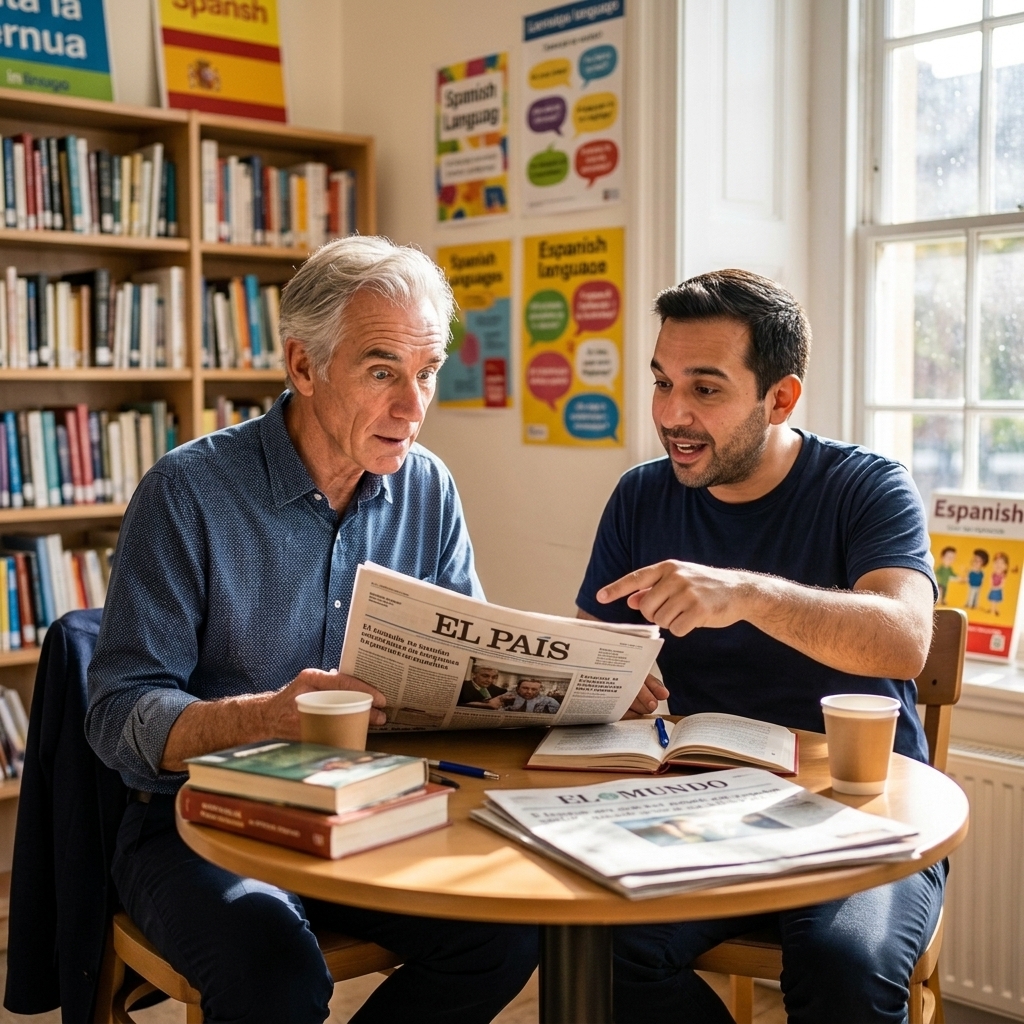
This guide covers the FSI data, the CEFR level-by-level breakdown, what daily consistency actually delivers in calendar time, and how to reach your specific goal without overcommitting to a plan you will abandon in three weeks.
Fletcher: "My Spanish teacher in school told me it would take five years. It has been eight. I am at B2. She was not entirely wrong." Octavio: "She was wrong about the years. She was right that it takes longer than you want. But here is what she did not tell you: the first year is the hardest, and after that it stops feeling like work."
Let us start with the data.
The official answer: what the U.S. Foreign Service Institute found
The Foreign Service Institute is not selling you anything. It trains U.S. diplomats — people who need to function professionally in a foreign country, often within months. The FSI has studied language acquisition time across 70+ languages since 1946. Their rankings are not theoretical. They reflect what it actually takes to reach operational proficiency.
For English speakers, Spanish falls into Category I — the easiest tier of languages to learn. Category I includes Spanish, French, Italian, and Portuguese. The FSI's official estimate for reaching professional working proficiency (roughly C1 / ILR Level 3) in a Category I language is 600 to 750 class hours (FSI, 2023).
For context: Category IV languages like Mandarin, Arabic, and Japanese require 2,200+ hours. Spanish takes roughly one-third as long.
One important caveat: FSI class hours assume 25 to 30 hours per week of structured instruction, homework, and immersive practice in a residential program. Most people learning Spanish on their own are not doing 25 hours a week. They are doing 30 to 60 minutes a day.
To convert FSI hours to self-study equivalents, apply a multiplier of 1.5 to 2x for unstructured time. That puts full professional proficiency at roughly 900 to 1,500 total self-study hours. That sounds like a lot. But professional proficiency (C1) is also not the goal for most learners. The section below breaks this down by CEFR level, so you can find the timeline that matches your actual goal.
Fletcher: "Six hundred and fifty hours. That sounds like a lot until you realize I spent more than that watching football this decade." Octavio: "And your Spanish is probably better than your football analysis at this point."
How long to reach each CEFR level: the honest numbers
The CEFR — Common European Framework of Reference — gives us a shared vocabulary for what "Spanish proficiency" actually means at different stages. Rather than "conversational" or "fluent" (vague), CEFR levels (A1 through C2) describe specific skills you can and cannot do at each stage.
For a deeper look at what these levels mean in practice and how acquisition actually works, see our comprehensible input guide.
Here are the realistic hour estimates from zero for each CEFR level, and what those hours translate to in calendar time at different daily commitments:
| CEFR Level | Label | What you can do | Hours from zero | At 30 min/day | At 1 hr/day |
|---|---|---|---|---|---|
| A1 | Absolute beginner | Greet people, introduce yourself, order food, count and spell | 0–80 hours | 0–5 months | 0–3 months |
| A2 | Elementary | Follow simple sentences on familiar topics, navigate travel situations | 80–200 hours | 5–13 months | 3–7 months |
| B1 | Intermediate | Understand main points of clear speech, handle most travel, describe experiences | 200–400 hours | 13–27 months | 7–13 months |
| B2 | Upper intermediate | Follow extended speech and films, read news articles, discuss most topics naturally | 400–600 hours | 27–40 months | 13–20 months |
| C1 | Advanced | Understand demanding texts, express spontaneously and fluently, use language flexibly | 600–800 hours | 40–53 months | 20–27 months |
| C2 | Mastery | Understand virtually everything with ease, nuanced spontaneous expression | 800+ hours | 53+ months | 27+ months |
The number that matters for most learners is B2. At B2, you can watch Spanish-language films and television, read newspaper articles, have natural conversations on almost any topic, and navigate daily life in a Spanish-speaking country with ease. This is what most people mean when they say "I want to be fluent in Spanish."
At one hour per day, B2 is roughly 13 to 20 months away from the start. At 30 minutes per day, it is 27 to 40 months — just over two to three years.
Each bar represents cumulative hours from zero, proportional to the 800-hour C1/C2 boundary.
Fletcher: "The B2 milestone is the one people should care about. That is where Spanish stops being a chore and starts being useful." Octavio: "It is also where it starts being enjoyable. At B2 you can finally watch a Mexican film without reading every subtitle. You catch the jokes. You feel the rhythm of the language."
Why your timeline might be shorter — or longer — than the averages
The CEFR hour estimates above assume a reasonably efficient learning approach with balanced practice across listening, reading, and some speaking. In reality, five factors stretch or compress that timeline significantly.
1. Your native language gives you a head start. The FSI estimates are calibrated for English speakers starting from zero. If you already speak another Romance language — Portuguese, Italian, French, Romanian — your starting point is closer to A2 or even B1. Thousands of vocabulary items and much of the grammatical structure transfer directly. A native Portuguese speaker might reach Spanish B2 in 200 hours, not 600.
2. Intensity changes calendar time without changing total hours. The total hours required to reach B2 are roughly the same whether you study for one year or five. What changes is the calendar. FSI's 600-hour target takes 24 weeks at 25 hours per week. The same 600 hours take 3.3 years at 30 minutes per day. Both paths arrive at the same proficiency level. You choose the speed.
3. Consistency beats volume. This is the most under-discussed factor. A learner who does 30 minutes every single day outperforms a learner who does three hours on Saturday and nothing the rest of the week — even though the weekly totals are similar. Spaced exposure builds durable memory pathways. Concentrated cramming builds fragile ones. The research on this is robust (Ebbinghaus, 1885; Cepeda et al., 2006).
4. What you practice determines what you improve. Listening hours build listening comprehension. Speaking hours build speaking. Reading builds reading. Someone who does 400 hours of bilingual podcast listening will have excellent comprehension and lagging formal writing skills. The CEFR level estimates assume roughly balanced practice. If you only listen, you will reach listening B2 while your speaking is still at B1.
5. Your definition of "learning Spanish" shapes your target. Survival Spanish for a two-week trip to Mexico? B1 listening is enough. Watching Narcos without subtitles? B2. Reading Gabriel García Márquez comfortably? C1. These are different targets requiring different hour totals. The table in the next section maps goals to levels precisely.
The FSI's 600-hour figure targets professional-level proficiency (C1). Most learners do not need that. Conversational fluency — following conversations, watching films, reading news articles — arrives at B2, around 400 to 600 hours from zero. At 30 minutes per day, that is 2.5 to 4 years. At 1 hour per day, 1.5 to 2 years.
Here is how daily commitment translates to calendar time for common proficiency targets:
| Daily study time | Weekly hours | Hours per year | Years to B2 (~500 hrs) | Years to C1 (~700 hrs) |
|---|---|---|---|---|
| 15 min/day | 1.75 hr/wk | 91 hr/yr | ~5.5 years | ~7.7 years |
| 30 min/day | 3.5 hr/wk | 182 hr/yr | ~2.7 years | ~3.8 years |
| 1 hour/day | 7 hr/wk | 365 hr/yr | ~1.4 years | ~1.9 years |
| 2 hours/day | 14 hr/wk | 730 hr/yr | ~8 months | ~11.5 months |
| Full immersion (~5 hr/day) | 35 hr/wk | 1,825 hr/yr | ~3 months | ~4.5 months |
Why B1 to B2 is the hardest stretch — and how to cross it
Here is something the timeline tables do not show: the hours from B1 to B2 feel longer than the hours from A1 to B1. Not because they take more time on the clock, but because progress becomes invisible.
At A1 to B1, each week brings obvious gains. New words unlock, new patterns click into place, and comprehension improves noticeably episode to episode. At B1, you already understand most everyday Spanish. You can follow conversations, navigate daily situations, and get the gist of most content at your level. The incremental gains per hour of practice are smaller — even as real acquisition is still happening.
SLA researchers call this the intermediate plateau. Learners at B1 frequently report feeling "stuck" even as their passive vocabulary and processing speed are growing measurably (Schmitt, 2010). The plateau is perceptual, not real — but it causes a lot of people to quit.
What actually works at this stage: shifting from scaffolded content (bilingual podcasts with transcripts) to semi-authentic content on varied topics, then increasing volume. More hours of the right kind of input — not harder grammar study — is what gets you from B1 to B2.
Octavio: "B1 to B2 is not a wall. It is a fog. You can see a little in front of you, but not all the way to the other side." Fletcher: "That is exactly what it felt like. I was not getting worse. I just could not tell if I was getting better. The trick was trusting the hours."
B1-level episodes on varied, current topics are the bridge. Each episode you understand is evidence of progress — even when the overall timeline feels slow.


For a full breakdown of how to structure your daily listening practice through the intermediate stage, see our guide to learning Spanish with podcasts — specifically the B1 section with the re-listening method.
What does "fluent in Spanish" actually mean?
The word "fluent" is doing too much work in most conversations about language learning. It means different things to different people, and those different things require very different hour totals.
Here is the honest breakdown by goal:
| Your goal | Minimum CEFR level | Hours from zero | Realistic calendar (1 hr/day) |
|---|---|---|---|
| Survive a trip to Mexico or Spain | A2 | 80–200 hours | 3–7 months |
| Hold a basic conversation | B1 | 200–400 hours | 7–13 months |
| Watch Spanish TV with subtitles | B1–B2 | 300–500 hours | 10–17 months |
| Watch Spanish TV without subtitles | B2 | 400–600 hours | 13–20 months |
| Read a Spanish novel comfortably | C1 | 600–800 hours | 20–27 months |
| Work professionally in Spanish | C1–C2 | 700–1,000+ hours | 23–33+ months |
| Pass DELE C2 | C2 | 1,000+ hours | 33+ months |
Most people reading this want B2: the level where Spanish becomes genuinely useful in daily life, where you can engage with Spanish-language culture on its own terms, and where the language stops requiring conscious effort on familiar topics.
Fletcher: "I spent two years chasing 'fluency' without defining it. When I finally said 'I want to watch a Spanish film without pausing every five minutes,' I had a target I could actually measure progress against." Octavio: "And now he pauses to tell me what the actors said wrong."
At B2, you can engage with content that was made for native speakers — not just content made for learners. That shift changes everything about how you experience the language.
How to shorten the timeline without burning out
"Study harder" is terrible advice. The learners who reach B2 fastest are not the ones who grind through the most hours in the shortest bursts. They are the ones who do the right thing consistently. Four strategies actually compress the effective timeline:
1. Prioritize comprehensible input over grammar drills. Passive vocabulary acquired through comprehensible input transfers to active use faster than vocabulary memorized from isolated lists (Krashen, 1982; Nation, 2001). Grammar study has its place, but it is less efficient per hour than input at the right difficulty level. Our comprehensible input guide covers the theory and the practical method in detail.
2. Anchor Spanish to an existing habit. The single biggest predictor of reaching B2 is not the quality of your resources — it is whether you are still doing it eighteen months from now. Habit anchoring works: attach Spanish to something you already do every day. Morning coffee. Your commute. A run. The habit does not require motivation if it is anchored to an existing trigger. A 30-minute podcast episode on a commute does not need to be scheduled. It just happens.
3. Stay at the 85–98% comprehension sweet spot. Content that is too easy bores you into a plateau. Content that is too hard frustrates you into quitting. The productive zone is slightly above your current level — you understand most of it, but not quite all. Practical test: if you cannot summarize the main point of a Spanish episode in English after listening, the content was too hard. Drop a level and build from there.
4. Track milestones, not hours. Hours are invisible. Milestones are concrete. Here are real milestones to watch for:
- Week 4: You recognize a Spanish word across two different episodes without looking it up
- Month 3: You understand the English intro before the host finishes saying it
- Month 6: You follow a Spanish segment on a familiar topic without the transcript
- Month 12: You start an episode on a topic you do not know and still follow the story
- Month 18: You think of a Spanish word before the English equivalent
Each of these is a real signal. They matter more than tracking hours in a spreadsheet.
The learners who reach B2 fastest are not those who study hardest in bursts. They are those who do 30 to 60 minutes every single day and attach it to a habit they already have. Consistency beats intensity every time.
Here is how the common learning methods compare on efficiency:
| Method | Typical hrs/week | Best CEFR range | Skills built | Main weakness |
|---|---|---|---|---|
| Bilingual podcast (daily) | 3–7 hr/wk | A2–B2 | Listening, vocabulary, pronunciation | No speaking output |
| Structured course (Babbel, Rosetta Stone) | 2–4 hr/wk | A1–B1 | Vocabulary, basic grammar | Minimal authentic listening |
| Grammar textbook | 2–5 hr/wk | A1–B2 | Explicit grammar, reading | No audio; difficult to sustain |
| Conversation practice (tutor, exchange) | 1–4 hr/wk | B1+ | Speaking confidence, natural speech | Needs existing comprehension base |
| Full immersion (country stay) | 25–40 hr/wk | Any | All skills simultaneously | Expensive and impractical for most |
| Self-directed comprehensible input | 5–10 hr/wk | A2–C1 | Listening, reading, vocabulary | Speaking output lags behind |
Fletcher: "The best Spanish study session I ever had was a commute where I did not even realize I was studying. Forty-five minutes, one episode, re-listen on the way back. Six hundred words of vocabulary exposure. And I was just trying to get to work." Octavio: "That is the goal. The day the learning becomes invisible is the day it starts working."
Realistic weekly study plans for every schedule
Three concrete weekly schedules — designed for what people actually stick to, not what sounds impressive in January:
The Commuter Plan — 30 minutes per day
Monday to Friday: One podcast episode on the commute (15 min), re-listen on the return trip (15 min). Weekend: optional second episode or vocabulary review. Total: 2.5 to 3.5 hours per week.
At this pace, expect to move from A2 to B1 in 18 to 24 months, and from B1 to B2 in another 24 to 30 months. Not fast — but this is the plan most people can actually maintain for three years.
The Dedicated Learner Plan — 1 hour per day
Monday to Friday: Morning episode with transcript (15 min), evening re-listen (15 min), vocabulary review and reading (30 min). Weekend: one longer session of 60 to 90 minutes with topic variety. Total: 6 to 8 hours per week.
Expect A2 to B1 in 10 to 12 months, B1 to B2 in another 12 to 18 months.
The Intensive Plan — 2+ hours per day
Daily: Podcast episode with active transcript work (30 min), Spanish reading (30 min), conversation practice or speaking output (30 min), additional passive listening (30 min). Weekend: longer session, Spanish film or extended audio. Total: 14 to 16 hours per week.
Expect A2 to B1 in 5 to 7 months, B1 to B2 in another 8 to 12 months.
| Plan | Daily time | Weekly hours | A2 → B1 | B1 → B2 |
|---|---|---|---|---|
| Commuter | 30 min | 3.5 hr | 18–24 months | 24–30 months |
| Dedicated | 1 hour | 7 hr | 10–12 months | 12–18 months |
| Intensive | 2+ hours | 14–16 hr | 5–7 months | 8–12 months |
If you are just starting, the first episode on any plan is the same:
Octavio: "Learners always want the intensive plan. They start the intensive plan. They last three weeks." Fletcher: "The commuter plan is the one that actually runs for three years. It does not feel like much per day. The total is enormous. Thirty minutes a day for three years is 547 hours. That is B2 territory."
The realistic answer to the question
Here is where all three variables come together: your target level, your daily time, and your method.
If your goal is B2 — real-world fluency, Spanish films without subtitles, natural conversations on any topic — and you can do 30 minutes a day with a comprehensible input approach, you are looking at 3 to 4 years from the start. At 1 hour a day, that becomes 1.5 to 2 years. At 2 hours a day, under a year.
If your goal is B1 — good conversation, travel comfort, understanding most things in familiar contexts — cut those numbers roughly in half.
The question "how long does it take to learn Spanish" has a real answer. But the more useful question is: "how long will it take me, given this goal and this daily commitment?" Once you pick a goal and a schedule, the timeline is mostly arithmetic.
People who reach B2 are not genetically gifted language learners. They are people who averaged 30 to 60 minutes a day for one to three years and did not quit when progress felt invisible.
Fletcher: "I used to ask how long it would take. Then I stopped asking and just listened every day. One morning I woke up and realized I had been dreaming in Spanish." Octavio: "That is the answer to your original question, by the way."
FAQ
Q: How long does it take to learn Spanish to conversational level?
Conversational Spanish — the ability to hold real conversations on everyday topics — corresponds roughly to B1. From zero, most English speakers reach B1 with 200 to 400 hours of quality study. At 30 minutes per day, that is 18 to 27 months. At 1 hour per day, 7 to 13 months. These estimates assume active learning — listening with transcripts, vocabulary review, some speaking practice — rather than passive background exposure. The jump from B1 to genuinely comfortable conversation at B2 requires another 200 to 300 hours. Most learners find that practical conversation becomes natural and enjoyable somewhere in the B1 to B2 range, not at a single clean milestone.
Q: Is Spanish hard to learn for English speakers?
Spanish is one of the easiest languages for English speakers. The FSI rates it Category I — the easiest tier — alongside Italian, French, and Portuguese. Spanish and English share thousands of cognates: words with common Latin or Greek roots that look and sound similar across both languages (hospital, animal, natural, principal, doctor, nation, culture). The grammar is more regular than English in some respects — Spanish spelling is nearly phonetic; verb endings follow predictable patterns — and more complex in others, particularly gendered nouns and two different verbs for "to be" (ser and estar). Overall, the time to proficiency for English speakers is roughly one-third that of Category IV languages like Mandarin or Arabic, which require 2,200+ FSI hours.
Q: Can I learn Spanish in 3 months?
Reaching basic survival Spanish (A2) in 3 months is realistic if you study intensively — 2 or more hours per day, every day. That totals 180+ hours, which is enough to navigate common situations, understand simple speech, and hold basic conversations. Reaching B1 (genuine conversation) in 3 months is possible only with full-immersion programs at 5+ hours per day, plus ambient exposure. Most people studying 30 to 60 minutes per day will reach A2 in 3 months, which is a real and meaningful milestone. Claims of "fluency in 3 months" at casual study levels are not supported by FSI data, mainstream second language acquisition research, or the experience of learners who have tracked their hours honestly.
Q: How long does it take to learn Spanish with podcasts specifically?
Podcasts are highly effective for building listening comprehension, vocabulary, and pronunciation — the skills that matter most for understanding native speech. A learner doing 30 minutes of bilingual podcast listening daily, with transcript review and vocabulary work, can reasonably expect to reach B1 listening comprehension in 12 to 18 months. B2 listening comprehension follows in another 18 to 24 months. Speaking skills lag behind because podcasts are input-only. Pairing podcast listening with regular conversation practice — a weekly language exchange, an italki tutor, or an app with speaking prompts — develops output skills in parallel. See our full guide to learning Spanish with podcasts for methods, schedules, and the re-listening technique that makes each episode count twice.
Q: What is the fastest way to learn Spanish?
The fastest method by calendar time is full immersion in a Spanish-speaking country with structured instruction — the approach FSI uses in residential programs. That method reaches professional proficiency in roughly 24 weeks. For self-directed learners without that option, the fastest realistic approach combines three elements: daily intensive input (1 to 2 hours of bilingual podcast listening plus reading), weekly conversation practice with a native speaker, and consistent daily habits rather than bursty weekend sessions. The single most impactful variable is daily consistency, not the method or the resource. Learners who do 30 to 45 minutes every day outperform learners who do 3 hours on Saturday — even when the weekly totals are similar — because spaced exposure builds more durable memory than massed practice.
Start your Spanish clock today
You now have the FSI data, the CEFR breakdown, the schedule math, and the method comparison. The only variable left is starting.
Every episode you listen to is hours on the clock. At Twilingua, each episode runs 12 to 15 minutes. Two passes — once with the transcript, once without — is 30 minutes. Five days a week. That is over 160 hours per year, without changing anything else about your schedule.
The commuter plan runs. The clock runs. The language builds.