How to Learn Spanish with Podcasts: 2026 Guide
Last updated: March 2026
You already spend 30 minutes a day with earbuds in. What if that time also made you better at Spanish?
Most people think learning Spanish requires flashcards, grammar drills, or expensive tutors. Research says otherwise. Listening to comprehensible content in your target language is one of the most effective ways to acquire a second language. And podcasts are the ideal delivery vehicle: they fit your commute, your workout, your dishwashing routine.
This guide covers the science, the method, and a realistic timeline for learning Spanish with podcasts in 2026.
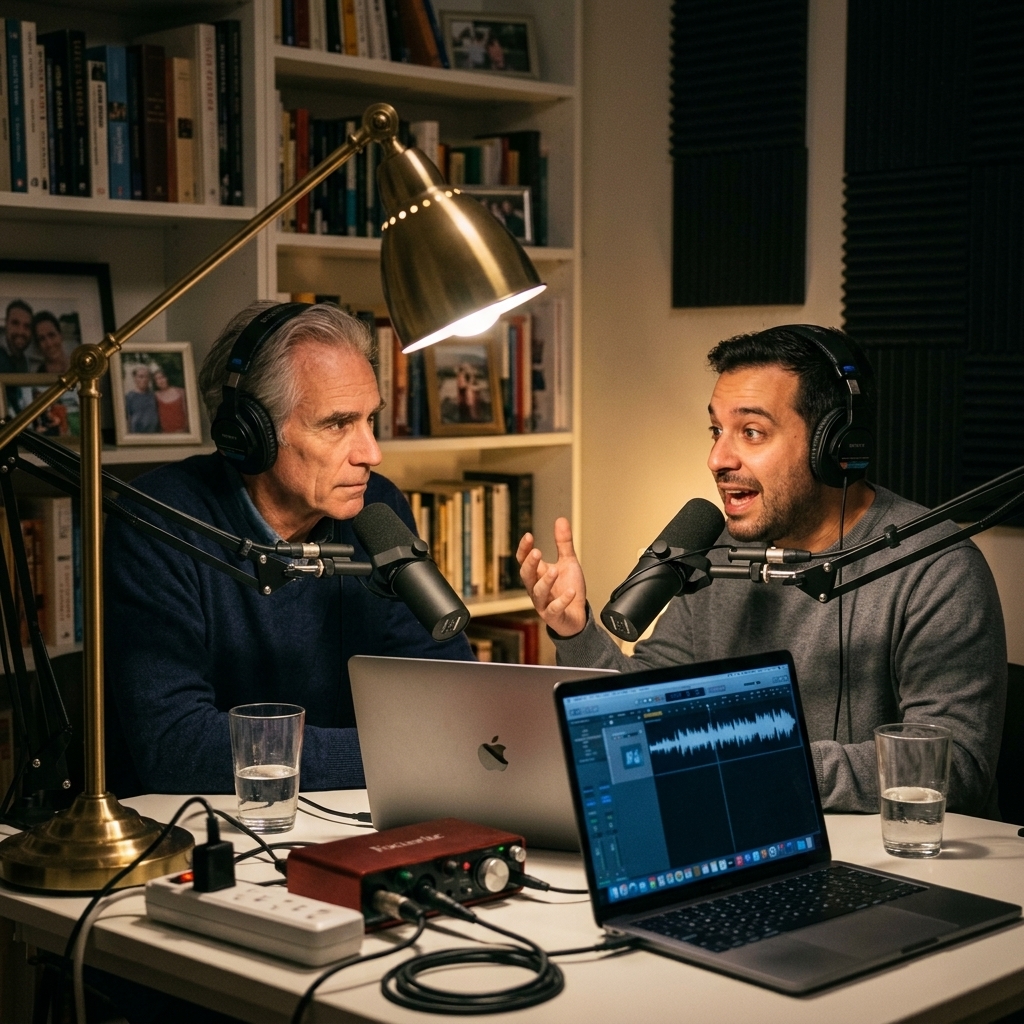
You already have the time. You just need a better format.
| Your routine | Without a podcast | With a podcast |
|---|---|---|
| Morning commute (20 min) | Music, scrolling | 1 full episode, transcript on screen |
| Gym session (30 min) | Playlist on repeat | 2 episodes, passive + active listen |
| Cooking / chores (15 min) | Background TV | Re-listen to today's episode |
| Total | 0 min of Spanish | 65 min of Spanish input |
What research says about learning Spanish by listening
The idea that you can learn a language by listening is not wishful thinking. It is backed by decades of research.
Linguist Stephen Krashen's input hypothesis, first published in 1982 and refined over four decades, argues that language acquisition happens when learners are exposed to input that is slightly above their current level. Krashen calls this "i+1": input at your comprehension level (i) plus a small stretch (+1). The key claim is that we acquire language by understanding messages, not by memorizing rules (Krashen, 1982).
This is not fringe theory. A meta-analysis by Vandergrift and Goh found that extensive listening practice produced significant gains in second-language comprehension, particularly when paired with contextual support like transcripts (Vandergrift & Goh, 2012).
There is a threshold, though. Paul Nation's research at Victoria University of Wellington established that learners need to understand roughly 95-98% of the words in a text for incidental learning to occur (Nation, 2006). Below that threshold, comprehension breaks down and so does acquisition. This is why jumping straight into a native Spanish podcast usually fails. You understand 40% of the words and quit after two episodes.
The solution is not slower Spanish. It is scaffolded Spanish: real content at real pace, with enough context and support that you clear that 95% comprehension threshold.
"I tried listening to a Spanish news podcast cold. Understood about four words. Two of them were 'el' and 'la'."
"That is more than most people admit."
Why podcasts specifically?
Podcasts activate dual-channel processing. When you listen while reading a transcript, you process input through both auditory and visual channels. Richard Mayer's cognitive theory of multimedia learning shows that dual-channel engagement produces stronger retention than either channel alone (Mayer, 2009).
Listening to Spanish while reading along helps you learn faster than just listening or just reading.
Podcasts also create natural spaced repetition. High-frequency vocabulary reappears organically across episodes. You hear "gobierno" (government) and "segun" (according to) episode after episode, reinforcing retention without flashcard decks.
Adapted from Mayer's multimedia learning research, 2009
You do not need dedicated study time. Podcasts fit into time you already spend on commutes, walks, and chores. At 30 minutes a day, you reach B1 listening comprehension in under a year.
Choosing the right podcast for your level
Not all Spanish podcasts are equal. The right one depends on your current proficiency. Pick too easy and you plateau. Pick too hard and you quit.
Here is how the Common European Framework (CEFR) levels map to podcast listening:
- A2 (elementary): You understand simple sentences about familiar topics. You need heavy English support and slow, clearly enunciated Spanish.
- B1 (intermediate): You can follow the main points of clear speech on familiar matters. You need some English scaffolding and can handle natural-speed Spanish on topics you know.
- B2 (upper intermediate): You can understand extended speech and follow complex arguments. You need minimal English support and can handle most native-speed content with a transcript.
| Podcast | Level | Format | Episode length | Bilingual? | Transcript? | Personalized? | Free tier |
|---|---|---|---|---|---|---|---|
| Twilingua | A2-B2 | Two hosts discuss real news and culture | 15 min | Yes (bridge method) | Yes, synchronized | Yes, by interests and level | 3 episodes/week |
| News in Slow Spanish | B1-B2 | Slowed-down news reading | 10-15 min | No (Spanish only) | Paid feature | No | Limited |
| Coffee Break Spanish | A1-B1 | Teacher-led grammar and conversation | 15-20 min | Partial (English explanations) | Paid feature | No | Season 1 free |
| SpanishPod101 | A1-C1 | Scripted dialogues with grammar notes | 5-15 min | Yes (heavy English) | Paid feature | No | Limited |
| Espanol con Juan | B1-B2 | Monologue on various topics | 10-20 min | No (Spanish only) | No | No | Yes, fully free |
| Hoy Hablamos | B1-C1 | Daily Spanish monologue | 5-10 min | No (Spanish only) | Paid feature | No | Yes, fully free |
| Radio Ambulante | C1+ | Narrative journalism | 30-45 min | No (Spanish only) | Yes | No | Fully free |
The key question: do you need bilingual support?
If you are A2 or B1, yes. A bilingual format where an English-speaking host provides context before and after the Spanish segment keeps you above that 95% comprehension threshold. You learn from the Spanish you hear because you actually understand what is being said.
If you are B2 or above, you can handle monolingual Spanish podcasts with a transcript. But even at B2, a bilingual debrief helps you catch nuance you might have missed.
| Monolingual Spanish podcast | Bilingual podcast | |
|---|---|---|
| What you hear | 10 minutes of Spanish, no context | English intro, Spanish story, English debrief |
| What you understand | Maybe 40-60% | 90-98% |
| What you feel | "Wait, what just happened?" | "Got it. The transport strike affects three cities." |
| What your brain learns | Very little (below comprehension threshold) | New vocabulary anchored to understood context |
| Result after 1 month | Frustration, you quit | Measurable progress, you keep going |
The active listening method: how to actually learn, not just hear
Pressing play is not enough. The difference between passive hearing and active listening is the difference between background noise and language acquisition.
Here is a four-step method that turns podcast listening into real learning.
Step 1: listen with the transcript
Follow along with the transcript as you listen. This connects the sounds you hear to the words on screen. When you encounter a word you do not know, you can see it spelled out instead of it flying past as an unintelligible blur.
Twilingua's synchronized transcript highlights each word as it is spoken, so your eyes and ears stay in sync (try it with any episode).
Step 2: save words you want to remember
When a new word appears in context, save it. Do not try to memorize it on the spot. Just flag it and move on. After the episode, review your saved words. You will remember them better because you encountered them inside a real story, not on a vocabulary list.
In Twilingua, you tap any Spanish word in the transcript to see its translation and save it to your personal word bank.
Step 3: re-listen without the transcript
After your first listen-through, play the episode again. This time, do not look at the transcript. You will notice that words and phrases you struggled with the first time are now recognizable. This second pass strengthens your auditory comprehension, which is the skill you actually need in real conversations.
Step 4: notice patterns, not rules
Do not try to extract grammar rules from what you hear. Instead, notice patterns. "Hablaron sobre el acuerdo" and "discutieron los resultados" both follow a similar structure. Your brain will internalize the pattern through repeated exposure faster than it will through a grammar chart.
The active listening cycle
- Listen with transcript -- Follow along as you listen. Connect sounds to words on screen.
- Save new words -- Tap unfamiliar words to save them. Do not stop to memorize.
- Re-listen without transcript -- Play the episode again. Notice what you now recognize.
- Notice patterns -- Let your brain absorb structure through repetition, not rules.
- Start a new episode -- Repeat the cycle. Each pass builds on the last.
The bridge approach: why bilingual podcasts accelerate learning
Most language learning forces a binary choice. Study in English (grammar explanations, translations, drills) or immerse in Spanish (and hope you figure it out). Both have problems.
English-only study teaches you about Spanish without enough exposure to spoken Spanish. Full immersion throws you in the deep end without confirming whether you understood anything.
The bridge approach combines both. Here is how it works in a Twilingua episode:
- English introduction. Fletcher sets up the story. He introduces the topic, explains key vocabulary you are about to hear, and gives you context so you know what to listen for.
- Spanish segment. Octavio tells the story in Spanish, calibrated to your level. A2 episodes use shorter sentences and higher-frequency vocabulary. B2 episodes use complex structures and domain-specific terms.
- English debrief. Fletcher returns to review what happened. He highlights tricky phrases, explains cultural context, and reinforces the key vocabulary.
This L1-L2-L1 structure (your native language, then the target language, then your native language again) is sometimes called the "sandwich method" in language teaching. Research on bilingual education consistently shows that strategic use of the learner's first language supports rather than hinders acquisition, particularly for comprehension of complex content (Cook, 2001).
"People think bilingual means easier. It does not mean easier. It means you understand what you are hearing, so your brain can actually learn from it."
"Right. If I am just hearing sounds I cannot parse, my brain files it as noise. But if I know the story is about a transport strike in Buenos Aires, suddenly 'huelga de transporte' clicks."
The bridge approach works because it keeps you in what Krashen calls the "sweet spot" of comprehensible input. You are challenged by the Spanish segment, but you are never lost.
The three phases of the bridge method
| Phase | Language | What happens | Purpose |
|---|---|---|---|
| 1. Introduction | English | Fletcher sets up the story, introduces key vocabulary | You know what to listen for |
| 2. Story | Spanish | Octavio tells the story at your level | You hear real Spanish you can actually understand |
| 3. Debrief | English | Fletcher reviews key phrases and cultural context | You confirm what you learned and fill gaps |
You always know where you are.
A realistic timeline: how many hours to reach each level
Language learning timelines are notoriously vague. Here is what the data says for English speakers learning Spanish through listening-based methods.
The U.S. Foreign Service Institute (FSI) classifies Spanish as a Category I language, estimating 600-750 classroom hours to reach "professional working proficiency," roughly B2-C1 (FSI, 2023). Podcast-based learning is lower intensity but higher consistency. A realistic estimate based on FSI data, adjusted for self-study:
| Starting level | Target level | Estimated podcast hours | At 30 min/day | At 1 hour/day |
|---|---|---|---|---|
| A1 (beginner) | A2 (elementary) | 100-150 hours | 7-10 months | 4-5 months |
| A2 (elementary) | B1 (intermediate) | 150-200 hours | 10-13 months | 5-7 months |
| B1 (intermediate) | B2 (upper intermediate) | 200-300 hours | 13-20 months | 7-10 months |
| B2 (upper intermediate) | C1 (advanced) | 300-400 hours | 20-27 months | 10-13 months |
These numbers assume active listening with transcripts and vocabulary review, not passive background listening.
Two important caveats. First, the jump from A2 to B1 is where most learners quit. This is the "intermediate plateau" where progress feels invisible. Podcasts are effective here because daily exposure accumulates into measurable progress over weeks.
Second, consistency matters more than volume. Thirty minutes every day beats two hours on Saturday.
Comprehension improvement over time: daily vs. weekend-only listening
| Month | 30 min/day, every day | 2 hours on weekends only |
|---|---|---|
| 0 | 30% (starting A2) | 30% (starting A2) |
| 2 | 40% | 34% |
| 4 | 52% | 40% |
| 6 | 65% | 48% |
| 8 | 75% (B1 threshold) | 55% |
| 10 | 82% | 62% |
| 12 | 88% | 68% |
| 14 | 92% | 75% (B1 threshold) |
Daily consistency reaches the B1 comprehension threshold six months faster than weekend-only listening at the same total weekly hours.
Common mistakes (and how to avoid them)
Mistake 1: starting with content that is too hard
The single most common mistake. You hear that immersion works, so you subscribe to a native Spanish news podcast. You understand nothing. You feel defeated. You quit.
Fix: Start with bilingual content at your level. Build up your vocabulary and listening stamina before attempting monolingual content. An A2 learner has no business listening to Radio Ambulante. Start with scaffolded episodes and move up when you consistently understand 90%+ without the English support.
Mistake 2: passive listening only
Having Spanish podcasts on in the background while you do other tasks is better than nothing, but not by much. Your brain needs to actively process the input for acquisition to happen.
Fix: Dedicate at least one focused listening session per day where the podcast has your full attention. Use the transcript. Save words. The commute is ideal because you cannot multitask anyway.
Mistake 3: never re-listening
You listen to an episode once and move on to the next. But one pass through complex Spanish content captures maybe 60% of what is there.
Fix: Listen to episodes twice. First with the transcript, then without. The second listen is where the real learning happens.
"I used to think re-listening was a waste of time. Like watching the same movie twice. But with language, the second time you hear things you completely missed. Words emerge from the blur."
"In Spanish we say 'la repeticion es la madre del aprendizaje.' Repetition is the mother of learning."
Mistake 4: obsessing over every unknown word
You pause the episode every 10 seconds to look up a word. You finish a 15-minute episode in 45 minutes. You are exhausted and you have not actually listened to much Spanish.
Fix: Let unknown words pass. If you understand the gist of the sentence, keep going. Save the word for later review if you want, but do not interrupt the flow. Comprehension is built through volume, not through translating every word in real time.
Mistake 5: no variety in topics
You only listen to episodes about one subject. Your Spanish becomes lopsided. You can discuss climate change in detail but cannot follow a conversation about sports.
Fix: Rotate topics. If your podcast lets you choose subjects (Twilingua does), pick at least three or four different areas. This exposes you to different vocabulary domains and makes your comprehension more robust.
| Mistake | Sign you are making it | Fix |
|---|---|---|
| Content too hard | You understand less than 70% | Drop to a lower level or bilingual format |
| Passive listening | You cannot recall the episode topic afterward | Listen without multitasking. Use a transcript. |
| No re-listening | You feel like you "sort of" understood | Listen again without the transcript |
| Pausing for every word | A 15-min episode takes 40+ min | Let unknown words pass. Save for later. |
| No topic variety | You only know vocabulary for one domain | Pick 3-4 different topic categories |
FAQ
How long does it take to learn Spanish with podcasts?
It depends on your starting level and daily listening time. For a typical A2 learner listening 30 minutes per day, reaching B1 takes roughly 10-13 months. Reaching B2 from B1 takes another 13-20 months at the same pace. These estimates are based on FSI data adjusted for self-study contexts. Consistency matters more than session length.
Can I learn Spanish just by listening to podcasts?
Podcasts build listening comprehension, which is the foundation of language ability. But to become well-rounded, you also need speaking practice, reading, and some writing. Think of podcasts as the core habit: they build your vocabulary, train your ear, and give you daily exposure. Supplement with conversation practice (even a weekly language exchange) and occasional reading in Spanish.
What level of Spanish do I need to start learning with podcasts?
You can start at A2 (elementary) if you choose the right format. A bilingual podcast that provides English context before and after the Spanish segment keeps you above the comprehension threshold. True beginners (A1) should pair podcast listening with a basic grammar foundation, since you need at least a few hundred words of vocabulary for podcast input to be meaningful.
Are bilingual podcasts better than Spanish-only podcasts?
For A2 and B1 learners, yes. Bilingual podcasts keep you above the 95% comprehension threshold that research identifies as necessary for incidental vocabulary acquisition. At B2 and above, you can benefit from Spanish-only podcasts, though a bilingual debrief still helps with nuance. The goal is to move from bilingual to monolingual over time as your comprehension improves.
How many episodes per week should I listen to?
Aim for at least five episodes per week. Daily exposure creates stronger neural pathways for language processing than sporadic study sessions. Even 15-20 minutes daily is effective. If you can manage 30-60 minutes, you will see faster results. The key is that it becomes a habit, not a task you have to motivate yourself to do.
Should I slow down the playback speed?
Resist the urge. Slowed-down Spanish trains your ear for a speech pattern that does not exist in the real world. Instead, choose content at the right level: content where the vocabulary and sentence structure match your ability, even if the speaking speed is natural. A bilingual format compensates for speed by giving you context, so you do not need artificial slowdown.

Start listening to your first bilingual episode
You now know why podcast-based learning works, how to choose the right level, how to listen actively, and what mistakes to avoid.
The next step is small: listen to one episode.
Twilingua gives you English context before and after the Spanish segment, a synchronized transcript, and tap-to-translate on any word. Pick a topic you care about: technology, politics, climate, culture, science, sports, or history.