Spanish for travel: phrases, prep, and the podcast playbook
Last updated: May 2026
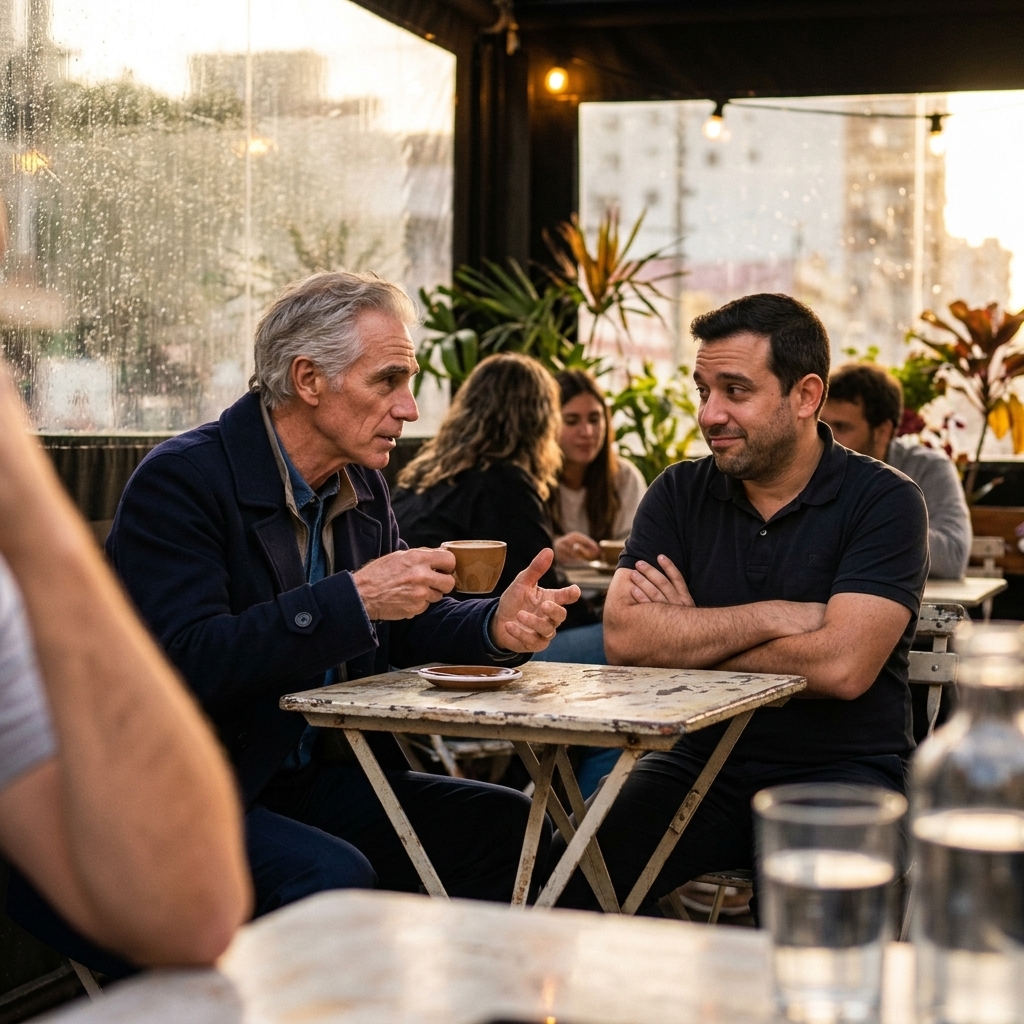
The first morning of a trip is when you find out how much of your Spanish actually works. You walk into a café in Madrid or Mexico City, you have rehearsed the line about un café con leche, por favor for weeks, and you deliver it cleanly. The barista nods. Then she asks something back — fast, half-swallowed, with a regional accent — and the entire room of textbook Spanish goes quiet in your head.
This is the gap that surprises most travelers. The problem with travel Spanish is not the speaking; with enough rehearsal almost anyone can produce a serviceable opening line. The problem is the response. Real conversation moves at native speed, contains words your phrasebook skipped, and frequently lands in an accent you have never heard before. The skill of travel Spanish is not memorizing phrases — it is preparing for the reply.
This guide is about preparing for the reply. The CEFR level different kinds of trips actually require. The six phrase categories that handle roughly 80% of in-country interactions. A six-week podcast-based prep plan. The regional vocabulary differences that matter. And the in-country tactics that keep you in Spanish even when the other person tries to switch you to English.
What kind of trip needs what level of Spanish
| Trip type | Daily Spanish exposure | Minimum useful CEFR | Recommended prep hours | What works without it |
|---|---|---|---|---|
| All-inclusive resort, English-staffed | 0–30 min | A1 (survival phrases) | 5–10 | Almost everything; staff speak English |
| City break, tourist zones | 1–2 hrs | A1+ to A2 | 20–40 | Most things in tourist areas |
| Independent road trip, smaller towns | 3–6 hrs | A2 | 60–100 | Patchy outside main routes |
| Homestay or language exchange | 6–10 hrs | A2 to B1 | 100–200 | Nothing — Spanish carries the day |
| Digital-nomad month in Mexico City / Medellín | 4–8 hrs | B1 | 200–400 | Daily life works; depth of friendship requires more |
Prep hours are total comprehensible-input hours, not classroom hours. The CEFR levels guide explains how the levels map to real-world ability if you want a deeper anchor.
Why travel Spanish is its own skill
People assume the Spanish they need for a two-week trip to Oaxaca is just "less" of the Spanish required for full fluency. It is not less; it is different. Travel Spanish has a distinct profile of speed, register, and predictability, and a learner optimized for it looks different from one optimized for, say, reading a novel.
Three properties make it specifically hard. The first is speed without context. In a classroom you have a teacher who slows down, repeats, and gestures. The bus driver telling you which stop to get off at does not. Albert Costa and Mikel Santesteban's bilingual lexical-access work (Costa & Santesteban, 2004) showed that any active translation step adds measurable latency on top of plain word retrieval. Real-time service speech — fast, mumbled, idiomatic — gives you almost no budget for that latency.
The second is transactional unpredictability. Travel conversations are short and live in narrow scripts (ordering, paying, asking directions), but the scripts have branches. You ask for the bill; the waiter responds "¿en efectivo o con tarjeta?" If you have not pre-loaded the branch, you stall. The phrasebook trained your opening line but not the three possible replies.
The third is accent variance. Andalusian Spanish drops half its consonants. Caribbean Spanish moves at twice the pace of a textbook recording. Mexican Spanish layers idioms your DELE prep ignored. A traveler trained only on neutral Latin American Spanish meets the Madrid taxi driver and falls apart.
"Travelers always tell me: 'I knew the words.' Yes — you knew them on paper. The skill of travel Spanish is recognizing words when they are spoken faster than you have ever heard them and stitched into a phrase your textbook never showed you. That is a separate skill, and it has to be trained separately."
"My first solo trip to Argentina I had what I thought was a solid A2. Twenty-four hours in, I realized I had trained for the wrong country. The vos, the sh-sound for ll, the speed — none of it matched the Mexican Spanish I had been studying. The vocabulary held up. The audio recognition didn't."
The implication is that the right way to prepare for a trip is not to "study harder" but to train on the kind of audio you will encounter — fast, transactional, regionally accurate — and to pre-load the response-side of each interaction, not just the opener.
The 80/20 phrase categories
Roughly 80% of what a traveler does in Spanish falls into six functional categories. The breakdown below isn't an inventory of every phrase — it is the structure each category follows and, crucially, the response you should expect. Phrasebooks tend to drill the question and ignore the answer, which is why most travelers freeze on turn two.
| Category | Canonical opener | Common variant | Expected reply you must parse |
|---|---|---|---|
| Greetings & micro-courtesy | Hola, buenos días. | Buenas. (catch-all, Spain) | Buenas, ¿qué le pongo? / Hola, ¿en qué puedo ayudarle? |
| Ordering food | Para mí, …, por favor. | Me trae …, por favor. | ¿Algo más? / ¿Para tomar? / ¿En efectivo o con tarjeta? |
| Transit & directions | ¿Cómo llego a …? | Disculpe, ¿esta calle es …? | Sigue recto, luego a la derecha. / Está a dos cuadras. |
| Payments | La cuenta, por favor. | ¿Cuánto es? / ¿Cuánto le debo? | Son veintidós con cincuenta. / ¿Necesita factura? |
| Emergencies & problems | Disculpe, tengo un problema con … | No funciona. / Lo he perdido. | ¿Dónde lo dejó? / Espere un momento, llamo a alguien. |
| Small talk | ¿De dónde eres? / ¿Vives aquí? | Me encanta tu ciudad. | Often long, often digressive — practice with podcasts. |
The pattern: the opener is a single line. The reply is a question — and that question is where unprepared travelers collapse. The fix is to memorize the reply space, not just the opener. Drill "¿algo más?" until it lands as automatically as "hola." Drill the four ways a server can ask "for here or to go." Drill the three ways a stranger will respond to "how do I get to the metro."
"The first useful change I made to my travel prep was: every time I learned a question to ask, I also wrote down two or three things the person was likely to ask me back. My speaking didn't get better. My not freezing got dramatically better."
"Conversations are not lists of phrases — they are graphs. Every node has branches. A phrasebook teaches you nodes. A real trip is the graph."
Two practical drills sit on top of this category map. First, shadowing the reply. Listen to a server in a podcast scene; pause after each line; repeat the reply you would expect, not the opener. Second, micro-recovery scripts. Memorize three sentences that buy you time when you have missed the reply: Perdona, ¿puedes repetir más despacio? / No te he entendido del todo. / ¿Cómo dices? These are the lifeline. They convert a freeze into a conversation.
The six-week podcast prep plan
The trip is six weeks away. You have 15–30 minutes a day. Here is how to spend it.
The plan assumes you start at roughly A1 (you know greetings, numbers, basic verbs) and want to arrive at solid A2 travel competence — enough to handle ordering, transit, and small-talk openers without panic. It uses comprehensible podcast input as the engine, because podcast listening trains exactly the skill that survival classroom Spanish does not: real-speed audio recognition. If you want a deeper rationale for input-led preparation, the Spanish immersion at home guide is the prerequisite framework.
Week 1 — Survival phrases & numbers. 20 min/day. Drill the six 80/20 categories above. Listen to one easy A1/A2 episode, twice. Memorize numbers 1–100, especially prices.
Week 2 — Ordering & payments deep dive. 25 min/day. Practice with food scenes. Add the central travel episode below and follow along with the transcript on the second pass.


Week 3 — Transit, directions, geography. 25 min/day. Listen to one episode with a city or region as its subject. Practice giving directions out loud, even to yourself, while walking.
Week 4 — Cultural context. 30 min/day. The point of a trip is the place. Pre-loading cultural background makes small talk effortless because you have things to ask about. This episode introduces the festivals and rituals you are likely to encounter:
Week 5 — Slow listening. 30 min/day. Switch to a slower comprehension pace: listen to one episode at 0.85x, then 1.0x. Add a regional accent episode if you can — the same one you would hear on the trip.
Week 6 — Live rehearsal. 30 min/day. Find a tutor on iTalki or Preply for two 30-minute conversations during the week. Tell them you are traveling to {destination} and have them role-play a server, a taxi driver, and a hotel clerk. This is the single highest-leverage hour of the entire six weeks. Do it.
The seven-day curve looks like this: each weekday is a single podcast episode listened to twice (first pass for gist, second with transcript), plus 5 minutes of category drilling. Saturday is the live tutor session. Sunday is rest — but you keep one Spanish podcast on while cooking or driving. Six weeks at this volume puts you at roughly 12–15 hours of focused input plus 3–4 hours of live speech — enough to arrive at the airport with the right scripts loaded and the audio recognition broken in.
[BAR-CHART: title="Where travelers actually spend their Spanish minutes on a typical 10-day trip (estimated minute distribution across the 80/20 categories)"]
"Six weeks is enough for survival, not depth. Don't try to add the subjunctive. Don't try to memorize the names of every fish on the menu. Pick the six categories, drill the responses, listen to one real episode a day. That is the plan that works."
"I have done the six-week prep three times now, before three different trips. Each time I am amazed at how much it does — and how little it does. By week six I can order, pay, navigate, and survive small talk. I cannot discuss politics. The point is I am not trying to."
Regional reality: the five words that actually change
The "is it Spain Spanish or Latin American Spanish?" question generates a lot of anxiety. For travel, the truth is calmer than the marketing makes it sound: roughly 95% of high-frequency vocabulary is shared across all major dialects, the grammar is identical, and any educated speaker will understand you whether you use vosotros or ustedes. What changes is a small, predictable set of words — and you only need to know the variant of your destination.
Five words a traveler should actually preload by region:
| Concept | Spain | Mexico | Río de la Plata (Argentina / Uruguay) | Caribbean |
|---|---|---|---|---|
| "to take" (a bus, an Uber) | coger (innocent, everyday) | tomar (using coger is vulgar — avoid) | tomar / agarrar | coger (also vulgar in many places — use tomar) |
| "to order" (in a restaurant) | pedir | ordenar or pedir | pedir | ordenar |
| Informal "you" | tú | tú | vos (with its own verb forms) | tú |
| "straw" | pajita | popote | pajita / sorbete | pitillo / sorbete |
| "bus" | autobús / bus | camión (urban) / autobús | colectivo / bondi | guagua |
If you are headed to Mexico, drill the coger warning and the word camión hard. If you are headed to Buenos Aires, accept that the vos conjugations will surround you and learn the basic ones (vos sos, vos tenés, vos podés). If you are headed to Spain, accept vosotros in the air and practice the form for "you all" you will hear on the streets. The five-word filter handles roughly 90% of the regional friction a traveler encounters in a two-week trip. Beyond that, ask the next local you meet — most are delighted to teach you their version.
"Spanish is one language with many accents and a small handful of vocabulary swaps. The anxiety about 'which Spanish to learn' is mostly imported from English-language marketing. Pick the dialect of the country you are visiting. Spend an hour with its top five swaps. Done."
"Your goal abroad is not to demonstrate fluency. Your goal is to stay in Spanish long enough that the practice compounds. If you have to slow the other person down, slow them down. Apologize once and move on. The trip is short."
The mental shift behind all of this is one we have written about before — the transition from translating to flowing. The thinking-in-Spanish guide covers it in depth, but the short version applies tactically: every time you accept a switch to English, the translation pipeline gets a tiny reinforcement. Every time you stay in Spanish — even badly — the direct route gets a tiny reinforcement. Two weeks of consistent staying-in-Spanish adds up to more practice than two months at home.
Travel Spanish is a separate skill from general fluency. Prepare for the *reply*, not the opener. Drill six functional categories, not a phrasebook. Spend six weeks on comprehensible podcast input plus two live tutor sessions, and skip the subjunctive entirely. In country, stay in Spanish gently, use the repeat-back trick, and accept that survival is the goal — depth is for the next trip.
FAQ
How much Spanish do I need before traveling to a Spanish-speaking country?
For a city break in a tourist zone, an A1+ to A2 level is sufficient — enough to greet, order, ask directions, pay, and recover from misunderstandings with a few memorized scripts. For an independent road trip, smaller towns, or any destination outside the tourist circuit, A2 is the realistic floor. Below that level you can still travel safely, but you will be reliant on English-speaking staff and translation apps, and you will miss most of the spontaneous interactions that make the trip memorable. Two to three months of focused podcast-based prep is enough to reach travel A2 from a near-beginner start.
Can I learn travel Spanish in a month?
You can build a survival vocabulary in a month — greetings, numbers, the six 80/20 phrase categories, and a few recovery scripts. What you cannot build in a month is the ear for fast real-world audio, which is the skill that separates "I rehearsed the phrase" from "I understood the reply." Six weeks is the realistic minimum for a traveler starting near zero, and even then the focus has to be daily comprehensible input rather than vocabulary lists. If you have only thirty days, accept that you will rely heavily on memorized openers and on repeat-back recovery scripts when the reply outruns you.
Should I learn Spain Spanish or Latin American Spanish for travel?
Learn the dialect of the country you are actually visiting. The grammar is identical across dialects and roughly 95% of high-frequency vocabulary is shared, so the choice is less consequential than language-learning marketing suggests. What matters is matching your audio training to your destination's accent: a learner who has only heard neutral Latin American Spanish will struggle in Madrid, and vice versa. Spend an hour preloading the five regional vocabulary swaps for your specific destination — coger in Mexico, vos in Argentina, vosotros in Spain — and you have handled most of the friction.
What do I do if locals keep switching to English on me?
Smile and reply in Spanish anyway. Most switches happen because the local is being helpful, not because your Spanish is bad — they are reading your accent and prioritizing efficiency for both of you. When you reply in Spanish twice, almost everyone reads the signal that you want to practice and switches back. If you are in a tourist-heavy area where servers are busy and English is faster for everyone, accept that the practice will be patchier there and seek out lower-stakes contexts: market vendors, taxi drivers, museum guards, and locals in side-street cafés are usually the best practice partners on any trip.
What is the single most useful phrase to know in travel Spanish?
¿Puedes repetir más despacio, por favor? — "Can you repeat that more slowly, please?" It is the universal recovery script. It works in any country, with any speaker, in any context. It signals that you are listening, that you want to stay in Spanish, and that you need a beat to catch up. Almost every traveler who freezes in a real conversation freezes because they do not have a recovery script ready and resort to English. Memorize this line until it lands without thinking, and then memorize one or two backups. That single sentence will save more interactions on your trip than any vocabulary list.