B1 · Intermediate
12 min
sciencelanguage learningbilingualismhistoryculturespain
El cerebro bilingüe: la ciencia de aprender idiomas
The Bilingual Brain: The Science of Learning Languages
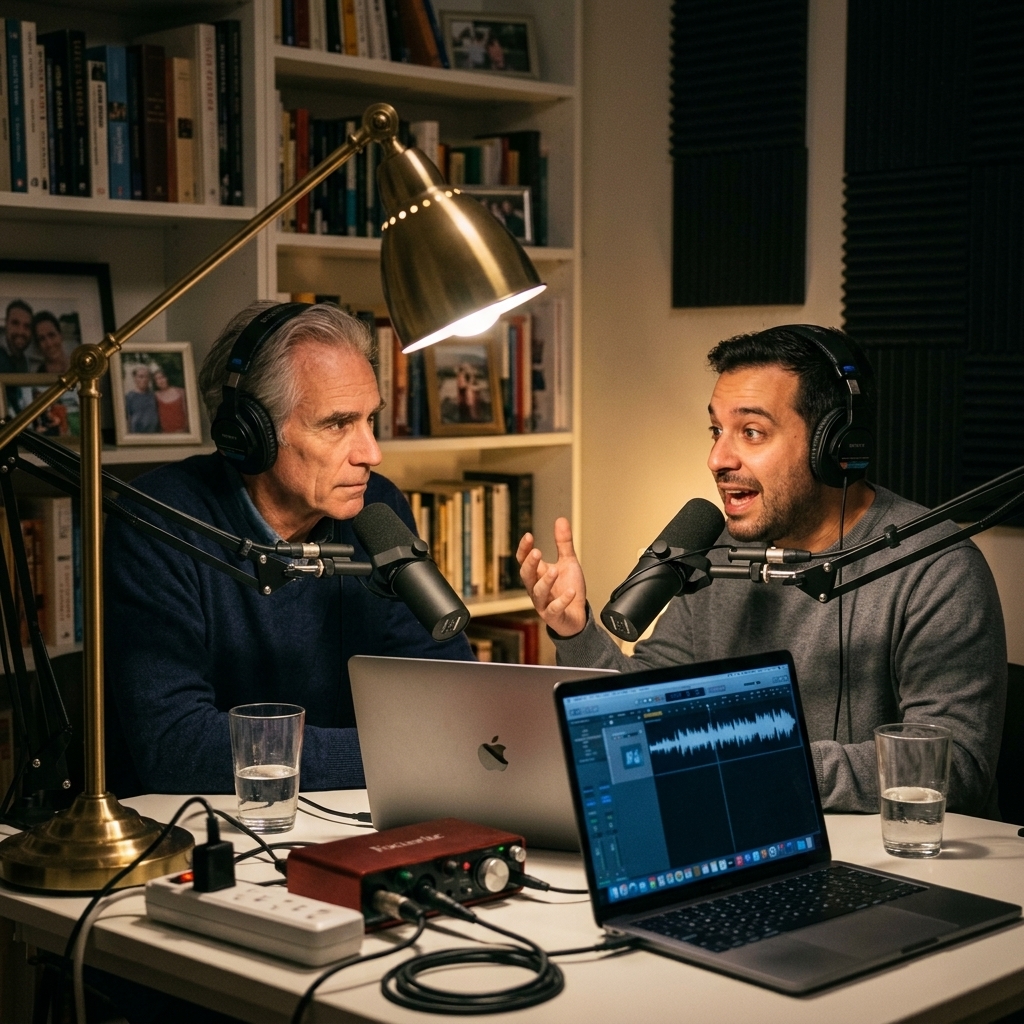
Fletcher breaks down this story in English. Octavio reacts and expands in Spanish. Follow along with the live transcript, tap any word for its translation. Intermediate level — perfect for intermediate learners expanding their range.


So I've been thinking about this lately, because I've been butchering Spanish for, I don't know, three years now, and I keep asking myself: is there a point where the door just closes?
Like, is my brain genuinely less capable of this than it was when I was eight?
Bueno, mira, esa es exactamente la pregunta correcta.
Well, look, that's exactly the right question.
Y la respuesta de la ciencia es complicada, porque el cerebro no funciona como una puerta que se abre o se cierra.
And the scientific answer is complicated, because the brain doesn't work like a door that simply opens or closes.
Right, so there's actually decades of research on this, and it turns out the story is a lot more interesting than the simple 'kids are better at languages' headline.
Es que el concepto más importante aquí se llama el 'período crítico'.
The thing is, the most important concept here is called the 'critical period'.
Un lingüista llamado Eric Lenneberg lo describió en los años sesenta.
A linguist named Eric Lenneberg described it in the 1960s.
La idea es que el cerebro es muy flexible para aprender idiomas cuando eres niño, y después esa flexibilidad disminuye.
The idea is that the brain is very flexible for learning languages when you're a child, and after that, that flexibility decreases.
Lenneberg, right.
And for years that idea basically dominated how people thought about language learning.
If you missed the window, tough luck.
Which, I have to say, felt very personal when I first read about it.
A ver, los niños tienen ventajas reales.
Look, children have real advantages.
Aprenden la pronunciación más fácilmente, y generalmente hablan sin acento extranjero.
They learn pronunciation more easily, and they generally speak without a foreign accent.
Cuando aprendes una lengua antes de los siete u ocho años, el cerebro usa las mismas áreas para los dos idiomas.
When you learn a language before the age of seven or eight, the brain uses the same areas for both languages.
Which makes me think of my granddaughter, actually.
She's five, and she's already picking up Spanish from her dad's family in Madrid without even trying.
She just absorbs it.
Sí, exactamente eso.
Yes, exactly that.
Y la pronunciación es especialmente importante.
And pronunciation is especially important.
Después de la pubertad, el cerebro ya tiene una especie de 'filtro' para los sonidos, y es más difícil escuchar y reproducir sonidos nuevos.
After puberty, the brain already has a kind of 'filter' for sounds, and it becomes harder to hear and reproduce new sounds.
But here's the thing, and this is where I push back a little on the doom and gloom, because the research also shows adults aren't just worse at languages.
They're different.
They actually have some real advantages.
La verdad es que sí.
The truth is, yes.
Los adultos aprenden gramática más rápido al principio porque ya entienden cómo funciona el lenguaje en general.
Adults learn grammar faster at the beginning because they already understand how language works in general.
Y los adultos tienen más vocabulario en su primera lengua, entonces pueden hacer conexiones más fácilmente.
And adults have more vocabulary in their first language, so they can make connections more easily.
That tracks with my experience, actually.
I can decode Spanish grammar rules pretty fast.
My problem isn't the logic of it.
My problem is that my mouth hasn't caught up with what my brain knows.
Mira, eso es muy normal.
Look, that's very normal.
Y hay algo interesante aquí: cuando una persona adulta aprende un segundo idioma, el cerebro usa áreas diferentes para los dos idiomas.
And there's something interesting here: when an adult learns a second language, the brain uses different areas for the two languages.
No las mismas áreas, sino áreas cercanas pero distintas.
Not the same areas, but nearby but distinct areas.
So the brain is literally organizing the two languages in different physical spaces.
And I assume that has consequences for how fluent you can eventually become.
Bueno, los científicos hablan de 'bilingüismo temprano' y 'bilingüismo tardío'.
Well, scientists talk about 'early bilingualism' and 'late bilingualism'.
Si aprendiste dos idiomas de pequeño, son casi como uno solo en el cerebro.
If you learned two languages as a child, they're almost like one in the brain.
Si los aprendiste de adulto, el cerebro los trata como sistemas separados.
If you learned them as an adult, the brain treats them as separate systems.
The extraordinary thing is, that separation isn't necessarily a disadvantage.
Some researchers argue it actually gives late bilinguals a different kind of cognitive flexibility.
You're consciously managing two systems, which is its own kind of mental workout.
Sí, y eso nos lleva a algo que los científicos llamaron durante muchos años 'la ventaja bilingüe'.
Yes, and that brings us to something scientists called for many years 'the bilingual advantage'.
La idea es que hablar dos idiomas mejora ciertas capacidades del cerebro, especialmente la atención y la memoria de trabajo.
The idea is that speaking two languages improves certain brain capacities, especially attention and working memory.
Right, I've read about this.
The theory is that because bilinguals are constantly, even unconsciously, managing two language systems, it strengthens the parts of the brain involved in executive function.
Attention, task-switching, filtering out irrelevant information.
Y también hay estudios que dicen que los bilingües desarrollan síntomas de Alzheimer más tarde que las personas que solo hablan un idioma.
And there are also studies that say bilinguals develop symptoms of Alzheimer's later than people who only speak one language.
Como si el cerebro bilingüe tuviera más reserva cognitiva.
As if the bilingual brain has more cognitive reserve.
Look, I want to believe that.
Genuinely.
But I've also read some pretty serious pushback on this research.
The replication problem is real in this field.
La verdad es que tienes razón en eso.
The truth is you're right about that.
En los últimos diez años, muchos científicos intentaron repetir esos experimentos y no encontraron los mismos resultados.
In the last ten years, many scientists tried to repeat those experiments and didn't find the same results.
El debate todavía continúa.
The debate is still ongoing.
Which is actually a healthy sign, I think.
Science working the way it's supposed to.
But it does mean we should be skeptical of the more extravagant claims.
'Learn Spanish and never get dementia' is probably not the bumper sticker.
No, no, espera, pero lo que sí es claro es que hablar dos idiomas cambia el cerebro de alguna forma.
No, no, wait, but what is clear is that speaking two languages changes the brain in some way.
Los estudios de neuroimagen son bastante consistentes en eso, aunque los efectos exactos son más difíciles de medir.
Neuroimaging studies are pretty consistent on that, even if the exact effects are harder to measure.
Fair enough.
And here's something I keep coming back to: the history angle.
Because when you look at it, the idea of the monolingual person as the default is actually pretty recent.
Historically, most people spoke more than one language.
Bueno, eso es muy importante.
Well, that's very important.
En la historia, el multilingüismo era completamente normal.
Historically, multilingualism was completely normal.
En los mercados medievales de Europa, la gente usaba tres o cuatro idiomas para comerciar.
In medieval European markets, people used three or four languages to trade.
Era una necesidad práctica.
It was a practical necessity.
The Roman Empire is a good example of this.
You had Latin for official business and law, Greek for philosophy and culture, local languages for everything else.
A Roman senator in the first century probably had three or four languages without thinking much about it.
Sí, y en la España medieval también.
Yes, and in medieval Spain too.
Había comunidades donde la gente hablaba árabe, latín, castellano antiguo y hebreo en la misma ciudad.
There were communities where people spoke Arabic, Latin, old Castilian, and Hebrew in the same city.
Toledo fue un ejemplo muy famoso de esto.
Toledo was a very famous example of this.
And then something changed.
The nation-state project of the nineteenth century basically said: one nation, one language, one identity.
That's when monolingualism became not just normal but politically desirable.
Exacto.
Exactly.
Y eso tuvo consecuencias enormes para muchas lenguas regionales.
And that had enormous consequences for many regional languages.
En España, por ejemplo, el castellano se promovió como el idioma nacional, y las otras lenguas, como el catalán o el vasco, perdieron mucho espacio oficial.
In Spain, for example, Castilian was promoted as the national language, and other languages, like Catalan or Basque, lost a lot of official space.
Which has political implications that are still very live today.
Spain is one of the most interesting cases in Europe for this, I think, because you have these genuinely distinct linguistic communities, and the question of language is never just about language.
No, nunca.
No, never.
En España, cuando la gente habla de catalán o vasco, también habla de identidad, de historia, de política.
In Spain, when people talk about Catalan or Basque, they're also talking about identity, history, politics.
Esos idiomas sobrevivieron la dictadura de Franco, cuando el gobierno intentó suprimirlos.
Those languages survived Franco's dictatorship, when the government tried to suppress them.
Eso les da una importancia emocional muy fuerte.
That gives them a very strong emotional importance.
And that emotional dimension is actually directly connected to the science of learning, isn't it.
Because one thing that does seem robust in the research is the role of emotional investment.
You learn better when you genuinely care about the language.
Totalmente.
Totally.
Y también está el debate entre aprender en un aula y aprender con inmersión.
And there's also the debate between learning in a classroom and learning through immersion.
Los estudios muestran que la inmersión es más efectiva para alcanzar fluidez, pero no todos pueden vivir en otro país.
Studies show that immersion is more effective for reaching fluency, but not everyone can live in another country.
I mean, that's where I've landed after three years of trying.
Apps, classes, grammar books.
All useful.
But the thing that actually moved the needle for me was spending two weeks in Madrid with my daughter and her husband's family, just fumbling through real conversations.
A ver, y me imagino que cometiste algunos errores interesantes en esas conversaciones, ¿no?
Well, and I imagine you made some interesting mistakes in those conversations, right?
Como la primera vez que usaste 'embarazado'...
Like the first time you used 'embarazado'...
We are not going back to the embarazado incident.
I told Octavio's mother I was very pregnant instead of very embarrassed at a dinner table, and somehow that story has become part of my permanent record.
What I will say is, that mistake taught me more about the word 'avergonzado' than any flashcard ever could.
Y eso es exactamente lo que dice la ciencia.
And that's exactly what the science says.
Los errores con consecuencias emocionales se recuerdan mejor.
Mistakes with emotional consequences are remembered better.
El cerebro procesa esas situaciones de forma más profunda porque hubo una reacción emocional.
The brain processes those situations more deeply because there was an emotional reaction.
There's a researcher, Stephen Krashen, who made a distinction between 'learning' and 'acquisition', and I think about it a lot.
Learning is conscious, studying grammar rules.
Acquisition is unconscious, just absorbing the language through use.
His argument is that acquisition is what actually drives fluency.
Mira, Krashen es importante pero también es un poco controversial.
Look, Krashen is important but also a bit controversial.
La idea de que la gramática explícita no ayuda mucho es interesante, pero muchos profesores no están de acuerdo.
The idea that explicit grammar doesn't help much is interesting, but many teachers disagree.
Creo que los dos procesos, el aprendizaje y la adquisición, funcionan juntos.
I think both processes, learning and acquisition, work together.
So the practical takeaway, if you're listening to this while you're learning Spanish or any language, is probably something like: don't just study.
Use it.
Make mistakes.
Find people or situations where the language actually matters to you emotionally.
Exacto.
Exactly.
Y no tengas miedo de parecer tonto.
And don't be afraid to seem foolish.
Ese miedo es uno de los problemas más grandes para los adultos.
That fear is one of the biggest problems for adults.
Los niños no tienen vergüenza cuando cometen errores.
Children have no shame when they make mistakes.
Los adultos, sí.
Adults do.
Y esa vergüenza bloquea el aprendizaje.
And that shame blocks learning.
Which brings it full circle, really.
The science suggests the 'critical period' is real but not a life sentence.
Adults face different challenges, not impossible ones.
And if a fifty-five-year-old former war correspondent can sit at a dinner table in Madrid and gradually, slowly, start to understand what's being said around him, there's hope for everyone.
Bueno, hay esperanza, sí.
Well, there is hope, yes.
Pero Fletcher, después de tres años, todavía tienes acento tejano cuando hablas español, y creo que eso no va a cambiar.
But Fletcher, after three years, you still have a Texas accent when you speak Spanish, and I think that's not going to change.
La ciencia también dice eso.
The science says that too.