B2 · Upper Intermediate
13 min
culturespanish societyfood and diningsocial habitshistory
Nobody Asked for the Check
Cuatro horas en la mesa y nadie pide la cuenta
La sobremesa is the time Spaniards spend lingering at the table after a meal, talking, arguing, and refusing to hurry. Octavio Solana and Fletcher Haines dig into why this habit says so much about Spanish culture and why it may be under threat.
La sobremesa es el tiempo que los españoles pasan en la mesa después de comer, hablando, discutiendo y sin prisa por irse. Octavio Solana y Fletcher Haines exploran por qué esta costumbre dice tanto sobre la cultura española y por qué está en peligro.
5 essential B2-level terms from this episode, with translations and example sentences in Spanish.
| Spanish | English | Example |
|---|---|---|
| la sobremesa | the time spent lingering at the table after a meal, talking | La sobremesa duró más que la comida misma, pero nadie quería irse. |
| surgir | to emerge, to arise, to come up spontaneously | Los mejores temas de conversación surgen solos cuando nadie los busca. |
| el pretexto | the pretext, the excuse | La comida fue el pretexto; la verdadera reunión empezó después. |
| la presencia | presence, being fully there | Los móviles destruyen la presencia que la sobremesa necesita. |
| regenerar | to regenerate, to restore | Una pausa larga no roba tiempo de trabajo; lo regenera. |
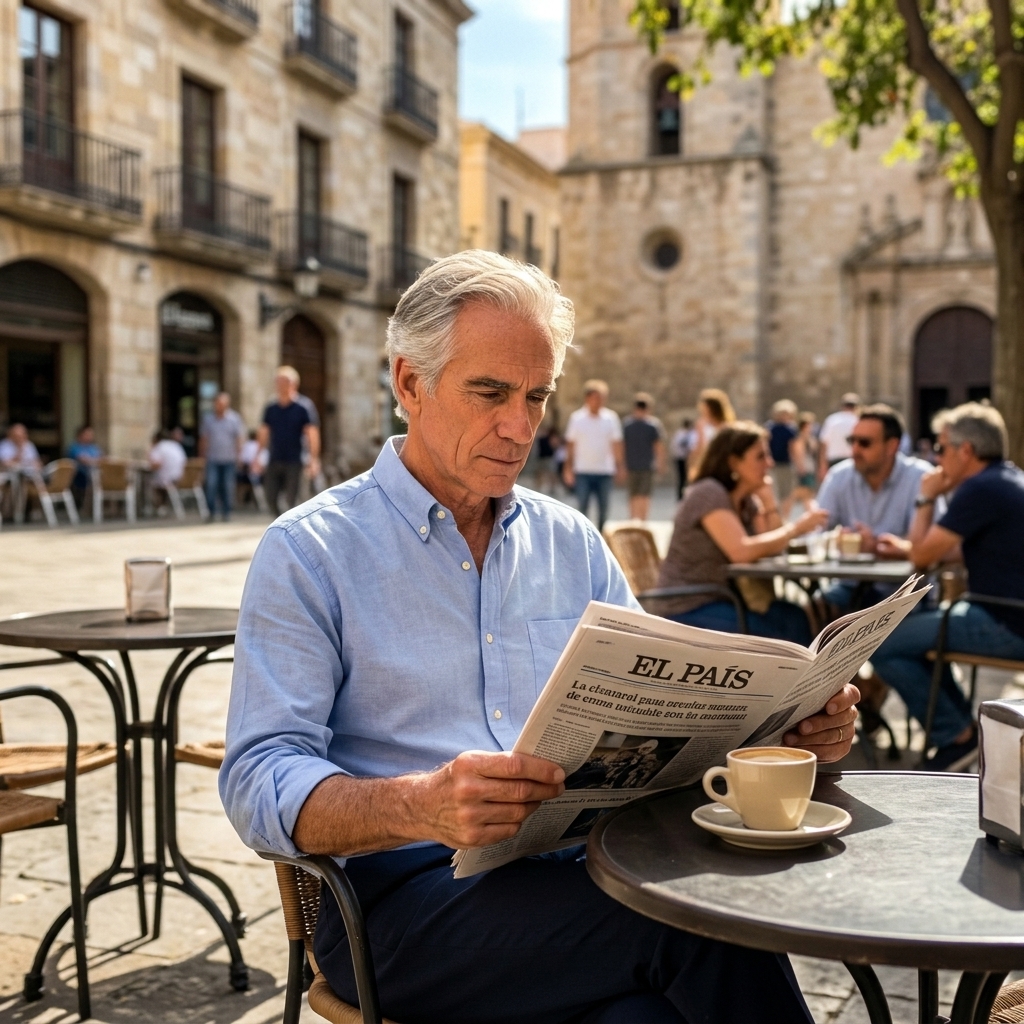
Three years ago I was at Sunday lunch with my son-in-law's family in Madrid.
We finished eating at maybe half past two.
I didn't leave that table until six forty-five in the evening.
And nobody, at any point, seemed to think this was unusual.
Claro que no.
Of course not.
Lo que describes se llama sobremesa, y para nosotros no es un accidente ni una anomalía.
What you're describing is called sobremesa, and for us it's not an accident or an anomaly.
Es la parte más importante de la comida.
It's the most important part of the meal.
The most important part.
Not the food.
La comida es el pretexto, Fletcher.
The food is the excuse, Fletcher.
La sobremesa es la razón por la que nos sentamos juntos.
The sobremesa is the reason we sit together.
Es el momento en que realmente hablamos, sin prisa, sin ningún sitio adonde ir.
It's the moment when we actually talk, with no rush, with nowhere else to be.
And here's what struck me that afternoon in Madrid: the conversation didn't get shallow after the plates were cleared.
If anything it went the other direction.
Politics, old family stories, an argument about a film someone had seen in 1987.
Exacto.
Exactly.
Durante la comida, a veces estás distraído: el vino, los platos, pasar el pan.
During the meal, you're sometimes distracted: the wine, the dishes, passing the bread.
Pero en la sobremesa ya no hay distracciones.
But in the sobremesa there are no more distractions.
Solo las personas y la conversación.
Just the people and the conversation.
Es cuando la gente dice las cosas de verdad.
It's when people say what they really mean.
Okay, and that raises a question I've been sitting with.
Where did this come from?
Because I've eaten with people all over the world, and this particular intensity, this refusal to treat the end of the meal as the end of the event, that feels specifically Spanish to me.
Hay varias explicaciones.
There are several explanations.
Una es histórica: durante siglos, la comida del mediodía fue la principal del día, no la cena.
One is historical: for centuries, the midday meal was the main one, not dinner.
Toda la familia se reunía, los negocios cerraban, y esa pausa larga era el centro de la jornada.
The whole family gathered, businesses closed, and that long pause was the center of the day.
La sobremesa era el espacio natural después de ese momento central.
The sobremesa was the natural space after that central moment.
Right, which connects to the siesta, the whole structure of the Spanish day being different from northern Europe or the States.
Sí, pero cuidado, porque la sobremesa no es la siesta.
Yes, but be careful, because the sobremesa is not the siesta.
Son cosas distintas.
They're different things.
La siesta es el descanso físico.
The siesta is physical rest.
La sobremesa es social, es conversación, es estar juntos.
The sobremesa is social, it's conversation, it's being together.
Puedes tener sobremesa sin dormir nada, y muchas veces así es.
You can have sobremesa without sleeping at all, and often that's exactly what happens.
Fair distinction.
So tell me about the climate argument, because I've heard people say this whole rhythm of the Spanish day, the long afternoon pause, came partly from the heat.
You just couldn't work through a two o'clock afternoon in Seville in August.
El clima influye, sin duda, pero sería demasiado simple reducirlo a eso.
The climate has an influence, no doubt, but it would be too simple to reduce it to that.
En el norte de España, en el País Vasco o en Galicia, el clima es frío y lluvioso, y la sobremesa existe igual.
In northern Spain, in the Basque Country or Galicia, the climate is cold and rainy, and sobremesa exists just the same.
Lo que da forma a la sobremesa no es el calor sino una idea compartida sobre el tiempo: que el tiempo que pasas con las personas que quieres no es tiempo perdido.
What shapes sobremesa isn't the heat but a shared idea about time: that time spent with people you love isn't wasted time.
That's a real difference in philosophy, actually.
In the States the background assumption is that unstructured time needs to be justified.
You linger, you feel vaguely guilty about it.
The Protestant work ethic never really went away.
Eso es exactamente lo que nos diferencia.
That's exactly what sets us apart.
En España, la persona que se levanta primero de la mesa, la que dice «bueno, tengo cosas que hacer», esa persona tiene que dar explicaciones.
In Spain, the person who gets up from the table first, the one who says 'right, I've got things to do,' that person has to explain themselves.
El movimiento por defecto es quedarse.
The default move is to stay.
Which is the complete inversion of how I grew up.
You finished eating, you cleared the table, the meal was over.
There was no ambiguity about when it ended.
Y eso me parece triste, la verdad.
And I find that sad, honestly.
No lo digo para atacar a los americanos, sino porque creo que algo se pierde cuando la comida es solo un proceso que hay que completar.
I don't say it to attack Americans, but because I think something is lost when eating is just a process to complete.
La mesa es un lugar de negociación, de afecto, de conflicto.
The table is a place of negotiation, of affection, of conflict.
Es donde las familias se construyen o se rompen.
It's where families are built or broken.
You know, I reported from Buenos Aires for a while, and there's a version of this there too.
The long Sunday lunch, the family crowded around a table, the meal bleeding into the afternoon.
I always assumed it was the Spanish influence coming through.
Es parte de ello, sí.
It's part of it, yes.
Pero también es interesante porque en Argentina la sobremesa tiene su propio carácter.
But it's also interesting because in Argentina sobremesa has its own character.
Más teatral, quizás.
More theatrical, perhaps.
Los argentinos no solo conversan, actúan.
Argentines don't just converse, they perform.
Okay, I want to push on something.
Because when I describe that four-hour afternoon to Americans, the first question I get is: what do you talk about for four hours?
And honestly, I'm not sure I can fully answer that.
Todo y nada.
Everything and nothing.
Empiezas hablando de lo que ha pasado esa semana, y de repente estás discutiendo sobre si el gobierno actual es peor que el anterior, y luego tu tío cuenta una historia de cuando era joven que ya has escuchado veinte veces, pero la escuchas igual.
You start by talking about what happened that week, and suddenly you're arguing about whether the current government is worse than the last one, and then your uncle tells a story from when he was young that you've heard twenty times, but you listen to it anyway.
No hay un tema.
There's no topic.
Hay una corriente.
There's a current.
A current.
That's a good way to put it.
And that brings me to the thing I find most interesting, which is what this means economically.
Because Spain has a complicated relationship with productivity statistics, and I've read pieces that point directly at the long lunch culture as part of the problem.
Ese argumento me cansa bastante.
That argument tires me out quite a bit.
Los países más productivos de Europa no son necesariamente los que trabajan más horas;
The most productive countries in Europe aren't necessarily the ones that work the most hours;
son los que trabajan mejor.
they're the ones that work better.
Y además, hay estudios que muestran que las pausas largas mejoran la concentración y la creatividad.
And besides, there are studies showing that long breaks improve concentration and creativity.
La sobremesa no roba tiempo, lo regenera.
Sobremesa doesn't steal time, it regenerates it.
Though Spain did push through some changes to working hours in recent years, the debate about syncing with the rest of Europe, getting rid of the long afternoon break in offices.
How much of that is actually landing?
En las empresas grandes, especialmente las multinacionales, el horario ya ha cambiado mucho.
In large companies, especially multinationals, the schedule has already changed a lot.
Mucha gente trabaja de nueve a seis sin pausa larga.
Many people work nine to six without a long break.
Y eso tiene un efecto directo: si sales del trabajo a las seis y media, no tienes sobremesa.
And that has a direct effect: if you leave work at six thirty, you don't have sobremesa.
Comes cuando puedes, rápido, y ya está.
You eat when you can, quickly, and that's that.
Which raises the generational question.
Is this something younger Spaniards actually still do, or are we at risk of this becoming a nostalgic tradition that exists mainly at grandparents' houses on Sundays?
Es una pregunta importante.
It's an important question.
Los jóvenes en las ciudades, con trabajos en empresas internacionales y pisos compartidos, tienen una relación diferente con la sobremesa.
Young people in cities, with jobs at international companies and shared flats, have a different relationship with sobremesa.
No han desaparecido de ella, pero sí la practican menos entre semana.
They haven't disappeared from it, but they do practice it less during the week.
El domingo sigue siendo sagrado, en muchas familias.
Sunday is still sacred, in many families.
And then COVID happened, and I'm curious what that did to all of this.
Because in one reading, lockdown destroyed the communal meal.
You couldn't have fifteen people around a table.
But in another reading, it forced people back indoors with their immediate families for months.
Hay algo de verdad en eso.
There's something to that.
Durante el confinamiento, muchas familias volvieron a comer juntas todos los días, porque no había otra opción.
During lockdown, many families went back to eating together every day, because there was no other option.
Y algunos descubrieron algo que habían olvidado: que esas horas en la mesa eran las únicas en que realmente se hablaban.
And some discovered something they had forgotten: that those hours at the table were the only ones in which they actually talked to each other.
Though I'd bet the phones were also at the table more than ever.
Los móviles son el enemigo número uno de la sobremesa.
Phones are the number one enemy of sobremesa.
No porque la tecnología sea mala en sí misma, sino porque rompen exactamente lo que la sobremesa necesita: presencia.
Not because technology is bad in itself, but because they break exactly what sobremesa requires: presence.
Si estás mirando la pantalla, no estás en la mesa, aunque tu cuerpo esté sentado ahí.
If you're looking at the screen, you're not at the table, even if your body is sitting there.
I want to ask you something personal.
Your own family, growing up in Madrid.
What did sobremesa actually look like in your house?
Because I think sometimes we romanticize these things into something more harmonious than they actually were.
No, no, para nada armoniosa siempre.
No, not at all always harmonious.
Mis padres discutían sobre política casi todos los domingos.
My parents argued about politics almost every Sunday.
Mi abuelo tenía opiniones muy fuertes sobre Franco, sobre la Transición, sobre todo.
My grandfather had very strong opinions about Franco, about the Transition, about everything.
Hubo sobremesas que terminaron con alguien levantándose enfadado.
There were sobremesas that ended with someone getting up angry.
Pero eso también es sobremesa.
But that's also sobremesa.
No es solo risas y café.
It's not just laughter and coffee.
That actually makes me feel better about some of the meals I've been part of.
Though I should say, growing up in Texas, our equivalent was maybe the ten minutes after Thanksgiving when someone inevitably said something about politics and then everyone scattered to watch football.
Diez minutos.
Ten minutes.
Fletcher.
Fletcher.
Eso no es una sobremesa, eso es un malentendido.
That's not a sobremesa, that's a misunderstanding.
In my defense, the turkey was very large and the Cowboys were usually on.
Lo que me preocupa, en serio, es lo que perdemos si la sobremesa desaparece.
What worries me, seriously, is what we lose if sobremesa disappears.
Porque no se trata solo de una costumbre gastronómica.
Because it's not just about a gastronomic custom.
Hay investigaciones sobre soledad, sobre salud mental, que muestran que las personas que tienen conversaciones largas y regulares con personas cercanas viven más y están mejor.
There is research on loneliness, on mental health, showing that people who have long and regular conversations with people close to them live longer and fare better.
La sobremesa es, básicamente, terapia gratuita.
Sobremesa is, basically, free therapy.
There's a lot of research coming out of the UK and the States right now about a loneliness epidemic, particularly among men over fifty.
And one of the consistent findings is that men are catastrophically bad at maintaining social connection outside of structured contexts, which is part of why retirement is so brutal for many of them.
What you're describing, a built-in daily ritual that forces connection, is actually a public health intervention that nobody had to design.
Nunca lo había pensado en esos términos, pero sí.
I had never thought of it in those terms, but yes.
La sobremesa no requiere que seas bueno comunicándote, no requiere que seas consciente de tu necesidad de conexión.
Sobremesa doesn't require you to be good at communicating, it doesn't require you to be aware of your need for connection.
Solo requiere que te quedes sentado.
It only requires you to stay seated.
Y la conversación surge sola, porque la naturaleza humana es así.
And the conversation emerges by itself, because human nature is like that.
Okay, one final pressure point.
You've been making the case for sobremesa this whole conversation, and I'm largely convinced.
But let me steelman the counterargument: isn't there something also worth saying for the culture that has learned to compartmentalize?
Eat well, get up, go do the next thing.
Is the Spanish model the only way to achieve what you're describing?
Puede que no sea la única forma, tienes razón.
It may not be the only way, you're right.
Pero sí creo que es una forma extraordinariamente eficiente.
But I do think it's an extraordinarily efficient one.
No necesitas organizar una cita, no necesitas un plan, no necesitas una aplicación de meditación.
You don't need to organize an appointment, you don't need a plan, you don't need a meditation app.
Solo necesitas no levantarte cuando termina el postre.
You just need not to get up when dessert is finished.
Es la acción más pasiva posible con el mayor efecto social posible.
It's the most passive possible action with the greatest possible social effect.
Don't get up.
That's the whole instruction.
I spent four and a half hours at a table in Madrid following exactly that instruction and I came away knowing that family in a way I hadn't managed in three years of formal dinners and polite attempts.
Por eso la sobremesa importa.
That's why sobremesa matters.
No es nostalgia.
It's not nostalgia.
Es una tecnología social que funciona.
It's a social technology that works.
Y espero que no la perdamos por querer parecernos a países que, honestamente, son mucho más solos que nosotros.
And I hope we don't lose it by trying to resemble countries that, honestly, are much lonelier than we are.
Ouch.
I'll accept that.
You used a phrase a while back that I keep turning over.
You said the sobremesa «surge sola», it emerges by itself.
That construction caught me, the idea that the conversation just rises up on its own.
Sí, «surgir solo» o «surgir sola» es una forma muy natural en español de decir que algo ocurre de manera espontánea, sin que nadie lo fuerce.
Yes, 'surgir solo' or 'surgir sola' is a very natural way in Spanish to say something happens spontaneously, without anyone forcing it.
Por ejemplo: «La solución surgió sola después de que hablamos».
For example: 'The solution emerged by itself after we talked.' It's not magic, but it wasn't planned either.
No es magia, pero tampoco fue planificado.
It just happened.
Simplemente pasó.
We do something similar in English with 'by itself' or 'on its own,' but we'd almost always need to name an agent first.
'The conversation emerged on its own' sounds slightly odd in English without more context.
Whereas in Spanish, 'surge sola' just lands immediately.
Y tiene sentido que esa expresión exista en español, porque describe algo que ocurre mucho en nuestra cultura.
And it makes sense that that expression exists in Spanish, because it describes something that happens a lot in our culture.
Las cosas buenas, la amistad, la conversación, la confianza, surgen solas cuando das el espacio adecuado.
Good things, friendship, conversation, trust, they emerge by themselves when you give them the right space.
No se pueden fabricar.
You can't manufacture them.
Se puede que ocurran, nada más.
You can only allow them to happen, nothing more.
Give them the right space.
Which is exactly what the sobremesa does.
I'm going to remember that.
And on that note, I'm going to stop fighting the urge to check the time and just let this conversation sit a little longer.
Octavio, gracias.
De nada, Fletcher.
You're welcome, Fletcher.
Y la próxima vez que estés en Madrid, te quedas a comer.
And next time you're in Madrid, you stay for lunch.
Sin reloj.
No watch.