B1 · Intermediate
14 min
scienceeducationwarhistorytechnology
The University That Burns: Science, War, and Knowledge as a Target
La Universidad que Arde: Ciencia, Guerra y el Conocimiento como Objetivo
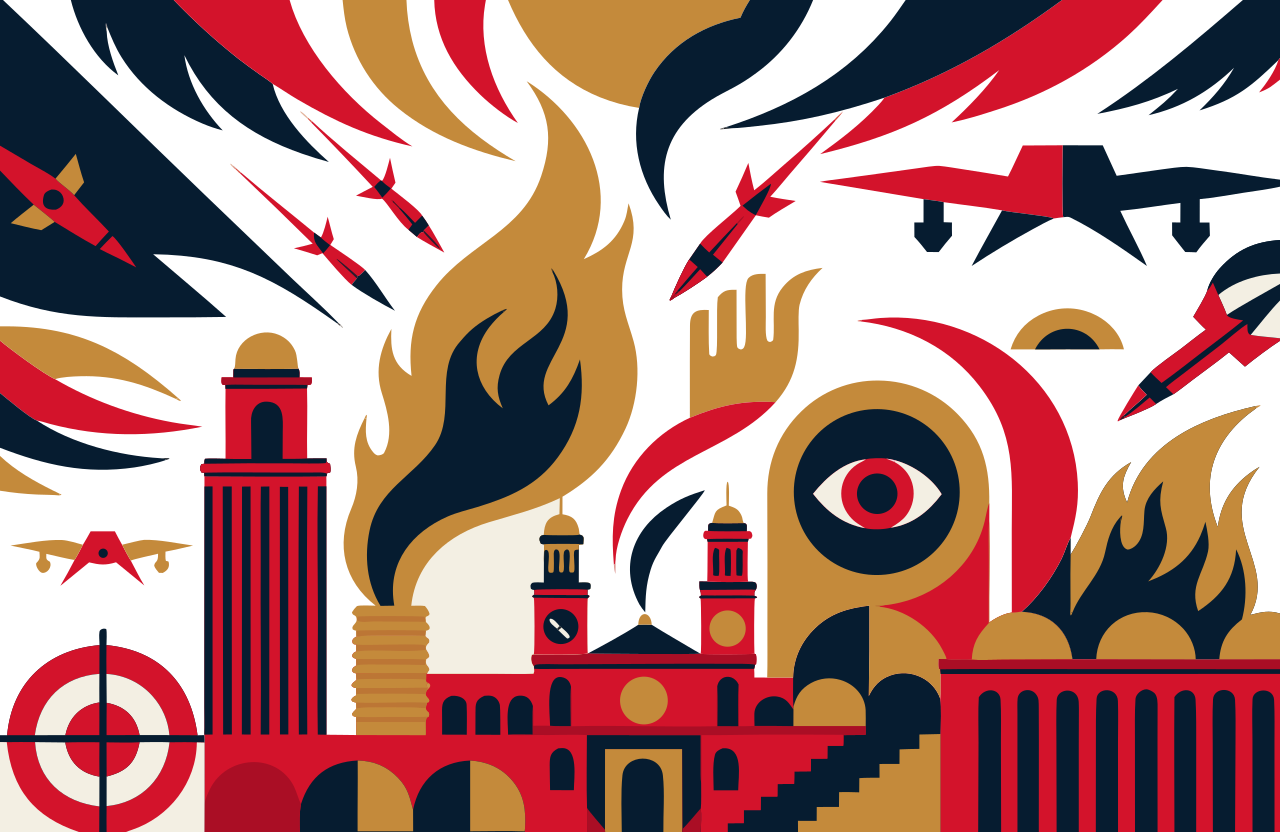
An airstrike damages facilities at Sharif University of Technology in Tehran, one of the most prestigious technical universities in the world. Fletcher and Octavio discuss Iran's long scientific tradition, the history of targeting knowledge institutions in war, and what happens when a nation loses its scientists.
Un ataque aéreo daña instalaciones en la Universidad Sharif de Tecnología en Teherán, una de las universidades técnicas más importantes del mundo. Fletcher y Octavio hablan sobre la larga historia de la ciencia iraní, la tradición de atacar instituciones del conocimiento en la guerra, y qué pasa cuando una nación pierde a sus científicos.


8 essential B1-level terms from this episode, with translations and example sentences in Spanish.
| Spanish | English | Example |
|---|---|---|
| conocimiento | knowledge | Las guerras destruyen el conocimiento de una civilización. |
| investigación | research | Los científicos no podían publicar su investigación por las sanciones. |
| sanciones | sanctions | Las sanciones hicieron muy difícil comprar equipos científicos. |
| aislado | isolated | El científico estaba muy aislado porque no podía ir a conferencias internacionales. |
| ingeniería | engineering | La Universidad Sharif es famosa por sus programas de ingeniería y matemáticas. |
| escapar | to escape | Muchos científicos escaparon de España durante la guerra civil. |
| destruir | to destroy | Los mongoles destruyeron las bibliotecas de Bagdad en el siglo trece. |
| sacrificio | sacrifice | Las familias iraníes hacen muchos sacrificios para que sus hijos estudien. |
So, something happened this week that I think got buried under all the missile counts and ceasefire proposals, and I want to dig into it.
An airstrike hit the Sharif University of Technology in Tehran.
The mosque and a filling station on campus were damaged.
And look, I know the headline is just 'building hit,' but this is not just any building.
Bueno, mira, la Universidad Sharif es muy importante.
Sharif University is extremely important.
Es como el MIT de Irán.
It is like the MIT of Iran.
Los estudiantes que estudian allí son los mejores del país en matemáticas, ingeniería y física.
The students who study there are the best in the country in mathematics, engineering, and physics.
The MIT of Iran, exactly.
And I think most people in the West have a completely distorted picture of Iranian science.
They think, I don't know, sand and oil and theocracy.
But Iran has one of the oldest and most sophisticated scientific traditions on the planet.
Sí, es que la gente no sabe esto.
Yes, people just don't know this.
En la Edad Media, los científicos iraníes y árabes estudiaron matemáticas, astronomía y medicina cuando Europa todavía vivía en la oscuridad.
In the Middle Ages, Iranian and Arab scientists were studying mathematics, astronomy, and medicine while Europe was still living in the dark ages.
Right, the Islamic Golden Age.
Scholars like al-Khwarizmi, who gave us the word algebra, or Ibn Sina, who wrote a medical encyclopedia that European universities were still teaching from in the seventeenth century.
That tradition runs deep.
Y la Universidad Sharif empezó en 1966.
And Sharif University was founded in 1966.
El nombre original era Universidad Aria Mehr, pero después de la revolución de 1979, cambiaron el nombre a Sharif, en honor a un estudiante que murió en la revolución.
Its original name was Arya Mehr University, but after the 1979 revolution they changed the name to Sharif, in honor of a student who died in the revolution.
Here's what gets me about Sharif specifically.
Its alumni are everywhere.
Silicon Valley, MIT, Caltech, CERN.
There's a running joke in tech circles that you can't throw a stone at a major research lab without hitting a Sharif graduate.
Iran produces engineers and mathematicians at a rate that is genuinely remarkable for a country under decades of sanctions.
Exacto.
Exactly.
Y muchos de estos estudiantes no quieren irse de Irán.
And many of these students do not want to leave Iran.
Quieren quedarse y trabajar en su país.
They want to stay and work in their own country.
Pero las sanciones y la guerra hacen la vida muy difícil.
But the sanctions and the war make life very difficult.
Which brings me to the darker chapter here, because this is not the first time Iranian scientists have been in the crosshairs.
Between 2010 and 2012, four Iranian nuclear scientists were assassinated.
Car bombs, motorcycles pulling up alongside them.
Masoud Alimohammadi, Majid Shahriari, Darioush Rezaeinejad, Mostafa Ahmadi-Roshan.
Sí, y en 2020, mataron a Mohsen Fakhrizadeh, el científico más importante del programa nuclear de Irán.
Yes, and in 2020 they killed Mohsen Fakhrizadeh, the most important scientist in Iran's nuclear program.
Lo mataron con una ametralladora controlada por control remoto en su coche.
He was killed with a remote-controlled machine gun mounted in a vehicle.
Fue un ataque muy sofisticado.
It was a very sophisticated attack.
The remote-controlled gun.
I remember reading about that.
It was reportedly a satellite-linked weapon that could distinguish him from the other people in the car.
The level of technological sophistication required for that is staggering.
And the message it sends to every other Iranian scientist is chilling.
Bueno, la pregunta es: ¿cuál es el objetivo?
The question is: what is the goal?
Si matas a un científico, ¿el programa para?
If you kill one scientist, does the program stop?
No.
No.
Hay otros científicos.
There are other scientists.
Pero sí puedes crear mucho miedo.
But you can create a great deal of fear.
Fear and delay.
The argument the Israelis and Americans made, implicitly, was that you don't have to destroy the whole program.
You just have to push it back by years.
Buy time.
And there's a cold strategic logic to it, even if it's morally repugnant.
Es que la historia de atacar la ciencia de un enemigo es muy larga.
The history of attacking an enemy's science is very long.
No empezó con Irán.
It did not start with Iran.
No, it absolutely did not.
I mean, the most famous example is the Allied effort in World War Two to stop the German atomic bomb program.
The raid on the Vemork heavy water plant in Norway in 1943.
Norwegian commandos destroyed the facility before the Nazis could produce enough material for a weapon.
Sí, y también había el programa americano para encontrar a los científicos alemanes después de la guerra.
Yes, and there was also the American program to find German scientists after the war.
La Operación Paperclip.
Operation Paperclip.
Los americanos llevaron a muchos científicos nazis a los Estados Unidos para trabajar en cohetes y misiles.
The Americans brought many Nazi scientists to the United States to work on rockets and missiles.
Wernher von Braun, who literally designed the V-2 rocket that killed thousands of people in London, ended up running NASA's Saturn V program that put men on the moon.
The moral compromises of science in war are...
they're profound.
A ver, volvamos a Sharif.
Let us go back to Sharif.
Esta semana el ataque fue a la mezquita y a la gasolinera del campus.
This week the strike hit the mosque and the filling station on campus.
No destruyeron los laboratorios principales.
They did not destroy the main laboratories.
Pero el mensaje es claro: ningún lugar es seguro.
But the message is clear: no place is safe.
Right.
And there's something historically significant about striking a university campus specifically.
Universities have this ancient tradition of being, if not exactly neutral, then at least somewhat protected spaces.
Even in medieval wars there were certain places you didn't hit.
La verdad es que eso ya no existe.
That protection no longer really exists.
En la Segunda Guerra Mundial, los aliados bombardearon Dresde.
In World War Two, the Allies bombed Dresden.
Había una universidad muy famosa allí.
There was a famous university there.
Y en la guerra de Yugoslavia, los serbios atacaron la Universidad de Sarajevo.
And in the Yugoslav war, Serbian forces attacked the University of Sarajevo.
The library in Sarajevo.
I remember that.
The National Library, which held hundreds of years of Bosnian cultural and scientific records.
Burned deliberately.
Librarians and ordinary citizens ran through sniper fire to save books.
There's something about destroying knowledge that is its own category of crime.
Mira, y esto pasa desde la antigüedad.
And this goes back to antiquity.
La Biblioteca de Alejandría.
The Library of Alexandria.
Las guerras mongolas destruyeron las bibliotecas de Bagdad en el siglo trece.
The Mongol wars destroyed the libraries of Baghdad in the thirteenth century.
Perdimos siglos de conocimiento humano.
We lost centuries of human knowledge.
The House of Wisdom in Baghdad.
That's a story I keep coming back to.
At its peak in the ninth and tenth centuries it was probably the greatest repository of scientific knowledge on earth.
Translations of Greek philosophy, original work in mathematics and medicine.
And then the Mongols came in 1258 and threw the books into the Tigris.
The river ran black with ink, allegedly.
Es una imagen muy poderosa.
That is a very powerful image.
Y es posible que sea un poco exagerada, pero el mensaje histórico es real.
It may be slightly exaggerated, but the historical point is real.
Cuando destruyes el conocimiento de una civilización, los efectos duran siglos.
When you destroy the knowledge of a civilization, the effects last for centuries.
So here's the question I keep circling back to with Iran specifically.
The scientists who survive, who are studying at Sharif right now, young people in their twenties, what do they do?
Do they stay?
Do they leave?
Because there's already a massive Iranian brain drain that predates this war by decades.
Bueno, el problema es muy serio.
The problem is very serious.
Antes de la guerra, muchos graduados de Sharif ya querían irse a Canadá, a Alemania, a los Estados Unidos.
Before the war, many Sharif graduates already wanted to leave for Canada, Germany, or the United States.
Las sanciones hacían muy difícil comprar equipos científicos o publicar investigaciones internacionales.
The sanctions made it very difficult to buy scientific equipment or publish international research.
I talked to an Iranian physicist a few years ago, brilliant woman, she'd done her doctorate at Sharif and was then at a university in Toronto.
She said the sanctions meant she couldn't even access some academic journals.
Journals that publish open science.
The irony of it was painful to her.
Es que la ciencia necesita colaboración internacional para funcionar bien.
Science needs international collaboration to function well.
Un científico iraní que no puede hablar con sus colegas en otros países, que no puede ir a conferencias, que no puede publicar, está muy aislado.
An Iranian scientist who cannot talk to colleagues in other countries, cannot attend conferences, cannot publish, is very isolated.
And yet, despite all of that, Iran has maintained a genuinely significant scientific output.
In certain fields, mathematics in particular, they punch well above their weight.
There are Iranian mathematicians who have won the Fields Medal, which is basically the Nobel Prize of mathematics.
Sí, Maryam Mirzakhani.
Yes, Maryam Mirzakhani.
Fue la primera mujer en ganar la Medalla Fields, en 2014.
She was the first woman to win the Fields Medal, in 2014.
Era iraní, estudió en Irán antes de ir a Harvard.
She was Iranian, she studied in Iran before going to Harvard.
Murió de cáncer en 2017.
She died of cancer in 2017.
Fue una pérdida enorme para las matemáticas.
It was an enormous loss for mathematics.
The extraordinary thing is that she became an icon in Iran even though the government had complicated feelings about her, because she didn't wear a hijab in her photos after she left the country.
But her face was everywhere in Tehran after the medal.
Science crosses those lines sometimes.
La verdad es que sí.
Yes, it does.
Y por eso atacar una universidad como Sharif es diferente a atacar una fábrica de misiles.
And that is why attacking a university like Sharif is different from attacking a missile factory.
Una fábrica produce armas.
A factory produces weapons.
Una universidad produce personas que piensan.
A university produces people who think.
People who think.
That's the thing.
And here's where I want to push on the strategic logic a little, because I've heard the argument made by serious people that targeting Iran's scientific and technical capacity is actually more humane than conventional warfare.
Fewer casualties, more lasting effect.
No, no, espera.
No, wait.
Eso no es correcto.
That is not correct.
Si destruyes la capacidad científica de un país, no solo afectas al ejército.
If you destroy a country's scientific capacity, you do not only affect the military.
Afectas a los médicos, a los ingenieros de hospitales, a los profesores.
You affect doctors, hospital engineers, teachers.
Toda la sociedad sufre.
The entire society suffers.
No, you're absolutely right about that.
And there's historical precedent.
After the Gulf War in 1991, the sanctions on Iraq destroyed its scientific infrastructure.
Iraq had one of the most educated populations in the Arab world.
By the late nineties, its universities were in ruins and its scientists had either left or couldn't get basic equipment.
Y eso no volvió.
And it never came back.
Puedes reconstruir un edificio en unos años.
You can rebuild a building in a few years.
Pero cuando un científico bueno se va de su país, muchas veces no vuelve.
But when a good scientist leaves their country, they often do not come back.
Su trabajo, sus ideas, su experiencia, ya no están en ese país.
Their work, their ideas, their experience are no longer in that country.
The human capital argument.
It's the thing economists say about education that actually turns out to be true.
A country's scientific capacity is not its buildings or even its equipment.
It's the people who know how to use them.
And those people take decades to train.
A ver, hay algo más que me parece importante.
There is something else that seems important to me.
Irán tiene una cultura muy larga de respeto por el conocimiento y la educación.
Iran has a very long culture of respect for knowledge and education.
Las familias iraníes hacen muchos sacrificios para que sus hijos estudien.
Iranian families make great sacrifices so their children can study.
La educación es un valor central.
Education is a central value.
I saw that when I was reporting from Tehran years ago.
I mean, before things got really bad.
Middle-class families, not wealthy, but middle class, putting enormous resources into tutoring, into books, into getting their kids into the right university.
Sharif was the dream.
Y ahora esas familias ven su universidad en las noticias porque recibió un ataque aéreo.
And now those families see their university in the news because it was hit in an airstrike.
Imagina cómo se sienten.
Imagine how they feel.
No es solo un edificio.
It is not just a building.
Es el futuro de sus hijos.
It is their children's future.
The future of their children.
Look, I want to end on something that doesn't feel hopeless, because I think there is something genuinely remarkable about how science survives war.
Not always, not completely, but there's a resilience to it.
Sí.
During the Spanish Civil War, many scientists and professors escaped to Mexico.
Durante la guerra civil española, muchos científicos y profesores escaparon a México.
The Mexican government welcomed them well.
El gobierno mexicano los recibió muy bien.
Those scientists founded new institutions and helped Mexico's development for decades.
Esos científicos fundaron instituciones nuevas y ayudaron al desarrollo de México durante décadas.
The Spanish exile scientists in Mexico City.
That's a beautiful and painful story.
Spain's loss was Mexico's gain, and it took Spain forty years to even begin to recover that scientific generation.
The diaspora carries the knowledge forward, but the country of origin is hollowed out.
Bueno, y eso es lo que puede pasar con Irán.
And that is what could happen with Iran.
Los científicos iraníes ya están en todas partes del mundo.
Iranian scientists are already all over the world.
Si hay paz algún día, la pregunta es si van a volver a construir las universidades de su país.
If there is peace someday, the question is whether they will return to rebuild their country's universities.
That's the question, isn't it.
The mosque at Sharif gets repaired.
The filling station gets rebuilt.
But the twenty-two-year-old student who was sitting in the library that morning, doing her mathematics, and decides this week that she's going to take that offer in Zurich.
That's harder to rebuild.
La verdad es que sí.
Yes.
Y esa es la pérdida más grande de esta guerra, y de muchas guerras.
And that is the greatest loss of this war, and of many wars.
No los edificios.
Not the buildings.
Las personas que podrían haber cambiado el mundo, pero que nunca tuvieron la oportunidad.
The people who could have changed the world, but never had the chance.