A2 · Elementary
13 min
climateenergygeopoliticsenvironment
El Tubo y el Planeta: Europa, el Petróleo y el Clima
The Pipe and the Planet: Europe, Oil, and the Climate
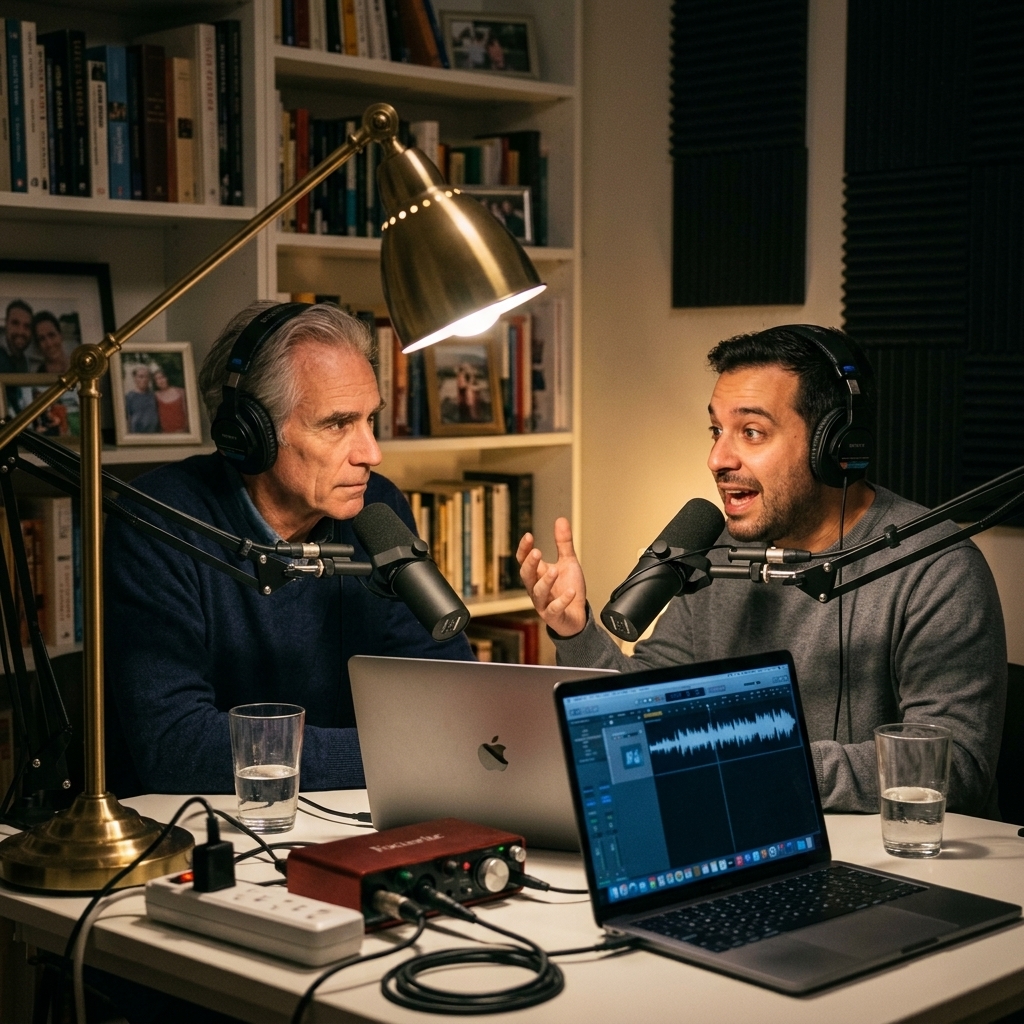
Fletcher breaks down this story in English. Octavio reacts and expands in Spanish. Follow along with the live transcript, tap any word for its translation. Elementary level — perfect for beginners building confidence.


So the news this week is that Ukraine has finished repairing the Druzhba pipeline.
It was damaged in a war-related strike, and now they're about to start pumping again.
And Zelenskyy is linking the whole thing to a ninety billion euro EU support package.
Bueno, el Druzhba es muy importante.
The Druzhba is very important.
Es un oleoducto muy grande.
It is a very large pipeline.
And I want to get into that, because I think most people hear the word 'pipeline' and their eyes glaze over.
But this thing is enormous.
The name 'Druzhba' actually means 'friendship' in Russian, which given the current circumstances is...
I mean, the irony is almost too much.
Mira, el nombre es de los años sesenta.
Look, the name is from the nineteen sixties.
Rusia y Europa eran amigos entonces.
Russia and Europe were friends back then.
Right, and that's the history worth pausing on.
This pipeline was built during the Cold War, which is remarkable when you think about it.
The Soviets were supplying oil to Eastern Bloc countries, and eventually to Western Europe too.
It runs from Russia, through Belarus and Ukraine, and splits into two branches that feed into Germany, Poland, Hungary, Slovakia, the Czech Republic.
Es que Europa necesita el petróleo.
The thing is, Europe needs the oil.
Siempre lo necesita.
It always needs it.
And that's where it gets really interesting for our climate conversation.
Because here's the thing: Europe has been making serious noise about decarbonization for years.
The European Green Deal, net zero by 2050, all of that.
And yet when a pipeline gets damaged, the first instinct is to fix it.
Bueno, la gente tiene frío en invierno.
Well, people are cold in winter.
Necesita calor.
They need heat.
No, you're absolutely right about that.
And I don't want to be glib about it.
When I was reporting from Eastern Europe in the nineties, the winters were brutal.
You could feel the dependence on those supply lines in a very physical way.
It wasn't abstract politics, it was people's radiators.
A ver, el gas y el petróleo son problemas para el clima.
Now, gas and oil are problems for the climate.
Esto es verdad.
That is true.
So here's what I want to explore today, because I think this pipeline story is actually a window into something much bigger.
It's about the gap between climate ambition and energy reality.
And Europe is maybe the most interesting case study on the planet for that tension.
Mira, Europa habla mucho del clima.
Look, Europe talks a lot about climate.
Pero usa mucho petróleo.
But it uses a lot of oil.
The extraordinary thing is how much the war in Ukraine actually accelerated the conversation.
When Russia invaded in 2022, suddenly European energy dependence was not just an environmental problem, it was a security problem.
And those two things colliding, I think, changed the politics in a way that years of climate summits never quite managed.
Es que la guerra cambia todo.
The thing is, war changes everything.
La gente tiene miedo.
People are afraid.
Fear is a hell of a motivator.
Germany, which had been the biggest champion of Nord Stream and cheap Russian gas, did an almost overnight reversal.
They started importing liquefied natural gas from the United States and Qatar.
They dusted off some coal plants they'd been trying to shut down.
El carbón es muy malo para el clima.
Coal is very bad for the climate.
Es terrible.
It is terrible.
It is.
And the carbon numbers from that period were genuinely alarming for climate scientists.
Here's what gets me, though: Germany also massively sped up its renewable energy permits at the same time.
It was this bizarre paradox where the crisis simultaneously pushed them toward dirtier energy in the short term and cleaner energy in the long term.
Bueno, los molinos de viento son buenos.
Well, wind turbines are good.
El sol también.
The sun too.
Right, solar and wind.
And Europe has actually made remarkable progress.
Spain, where you're from, is a fascinating example.
Last year Spain had stretches where renewables covered more than a hundred percent of electricity demand.
They were exporting surplus power to France.
La verdad es que España tiene mucho sol.
The truth is that Spain has a lot of sun.
Es una ventaja.
That is an advantage.
An enormous advantage.
But Germany doesn't have that.
Poland definitely doesn't have that.
And that's why when we talk about European climate policy, you can't treat the continent as one thing.
The geography alone makes the energy transition profoundly uneven.
Es que Polonia usa mucho carbón.
Poland uses a lot of coal.
Mucho.
A lot.
Es un problema grande.
It is a big problem.
Poland is genuinely one of the most complicated climate stories in Europe.
About seventy percent of its electricity still comes from coal.
And there are entire communities, entire regions, whose identity and economy are built around the mines.
The politics of asking those people to just switch to solar, I mean, it's not that simple.
Mira, el trabajo es importante.
Look, work is important.
La gente necesita trabajo.
People need jobs.
And this is the thing that I think gets lost in a lot of climate reporting, the human dimension of the transition.
I remember covering the aftermath of steel mill closures in the American Midwest.
The grief is real.
When you close a mine, you're not just closing an economic unit, you're ending a way of life.
A ver, en España también.
In Spain too.
Las minas de carbón en Asturias.
The coal mines of Asturias.
Es triste.
It is sad.
Asturias, yes.
I actually spent a week there once, back in the mid-nineties, reporting on the mine closures.
And the anger was so raw.
People felt abandoned by Madrid, by Brussels, by the whole idea of European modernity that was supposed to make their lives better but just took their livelihoods instead.
Bueno, ahora hay parques eólicos en Asturias.
Well, now there are wind farms in Asturias.
Es diferente.
It is different.
That's actually a hopeful data point.
The same geography that made Asturias good for coal, the mountains, the atlantic winds, makes it pretty good for wind turbines.
The question is always whether the jobs in the new economy go to the same people who lost jobs in the old one.
And the honest answer is, often they don't.
Es que los trabajos nuevos necesitan estudios diferentes.
The new jobs require different training.
Es difícil.
It is difficult.
Exactly.
So let's bring this back to the Druzhba pipeline, because I think this is the connective tissue.
When Ukraine finishes repairing that pipeline and Central European countries start receiving oil again, they're not celebrating.
They're breathing a sigh of relief.
And that tells you something about where the transition actually is.
La verdad es que el petróleo es fácil.
The truth is that oil is easy.
Los coches necesitan petróleo.
Cars need oil.
Transportation is still the stubborn one, isn't it.
Look, electricity grids can be decarbonized, you can replace a gas power plant with a wind farm.
But moving freight across continents, aviation, shipping, heavy industry, those are incredibly hard to electrify.
And that's where oil isn't going away anytime soon.
Mira, los coches eléctricos son buenos.
Look, electric cars are good.
Pero son caros también.
But they are also expensive.
The cost barrier is real and it's politically explosive.
There's been real backlash across Europe from people who feel like the green transition is something designed by wealthy urban professionals for wealthy urban professionals.
Farmers blocking roads in France and Germany, fishermen protesting in the Netherlands.
The resentment is a live current running through European politics right now.
Es que el agricultor tiene problemas diferentes.
The farmer has different problems.
La ciudad no entiende.
The city does not understand.
That urban-rural gap in the climate conversation is something I find genuinely fascinating.
And a little worrying, honestly.
Because if you lose the countryside on climate, you lose elections.
And if you lose elections, you lose the policy continuity that any long-term transition requires.
Bueno, el clima es un problema para todos.
Well, climate is a problem for everyone.
El campo también sufre.
The countryside suffers too.
Right, and that's the argument that doesn't always land.
Because the farmer experiencing drought in Extremadura knows the climate is changing, they feel it every single summer.
But if you tell them the solution means they can't afford to fuel their tractor, that argument breaks down fast.
La verdad es que el agua es el problema grande en España.
The truth is that water is the big problem in Spain.
El campo tiene sed.
The countryside is thirsty.
Water scarcity in southern Europe is one of the starkest, most measurable climate consequences on the continent.
The Iberian Peninsula has lost something like twenty percent of its average rainfall over the past few decades.
The Tagus, the Guadalquivir, rivers that sustained civilizations for thousands of years, their flows are declining.
That's not a model projection, that's happening now.
A ver, en Madrid el verano es muy caliente ahora.
In Madrid the summer is very hot now.
Antes no era así.
Before it was not like this.
You know, I was in Madrid in August of 2021 and I thought I'd accidentally flown to Riyadh.
It was forty-seven degrees Celsius.
I've covered the Middle East, I know what heat feels like, and Madrid in the forties is something I genuinely was not prepared for.
Mira, las personas mayores sufren mucho con el calor.
Look, older people suffer a lot in the heat.
Es peligroso.
It is dangerous.
The mortality numbers from European heat waves are something most people don't fully absorb.
The 2003 heat wave killed somewhere between seventy and eighty thousand people across Europe.
France alone lost fifteen thousand in two weeks.
It barely registered as a climate story at the time, but it was one of the deadliest weather events in European recorded history.
Es que el calor mata.
Heat kills.
Pero la gente no lo ve.
But people do not see it.
No lo cree.
They do not believe it.
There's a visibility problem with climate mortality that I've thought about a lot as a journalist.
A building collapses and it's front page news for a week.
Twenty thousand elderly people die quietly in apartments with no air conditioning and it takes years for the story to land properly.
The slow death doesn't have the same visual grammar as the sudden one.
Bueno, el periodismo necesita imágenes.
Well, journalism needs images.
Sin imágenes, no hay historia.
Without images, there is no story.
And you'd know that better than almost anyone, given your years at El País.
Look, I think that's one of the deep structural problems in how we communicate climate.
The timescales and the causes are diffuse, the deaths are invisible, and the solutions require collective action over generations.
It's almost the opposite of what journalism is structurally built to cover.
La verdad es que el periodismo cambia.
The truth is that journalism is changing.
Los jóvenes tienen miedo del clima.
Young people are afraid of climate.
The generational shift is real and I see it in my students at UT Austin.
They're not debating whether climate change is happening, that conversation is over for them.
What they're debating is whether anything can actually be done about it, and there's a genuine thread of despair running through a lot of those conversations that I find both understandable and, honestly, a little alarming.
Es que la esperanza es importante.
Hope is important.
Sin esperanza, no hay acción.
Without hope, there is no action.
So here's where I want to land this.
The Druzhba pipeline gets repaired, oil starts flowing again into Central Europe, and Zelenskyy ties it to a ninety billion euro support package.
On one level that looks like a climate setback.
On another level, the EU support package includes significant green investment.
The two things are bundled together.
And maybe that bundling is actually what pragmatic climate politics looks like.
Mira, el mundo real es complicado.
Look, the real world is complicated.
Las ideas puras no funcionan siempre.
Pure ideas do not always work.
That's a generous reading, and I go back and forth on it.
The cynical version is that every generation tells itself it's being pragmatic while actually just delaying.
The optimistic version is that Europe has demonstrably cut its emissions significantly since 2005 while growing its economy.
Both things are true, which is the uncomfortable place where most honest climate conversations end up.
A ver, el planeta no espera.
The planet is not waiting.
El tiempo es importante.
Time matters.
The planet doesn't care about our political timelines.
That's the thing.
The physics of carbon in the atmosphere operates on its own schedule, completely indifferent to election cycles or pipeline repairs or ninety billion euro packages.
And I think that's the note to end on.
Because it's the one thing in this whole conversation that isn't actually up for debate.
Bueno, el planeta es nuestro hogar.
Well, the planet is our home.
Necesitamos cuidarlo.
We need to take care of it.
Es todo.
That is everything.