A2 · Elementary
12 min
climateenvironmentsciencegeopolitics
El planeta tiene fiebre
The Planet Has a Fever
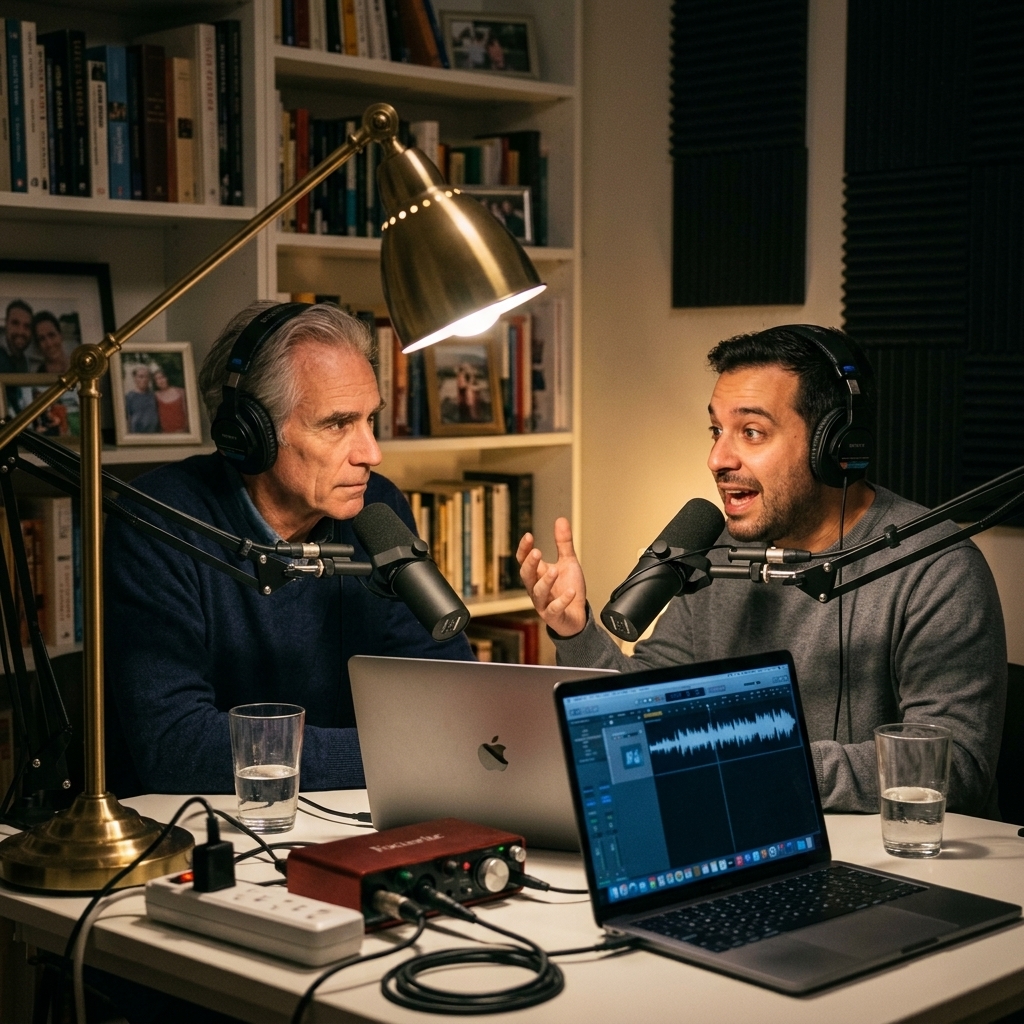
Fletcher breaks down this story in English. Octavio reacts and expands in Spanish. Follow along with the live transcript, tap any word for its translation. Elementary level — perfect for beginners building confidence.


So the World Meteorological Organization dropped its annual State of the Global Climate report this week, and I've been sitting with the numbers for a couple of days now.
Look, I've read a lot of these reports over the years.
This one landed differently.
Bueno, mira.
Well, look.
El planeta tiene un problema muy grande.
The planet has a very big problem.
El calor en los océanos es un récord.
The heat in the oceans is a record.
Nunca fue tan alto.
It has never been this high.
Right, and that phrase, ocean heat content, I want to make sure we explain what that actually means, because it sounds technical but the implications are anything but abstract.
A ver.
Right, let's see.
Los océanos absorben mucho calor.
The oceans absorb a lot of heat.
Absorben el calor del sol.
They absorb heat from the sun.
También absorben el calor de los gases.
They also absorb heat from the gases.
The gases being the greenhouse gases, the carbon dioxide, the methane.
The oceans are essentially acting as a buffer, absorbing heat that would otherwise be baking the atmosphere directly.
And the report says that buffer hit a record in 2025.
Sí, exacto.
Yes, exactly.
El océano es como una esponja.
The ocean is like a sponge.
Absorbe, absorbe, absorbe.
It absorbs, absorbs, absorbs.
Pero ahora está muy lleno.
But now it is very full.
A sponge that's reached capacity.
And the other term in the report that really stopped me was energy imbalance.
The Earth is taking in more energy from the sun than it's releasing back into space.
More energy is arriving than is leaving.
That's the imbalance.
La verdad es que es muy simple.
The truth is it is very simple.
El sol manda energía.
The sun sends energy.
La Tierra necesita mandar energía también.
The Earth needs to send energy back too.
Pero ahora no puede.
But now it cannot.
And why can't it?
Because greenhouse gases, essentially, are acting like a blanket around the planet.
The heat can't escape.
The extraordinary thing is that scientists have been measuring this energy imbalance since roughly 2005, and every year the number gets worse.
Bueno, los gases son el problema.
Well, the gases are the problem.
Nosotros producimos muchos gases.
We produce a lot of gases.
Los coches, las fábricas, todo.
Cars, factories, everything.
I want to give this some historical weight, because I think the numbers lose their meaning without context.
In 1990, when the IPCC published its very first climate assessment, global CO2 concentration in the atmosphere was around 354 parts per million.
In 2025, we crossed 424.
We were warned, clearly and early, and emissions kept climbing.
Mira, sabemos el problema desde hace muchos años.
Look, we have known about the problem for many years.
Pero los países no cambian mucho.
But countries don't change much.
Es difícil, claro.
It's difficult, of course.
It is difficult.
And I don't want to be glib about that, because the economic forces involved are enormous.
I covered the Kyoto Protocol negotiations in the late nineties, and even then the gap between what scientists were saying needed to happen and what governments were willing to commit to was staggering.
Es que los políticos hablan mucho.
The thing is, politicians talk a lot.
Pero los números suben cada año.
But the numbers go up every year.
Hay un problema con las palabras y los hechos.
There is a problem between words and actions.
Words and actions, yes.
That tension is exactly what makes these annual WMO reports so uncomfortable to read.
They are, in a sense, a report card on whether the promises made at Paris, at Glasgow, at Dubai, actually translated into results.
And the 2025 data suggests, largely, they haven't.
La verdad es que 2025 fue muy caliente.
The truth is that 2025 was very hot.
El año anterior también.
The year before too.
Y el anterior también.
And the one before that too.
Right.
The last ten years are, collectively, the ten hottest on record.
That's not a coincidence, that's a trend line.
And what the WMO is flagging now is that the ocean heat content record is particularly significant, because oceans have a long memory.
Sí, el océano guarda el calor mucho tiempo.
Yes, the ocean holds heat for a long time.
No es como el aire.
It is not like the air.
El océano es lento pero poderoso.
The ocean is slow but powerful.
Slow but powerful.
I like that.
And the consequence of that stored heat is what worries oceanographers most right now, which is thermal expansion.
Warm water takes up more space than cold water.
So warmer oceans mean physically rising sea levels, separate from ice melt entirely.
Bueno, el agua caliente sube.
Well, warm water rises.
El nivel del mar sube.
Sea levels rise.
Es un problema para las ciudades cerca del mar.
It is a problem for cities near the sea.
Jakarta, Miami, Bangkok, Dhaka.
I was in Dhaka in 2008 reporting on flooding, and people there were already talking about displacement in the tens of millions.
Not as a future scenario, as a present reality.
And the sea level projections have not gotten more optimistic since then.
Mira, en España también hay problemas.
Look, in Spain there are problems too.
Valencia tuvo inundaciones muy fuertes.
Valencia had very strong floods.
Muchas personas murieron.
Many people died.
The Valencia floods in late 2024.
That was devastating.
And scientists connected that event directly to warmer Mediterranean waters, which supercharged the storm that caused the flooding.
The Mediterranean is one of the fastest-warming bodies of water on the planet right now.
El Mediterráneo es muy importante para España.
The Mediterranean is very important for Spain.
Para la pesca, para el turismo, para todo.
For fishing, for tourism, for everything.
Y ahora está muy caliente.
And now it is very hot.
For fishing especially.
Warmer waters change where fish can live and breed.
Species that were historically Mediterranean are moving north.
Species from further south are appearing in waters they were never in before.
The whole ecosystem is shifting, and fishing communities are feeling that in real, economic terms.
A ver, los peces cambian de lugar.
Right, the fish change their location.
Los pescadores no encuentran los mismos peces.
Fishermen don't find the same fish.
Es un problema muy real.
It is a very real problem.
Here's what gets me about the ocean heat content record specifically.
The ocean has absorbed roughly ninety percent of the excess heat trapped by greenhouse gases since industrialization.
Ninety percent.
Without that, the atmosphere would be dramatically hotter than it already is.
The ocean has essentially been protecting us, and we've been filling it up.
Sí, el océano nos protege.
Yes, the ocean protects us.
Pero tiene un límite.
But it has a limit.
Y ahora llegamos al límite.
And now we are reaching that limit.
And when you reach that limit, a few things happen.
Coral bleaching accelerates, because corals are extraordinarily sensitive to water temperature.
We're already seeing mass bleaching events on the Great Barrier Reef, in the Caribbean, in the Indian Ocean.
And coral reefs support roughly a quarter of all marine species.
Los corales son muy importantes.
Corals are very important.
Muchos peces viven en los corales.
Many fish live in the corals.
Sin corales, hay menos peces.
Without corals, there are fewer fish.
Fewer fish, and therefore less food for something like a billion people who rely on seafood as their primary protein source.
I keep coming back to this point because climate change is so often framed as an environmental issue, but it's fundamentally a food security issue, a migration issue, an economic issue.
It's everything.
Bueno, el clima cambia todo.
Well, the climate changes everything.
La comida, el agua, la economía.
Food, water, the economy.
No es solo un problema de la naturaleza.
It is not only a problem of nature.
And I think that's a point worth sitting with.
The WMO report isn't just a scientific document.
It's a record of consequences that fall disproportionately on the poorest countries, the ones that emitted the least and are absorbing the most damage.
I spent time in Sub-Saharan Africa watching that dynamic play out in real time.
It's deeply, structurally unjust.
Es que los países pobres sufren más.
The thing is, poor countries suffer more.
Pero contaminan menos.
But they pollute less.
No es justo.
It is not fair.
Es un problema muy grande.
It is a very big problem.
So what does the report actually call for?
The WMO doesn't make policy, it documents.
But the implicit message is that we are well past the point where incremental action is sufficient.
The 1.5 degree target from the Paris Agreement is effectively gone at this point, most climate scientists will tell you off the record.
The conversation now is about limiting the damage at 2 degrees.
La verdad es que necesitamos cambios muy grandes.
The truth is we need very big changes.
No pequeños cambios.
Not small changes.
Cambios en todo el sistema.
Changes in the whole system.
Systemic changes.
And that's where it gets genuinely complicated, because the systems that produce greenhouse gases are the same systems that have lifted billions of people out of poverty.
The energy grid, industrial agriculture, freight and shipping.
You can't just turn them off.
The transition has to be managed, and it has to be fast, and those two things are in tension.
Sí, necesitamos energía.
Yes, we need energy.
Pero necesitamos energía limpia.
But we need clean energy.
El sol, el viento.
The sun, the wind.
España tiene mucho sol.
Spain has a lot of sun.
Spain is actually one of the more interesting cases in Europe on this.
Renewable energy production in Spain has grown enormously over the last decade.
There are days when the Spanish grid runs almost entirely on renewables.
That's not nothing.
That's proof that the transition is technically possible, at scale.
Sí, España usa mucha energía del sol y del viento ahora.
Yes, Spain uses a lot of energy from the sun and wind now.
Es una cosa buena.
That is a good thing.
Pero necesitamos más.
But we need more.
More, and faster.
And coordinated globally, which is where it always gets stuck.
Because the country that moves fastest on decarbonization can end up at a competitive disadvantage if its neighbors don't follow.
That's a real economic argument, not a cynical one.
It's the core dilemma of international climate politics, and it's been the core dilemma since Rio in 1992.
Mira, todos los países necesitan trabajar juntos.
Look, all countries need to work together.
Un país solo no puede cambiar el clima.
One country alone cannot change the climate.
Es imposible.
It is impossible.
No country alone can fix this.
And yet each annual report, each record broken, makes the cost of inaction more concrete.
This WMO report lands in a week where the world is watching an oil-price war connected to Iran, where fuel rationing is starting in Slovenia because of supply disruptions.
The fossil fuel system is fragile, and the climate system is telling us it cannot absorb any more of its byproducts.
Both messages at the same time.
Es que el petróleo es un problema para el clima.
The thing is, oil is a problem for the climate.
Y también para la política.
And also for politics.
Los dos problemas son iguales.
The two problems are the same.
They are the same problem.
That's the connection I think often gets missed in week-to-week news coverage.
The geopolitics of oil, the conflicts that spin out of energy dependence, the price volatility, all of it is intertwined with the fact that we built a civilization on a resource that is now cooking the planet.
The WMO report is one chapter of a much longer story.
Bueno.
Well.
El planeta tiene fiebre.
The planet has a fever.
Y nosotros sabemos la causa.
And we know the cause.
Ahora necesitamos actuar.
Now we need to act.
Es urgente.
It is urgent.
Urgente.
That's the word, isn't it.
Not alarming, not concerning, not troubling.
Urgent.
The data is saying what it has been saying for thirty years, only louder now.
I think what the WMO report ultimately demands from the rest of us is that we stop treating it as background noise and start treating it as the defining challenge of the moment.
Which, I know, is easier said than done.
La verdad es que el mundo puede cambiar.
The truth is that the world can change.
Yo soy optimista.
I am optimistic.
Pero necesitamos actuar hoy, no mañana.
But we need to act today, not tomorrow.