B1 · Intermediate
13 min
businesseconomicsgeopoliticsenergywar
El Complejo Que Arde: Petroquímica, Guerra y Negocios Globales
The Complex That Burns: Petrochemicals, War, and Global Business
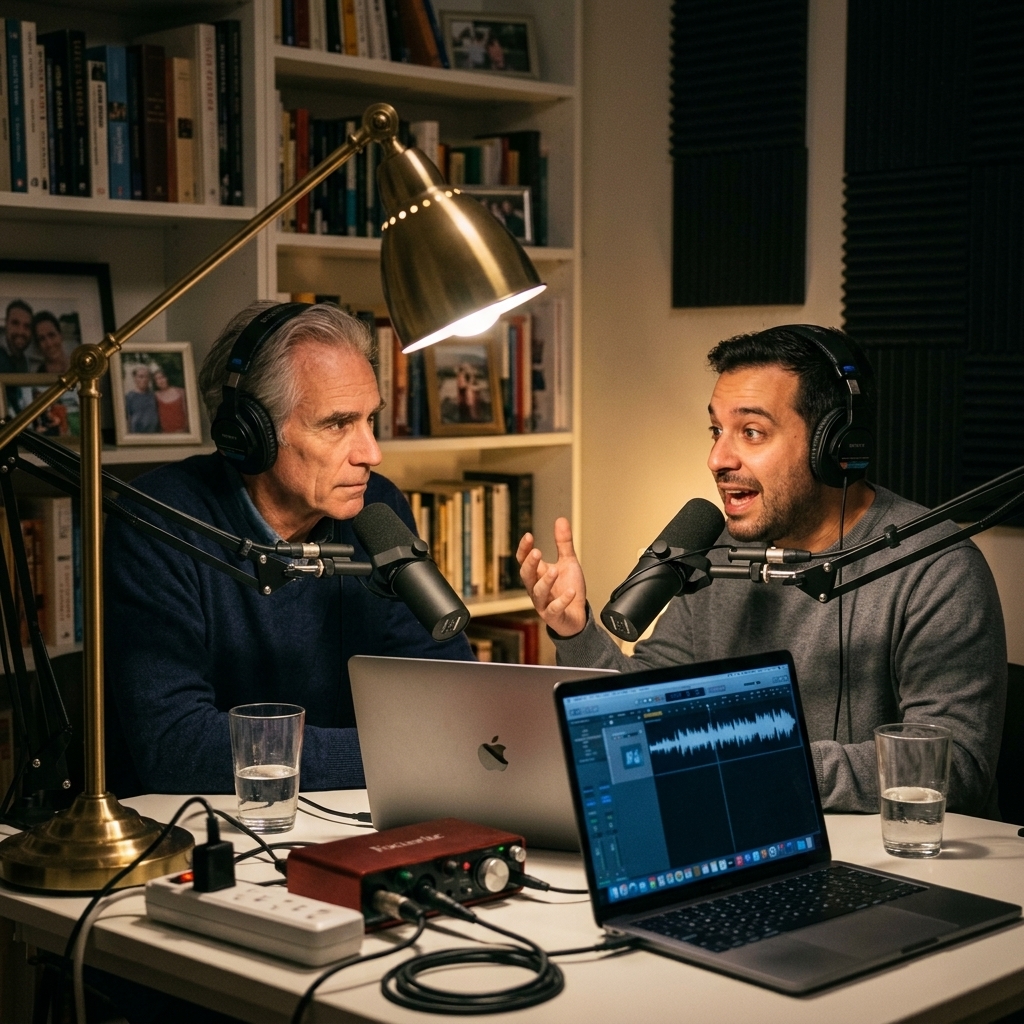
Fletcher breaks down this story in English. Octavio reacts and expands in Spanish. Follow along with the live transcript, tap any word for its translation. Intermediate level — perfect for intermediate learners expanding their range.

So, Octavio.
Five people killed, 170 injured.
Israeli missile strike on a petrochemical complex in Bandar-e Mahshahr, southern Iran.
I want to start with something basic: why a petrochemical plant?
Bueno, mira, Bandar-e Mahshahr no es un lugar cualquiera.
Well, look, Bandar-e Mahshahr is not just any place.
Es una ciudad industrial en la provincia de Khuzestán, y allí está uno de los complejos petroquímicos más grandes del mundo.
It is an industrial city in Khuzestan province, and there sits one of the largest petrochemical complexes in the world.
One of the largest in the world.
I want people to understand the scale of that.
We are not talking about a small factory.
No, para nada.
No, not at all.
El complejo tiene muchas plantas diferentes.
The complex has many different plants.
Producen plásticos, fertilizantes, productos químicos.
They produce plastics, fertilizers, chemical products.
Exportan a Asia, a Europa, a muchos países del mundo.
They export to Asia, to Europe, to many countries around the world.
Right.
And here is what I find striking: this is not a military target in any traditional sense.
This is an industrial and commercial hub.
Attacking it is a choice to hit the economy, not the army.
Exacto.
Exactly.
Y eso es muy importante.
And that is very important.
Cuando un país destruye la industria de otro país, el daño no termina cuando para la guerra.
When a country destroys another country's industry, the damage does not end when the war stops.
El daño continúa muchos años después.
The damage continues for many years afterward.
Let me put some numbers on this.
Iran's petrochemical sector was generating something like twenty-three billion dollars a year in revenue before the current conflict.
It was one of the few parts of the economy still producing real export income despite years of sanctions.
Sí, y es que las sanciones ya hicieron mucho daño al petróleo iraní.
Yes, and the thing is that sanctions already did a lot of damage to Iranian oil.
Pero la petroquímica era diferente, porque los productos químicos son más difíciles de controlar.
But petrochemicals were different, because chemical products are harder to control.
Iran encontró compradores en China, en la India, en muchos países de Asia.
Iran found buyers in China, in India, in many countries in Asia.
So petrochemicals became a kind of escape valve.
When the oil sanctions bit hard, Iran pivoted, and Bandar-e Mahshahr was central to that pivot.
Exactamente.
Exactly.
La ciudad es especial porque está cerca del Golfo Pérsico.
The city is special because it is close to the Persian Gulf.
Los barcos pueden cargar los productos directamente.
Ships can load the products directly.
Es muy conveniente para exportar.
It is very convenient for exporting.
The geography matters enormously.
I covered a story in the nineties about how port access determines economic power in ways that maps rarely make obvious.
You lose the port, or you lose the facility next to the port, and the whole chain breaks.
Bueno, y eso fue exactamente lo que pasó en la guerra entre Irán e Irak en los años ochenta.
Well, and that is exactly what happened in the war between Iran and Iraq in the nineteen eighties.
Khuzestán fue una zona de combate durante ocho años.
Khuzestan was a combat zone for eight years.
Destruyeron mucha infraestructura industrial en esa región.
They destroyed a great deal of industrial infrastructure in that region.
The Iran-Iraq War.
Eight years of brutal fighting, and Khuzestan was the main battleground.
That war ended in 1988 and it took Iran more than a decade to rebuild those facilities.
Here we are again.
Sí, y la gente de Khuzestán lo sabe.
Yes, and the people of Khuzestan know it.
Esa región tiene petróleo, tiene industria, pero también tiene mucha memoria de la guerra.
That region has oil, it has industry, but it also has a long memory of war.
Muchos iranios de esa zona son árabes, no persas.
Many Iranians from that area are Arabs, not Persians.
Es una región muy compleja.
It is a very complex region.
That ethnic dimension is important and I am glad you raised it.
Khuzestan has an Arab minority that has historically felt marginalized by Tehran.
There have been protests there, even before this war.
Hitting that region sends multiple messages at once.
A ver, sí, pero yo creo que el objetivo principal es económico.
Look, yes, but I think the main objective is economic.
Israel quiere debilitar la capacidad de Irán para financiar la guerra.
Israel wants to weaken Iran's capacity to finance the war.
Sin dinero, es más difícil comprar armas y pagar a los aliados.
Without money, it is harder to buy weapons and pay allies.
No, you are absolutely right about that.
This is a strategy with a name: economic warfare.
And it has a long, complicated history.
The idea is that if you strangle the enemy's economy hard enough, you either force them to negotiate or you cause enough internal pressure that the government loses support.
Mira, pero la historia también muestra que eso no siempre funciona.
Look, but history also shows that does not always work.
Las sanciones contra Irán empezaron en 1979.
Sanctions against Iran started in 1979.
Cuarenta y siete años después, el gobierno todavía existe.
Forty-seven years later, the government still exists.
Forty-seven years.
That is a genuinely striking number.
I have interviewed economists who spent careers studying Iran sanctions, and the consistent finding is that they impose real pain on ordinary people while the political elite finds ways to adapt.
Which raises a question: who actually suffers when you bomb a petrochemical plant?
Los trabajadores, claro.
The workers, of course.
En Bandar-e Mahshahr, mucha gente trabaja en los complejos.
In Bandar-e Mahshahr, many people work in the complexes.
Son ingenieros, técnicos, obreros.
They are engineers, technicians, workers.
Ayer murieron cinco personas y 170 resultaron heridas.
Yesterday five people died and 170 were injured.
Esas personas no son militares.
Those people are not military.
And that civilian toll is part of what makes this kind of targeting so morally contested.
Look, I spent years covering conflicts where this exact debate played out.
Is infrastructure a legitimate military target?
International law says it depends on whether it contributes directly to the war effort.
La verdad es que esa línea es muy difícil de definir.
The truth is that line is very hard to define.
El dinero de la petroquímica va al gobierno iraní.
The money from petrochemicals goes to the Iranian government.
El gobierno usa ese dinero para pagar la guerra.
The government uses that money to pay for the war.
Entonces, ¿es un objetivo militar o no?
So, is it a military target or not?
That is exactly the logic Israel is using, and it is the same logic that has been used to justify targeting power grids, bridges, and water treatment facilities in every major conflict of the last thirty years.
Once you accept the principle, it covers almost everything.
Es que exactamente.
Exactly that.
Y eso es peligroso.
And that is dangerous.
Porque si todos los países aceptan esa lógica, entonces en una guerra todo es un objetivo posible.
Because if all countries accept that logic, then in a war everything is a possible target.
Las fábricas, los puertos, las escuelas que tienen paneles solares.
Factories, ports, schools that have solar panels.
Right.
And there is a second-order business story here that I think gets missed.
Bandar-e Mahshahr does not just supply Iran.
Those chemical products go into global supply chains.
Plastics, fertilizers, polymers.
Companies in Europe and Asia that depended on Iranian materials now have a problem.
Bueno, sí, pero muchas empresas europeas ya no compraban materiales iraníes directamente por las sanciones.
Well, yes, but many European companies were already not buying Iranian materials directly because of sanctions.
Compraban a través de intermediarios en China o en Turquía.
They bought through intermediaries in China or Turkey.
Ahora esos intermediarios también tienen un problema.
Now those intermediaries also have a problem.
The shadow supply chain.
I mean, this is one of those things that sanctions experts talk about constantly.
You ban direct trade, so everything goes underground, routed through third countries, rebranded, reshipped.
It becomes very hard to trace.
Y ahora esas rutas también están en peligro porque el Estrecho de Ormuz está casi cerrado.
And now those routes are also in danger because the Strait of Hormuz is almost closed.
Los barcos no pueden pasar fácilmente.
Ships cannot pass easily.
Es una crisis económica en muchas direcciones al mismo tiempo.
It is an economic crisis in many directions at the same time.
Here is what gets me about the fertilizer angle specifically.
Iran was a significant producer of urea and ammonia-based fertilizers.
Those go to agricultural markets.
Farmers in South Asia, in parts of Africa, depended on that supply.
When the plant burns, food prices somewhere else go up.
A ver, sí.
Look, yes.
Y eso es algo que la gente no piensa cuando ve las noticias de un bombardeo.
And that is something people do not think about when they see the news of a bombing.
Ven el fuego y piensan en la guerra.
They see the fire and think about the war.
Pero no piensan en el agricultor en Bangladesh que no puede comprar fertilizante el año próximo.
But they do not think about the farmer in Bangladesh who cannot buy fertilizer next year.
And this is not hypothetical.
I remember covering the aftermath of sanctions on Iraqi petrochemical production in the nineties.
The effects rippled in directions nobody anticipated.
Commodity markets are deeply interconnected, and they do not care about geopolitics.
They just reprice.
La verdad es que el mercado de los productos químicos ya cambió mucho en los últimos años por las sanciones.
The truth is that the chemical products market already changed a lot in recent years because of sanctions.
Muchos países buscaron nuevos proveedores.
Many countries searched for new suppliers.
Arabia Saudita, Qatar, los Emiratos, todos expandieron su producción petroquímica.
Saudi Arabia, Qatar, the Emirates, all expanded their petrochemical production.
The extraordinary thing is that the Gulf states, who are Iran's rivals, actually benefited commercially from sanctions on Iran.
Their petrochemical industries grew precisely because Iran was excluded from markets.
Now that Iran's physical infrastructure is being destroyed, that competitive advantage deepens.
Sí, y eso es geopolítica y negocios al mismo tiempo.
Yes, and that is geopolitics and business at the same time.
No puedes separar las dos cosas.
You cannot separate the two things.
Cuando Israel destruye una fábrica iraní, también ayuda a los competidores comerciales de Irán en el Golfo.
When Israel destroys an Iranian factory, it also helps Iran's commercial competitors in the Gulf.
Eso no es un accidente.
That is not an accident.
I want to think about what reconstruction looks like, if and when this war ends.
Because Bandar-e Mahshahr was built over decades.
These plants represent billions in capital investment, specialized equipment, trained workers.
You cannot rebuild that in a year.
Exacto.
Exactly.
Después de la guerra con Irak en los años ochenta, Irán tardó más de diez años en reconstruir Khuzestán.
After the war with Iraq in the nineteen eighties, Iran took more than ten years to rebuild Khuzestan.
Y en esa época no había sanciones internacionales.
And in that era there were no international sanctions.
Ahora las condiciones son mucho peores.
Now the conditions are much worse.
So the economic damage could last a generation.
And that has political consequences inside Iran too.
A government that cannot provide jobs, that cannot rebuild industry, that presides over a ruined economy, faces a different kind of pressure from its own population.
Mira, sí, pero la historia de Irán también muestra que el gobierno puede usar la narrativa de la agresión extranjera para mantener el poder.
Look, yes, but Iran's history also shows that the government can use the narrative of foreign aggression to maintain power.
Cuando un país sufre ataques, muchas veces la gente apoya más al gobierno, no menos.
When a country suffers attacks, many times people support the government more, not less.
The rally-around-the-flag effect.
You see it everywhere.
The question is always how long it lasts.
In Iran's case, there was already significant public disillusionment before this war started.
Young people, women, the working class, they were already in the streets over economic grievances.
This war complicates that picture in ways that are very hard to predict.
Bueno, y mientras tanto, los trabajadores de Bandar-e Mahshahr perdieron su trabajo, sus familias perdieron su dinero, y nadie sabe cuándo van a poder reconstruir.
Well, and meanwhile, the workers of Bandar-e Mahshahr lost their jobs, their families lost their income, and nobody knows when they will be able to rebuild.
Eso es lo que significa una guerra económica para las personas reales.
That is what economic war means for real people.
That is the thing that always stays with me from thirty years of covering conflict.
The headlines are about missiles and strategy.
But in the weeks after, you find the people who used to work in the building that is now rubble, and that is a completely different story.
La verdad es que esa es la historia más importante.
The truth is that is the most important story.
No el misil.
Not the missile.
No el complejo.
Not the complex.
Sino las personas que vivían de ese complejo.
But the people who depended on that complex for their living.
Ellos no decidieron la guerra, pero ellos pagan el precio.
They did not decide the war, but they pay the price.
Bandar-e Mahshahr.
Five dead, 170 injured, a major industrial complex on fire.
And somewhere in the accounting of this war, that becomes a line item in an economic strategy.
That tension, between strategy and the people inside it, is something worth sitting with.
Thanks for listening to Twilingua.
Gracias.
Thank you.
Y la próxima vez que compres un producto de plástico, recuerda que viene de algún lugar, y ese lugar tiene una historia.
And the next time you buy a plastic product, remember that it comes from somewhere, and that somewhere has a history.