A2 · Elementary
7 min
food securityenvironmentconflictrussia
The Oil Rain: Food and the Land
La Lluvia de Petróleo: La Comida y la Tierra
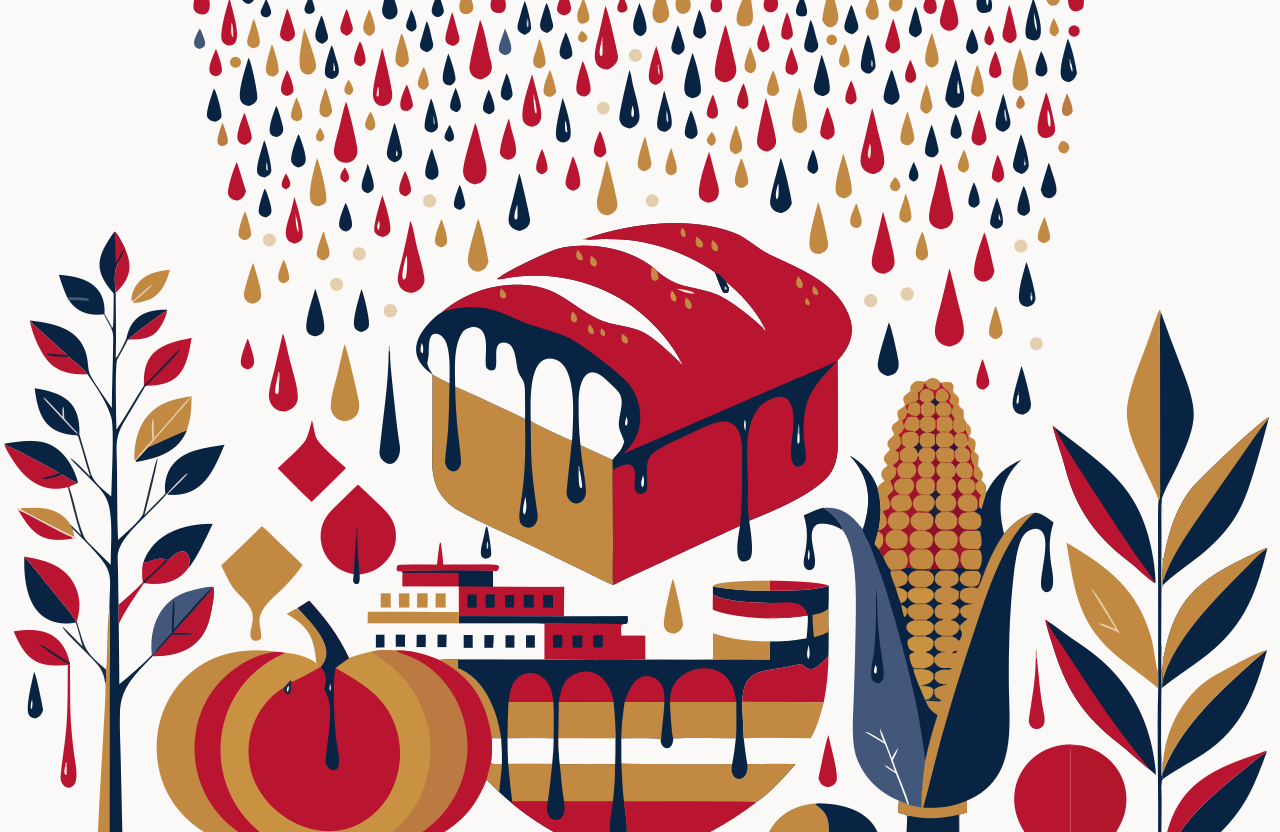
In Tuapse, Russia, residents filmed oil falling from the sky after a massive fire at an oil terminal. Fletcher and Octavio dig into what that means for food, land, and the people who depend on both.
En Tuapse, Rusia, los residentes graban videos de petróleo cayendo del cielo después de un incendio enorme en una terminal de petróleo. Fletcher y Octavio hablan sobre qué significa esto para la comida, la tierra y la gente.


6 essential A2-level terms from this episode, with translations and example sentences in Spanish.
| Spanish | English | Example |
|---|---|---|
| el petróleo | oil / petroleum | El petróleo cae del cielo en Tuapse. |
| la tierra | the land / the soil / the earth | La tierra da comida a la gente. |
| el cultivo | the crop / the harvest | Los cultivos de trigo son importantes en Rusia. |
| dar | to give | El árbol da fruta en el verano. |
| sucio / sucia | dirty / contaminated | El agua está sucia después del incendio. |
| seguro / segura | safe | No sé si la comida es segura. |
There's a video going around this week that I genuinely could not look away from.
People in a Russian city standing outside, holding out their hands, and oil is falling on them.
From the sky.
Like rain.
Sí.
Yes.
Es Tuapse.
It's Tuapse.
Hay un incendio grande.
There's a big fire.
La terminal de petróleo arde.
The oil terminal is burning.
The fire's been extinguished now, apparently.
But not before days of burning, and not before whatever was in that smoke and that fallout came down on the rooftops and the gardens and the people of Tuapse.
La gente dice: el agua está sucia.
The people say: the water is dirty.
El aire huele mal.
The air smells bad.
And that's where the food angle hits.
Because Tuapse is not just some industrial town in a vacuum.
It sits in Krasnodar Krai.
Which is, if you know anything about Russian geography, the most important agricultural region in the country.
Correcto.
Correct.
Krasnodar tiene mucho trigo.
Krasnodar has a lot of wheat.
Tiene girasoles.
It has sunflowers.
Tiene uvas también.
It has grapes too.
Right, this is Russia's breadbasket.
Wheat, corn, sunflowers, wine grapes, fruit orchards.
The Soviets called it the granary of the nation, and it still earns that name.
El aceite de girasol viene de aquí.
Sunflower oil comes from here.
Mucho aceite de girasol.
A lot of sunflower oil.
And that matters globally, not just locally.
Russia and Ukraine together produce somewhere around sixty percent of the world's sunflower oil.
So when this region is in trouble, it's not a local problem.
El petróleo en la tierra es muy malo.
Oil in the soil is very bad.
Los cultivos mueren.
The crops die.
Walk me through that a bit.
When petroleum residue falls on agricultural land, what actually happens to the soil?
El petróleo bloquea el agua.
Oil blocks water.
Las plantas no pueden beber.
The plants can't drink.
Y los químicos entran en la comida.
And the chemicals enter the food.
So you can have contamination that works its way up the food chain without anyone seeing it.
The wheat looks fine, the sunflower looks fine, but what's inside it is not fine.
Sí.
Yes.
Y los animales también comen la hierba.
And the animals also eat the grass.
La leche puede ser mala.
The milk can be bad.
That's a detail that doesn't make the headlines but it should.
Dairy herds grazing on contaminated pasture.
That enters the food supply quietly, invisibly.
And I keep thinking of Chernobyl, because that's exactly what happened there.
Chernóbil es diferente.
Chernobyl is different.
Pero sí, la idea es igual.
But yes, the idea is the same.
La contaminación invisible.
The invisible contamination.
After Chernobyl, the Soviet government kept selling food from the contaminated zone for months.
Because telling the truth would have meant admitting the scale of the disaster.
And I wonder how much of that playbook is still in use.
En Rusia ahora, la información es difícil.
In Russia now, information is difficult.
El gobierno no dice todo.
The government doesn't say everything.
Which is the core problem, isn't it.
The people of Tuapse are uploading videos to social media because that's the only channel they have left.
The official line is: fire's out, everything's fine.
And the people are standing there with black hands.
La gente tiene miedo.
The people are afraid.
No saben si el agua es segura.
They don't know if the water is safe.
No saben si la comida es segura.
They don't know if the food is safe.
And that fear itself changes behavior.
People stop buying local produce.
Farmers can't sell what they've grown.
Markets freeze.
Even if ninety percent of the land is fine, the doubt poisons the whole economy.
Sí.
Yes.
El mercado local pierde dinero.
The local market loses money.
Los agricultores son pobres ahora.
The farmers are poor now.
Let's pull the lens back a bit further.
This terminal is at the port of Tuapse on the Black Sea.
It's been one of Russia's primary oil export hubs.
There's an argument to be made that it's a legitimate military target in the context of this war.
Does that complicate how you think about this?
Es complicado, sí.
It's complicated, yes.
La guerra destruye cosas importantes.
War destroys important things.
La comida también sufre en la guerra.
Food also suffers in war.
There's a very long history of food being a weapon of war.
Not just as a target but as a deliberate tool.
Sieges, blockades, scorched earth.
Stalin used hunger as a weapon against Ukraine in the early 1930s.
The Holodomor.
And it killed millions.
El Holodomor es terrible.
The Holodomor is terrible.
Ucrania recuerda esto.
Ukraine remembers this.
Es importante para los ucranianos.
It is important for Ukrainians.
And now that same agricultural region, Ukraine and southern Russia, is once again at the center of a conflict that's affecting food supplies globally.
Grain prices spiked after 2022.
Poorer countries in the Middle East and North Africa felt it immediately.
En España, el pan también es más caro.
In Spain, bread is also more expensive.
La gente lo nota en el supermercado.
People notice it at the supermarket.
You feel a war in the bread aisle.
That's not a metaphor, that's economics.
The connection between a missile strike on a Black Sea port and what someone pays for a loaf in Madrid is real and direct.
Y el aceite de girasol.
And sunflower oil.
En España usamos mucho aceite.
In Spain we use a lot of oil.
El precio sube.
The price goes up.
The olive oil situation in Spain has been its own crisis the last couple of years, and then sunflower oil prices on top of that.
Ordinary families making dinner are absorbing the cost of a war they didn't start.
Exacto.
Exactly.
La gente normal paga el precio.
Normal people pay the price.
No los gobiernos.
Not the governments.
La gente.
The people.
What strikes me about the Tuapse footage is how immediate it makes this.
It's not abstract.
It's a person holding out their hand and watching black liquid fall into their palm.
And you realize: that person probably grows something.
Or knows someone who does.
Or eats something grown nearby.
La comida conecta a la gente con la tierra.
Food connects people to the land.
Siempre.
Always.
En todos los países.
In every country.
That's well put.
And it's something that gets lost when we talk about food as a commodity or a supply chain.
At the end of every supply chain there's a patch of ground and someone who works it.
En español decimos: "la tierra da la vida".
In Spanish we say: "the land gives life".
La tierra es muy importante.
The land is very important.
La tierra da la vida.
The land gives life.
I like that.
Though I notice you said "da" there, not "tiene" or "produce." Is that a fixed expression or just how you'd say it naturally?
"Dar" es dar un regalo.
"Dar" is to give a gift.
La tierra da comida, da agua, da vida.
The land gives food, gives water, gives life.
Es un regalo.
It is a gift.
So "dar" carries this generosity in it.
The land doesn't just produce, it gives.
English has that too but we don't reach for it as naturally.
We'd more often say the land produces, or yields.
"Gives" feels almost poetic in English.
In Spanish it's just...
the normal word?
Sí, es normal.
Yes, it's normal.
"El árbol da fruta." "El mar da pescado." Es natural.
"The tree gives fruit." "The sea gives fish." It is natural.
And I suppose when oil falls from the sky onto that tree, onto that sea, the gift stops.
That's the whole story in one verb.
Alright, Octavio, "dar." The land gives.
Until someone takes that away.
Exacto.
Exactly.
Y la gente de Tuapse necesita respuestas.
And the people of Tuapse need answers.
No palabras.
Not words.
Respuestas.
Answers.