A2 · Elementary
14 min
culturehistorypoliticsreligionwar
The Cross and the Cedar: Lebanon and the Culture That Is Disappearing
La Cruz y el Cedro: El Líbano y la Cultura que Desaparece
An Israeli airstrike kills Pierre Mouawad, a Lebanese Christian politician, in Ain Saadeh, a Christian town near Beirut. Today we talk about Lebanon's unique cultural identity, its religious communities, and what is lost when war destroys a place like this.
Un ataque israelí mata a Pierre Mouawad, un político cristiano libanés, en Ain Saadeh, una ciudad cristiana cerca de Beirut. Hoy hablamos sobre la identidad cultural única del Líbano, sus comunidades religiosas, y lo que se pierde cuando la guerra destruye un lugar así.
10 essential A2-level terms from this episode, with translations and example sentences in Spanish.
| Spanish | English | Example |
|---|---|---|
| comunidad | community | El Líbano tiene muchas comunidades religiosas. |
| religioso | religious | Hay grupos religiosos muy diferentes en el Líbano. |
| guerra | war | La guerra es muy terrible para la gente. |
| cultura | culture | La cultura libanesa es muy rica y antigua. |
| famoso | famous | Fairuz es una cantante muy famosa en el mundo árabe. |
| bandera | flag | La bandera del Líbano tiene un árbol verde. |
| paz | peace | El Líbano necesita paz para vivir bien. |
| desplazado | displaced person | Hay muchas personas desplazadas en el Líbano ahora. |
| árbol | tree | El cedro es un árbol muy importante en el Líbano. |
| historia | history | El Líbano tiene una historia muy larga. |
So, this week, an Israeli airstrike hit a town called Ain Saadeh, just east of Beirut.
It killed a Lebanese Forces Party official named Pierre Mouawad, his wife, and another woman.
And the detail that stopped me cold: Ain Saadeh is a predominantly Christian town.
Sí.
Yes.
El Líbano tiene muchas comunidades religiosas.
Lebanon has many religious communities.
Right, and that's what I want to dig into today, because I don't think most people outside the region really grasp how extraordinary that is.
Lebanon has eighteen officially recognized religious communities.
Eighteen.
In a country smaller than Connecticut.
Bueno, hay cristianos, musulmanes y drusos en el Líbano.
Well, there are Christians, Muslims, and Druze in Lebanon.
And the Christians themselves are split into several groups.
The biggest are the Maronites, who are Catholic but have their own rite, their own liturgy, their own patriarch.
They've been in those mountains since the fifth century.
I spent time in Beirut in the nineties and the Maronite neighborhoods felt genuinely different, architecturally, culturally, from the rest of the city.
Mira, los maronitas son muy importantes en el Líbano.
Look, the Maronites are very important in Lebanon.
They are.
And the Lebanese Forces Party, the party Pierre Mouawad belonged to, is a Christian party, explicitly anti-Hezbollah.
So here you have a Christian Lebanese politician, in a Christian town, killed by Israel, which is supposedly targeting Hezbollah.
The irony is brutal.
Es que muchos libaneses no apoyan a Hezbolá.
The thing is, many Lebanese people do not support Hezbollah.
No, you're absolutely right about that.
And that's the thing that gets lost in the coverage.
Lebanon is not a monolith.
You have Christians who despise Hezbollah, Sunni Muslims who despise Hezbollah, Druze who want nothing to do with any of it.
The country is being punished collectively for the actions of one armed faction.
A ver, el Líbano es un país muy pequeño pero muy complejo.
Let's see, Lebanon is a very small but very complex country.
Incredibly complex.
And the complexity is built into the constitution.
In 1943, when Lebanon got independence from France, the different communities signed what they called the National Pact.
It wasn't a written document, it was a gentlemen's agreement: the president will always be Maronite Christian, the prime minister will always be Sunni Muslim, the speaker of parliament will always be Shia Muslim.
La verdad es que este sistema es muy difícil.
The truth is that this system is very difficult.
Difficult is one word for it.
Political scientists call it confessionalism.
The idea is that every religious community gets a guaranteed share of political power.
In theory it sounds generous.
In practice it creates a system where your religion determines your politics before you're even born, and where reform is almost impossible because every community fears losing its protected slice.
Bueno, pero la cultura libanesa es también muy rica.
Well, but Lebanese culture is also very rich.
Phenomenally rich.
And this is what I keep coming back to.
Beirut, before the civil war, was genuinely one of the most cosmopolitan cities in the world.
People called it the Paris of the Middle East, which is a cliché, but like most clichés it has a real core of truth.
Publishing houses, universities, fashion, food, music, a press that was genuinely free.
Mira, la comida libanesa es famosa en todo el mundo.
Look, Lebanese food is famous all over the world.
It really is.
Hummus, tabbouleh, kibbeh, fattoush, that extraordinary bread.
I remember eating mezze on a rooftop in Gemmayzeh, which is this old neighborhood of Beirut, and thinking: this is one of the great food cultures on earth.
And the extraordinary thing is how much of it has spread globally through the Lebanese diaspora.
Hay muchos libaneses en todo el mundo.
There are many Lebanese people all over the world.
The numbers are staggering.
There are roughly four million people in Lebanon itself.
But the Lebanese diaspora, worldwide, is estimated at somewhere between eight and fourteen million people, depending on who you count.
Brazil alone has the largest Lebanese community outside Lebanon.
Carlos Slim, who was for a while the richest man in the world, is of Lebanese descent.
Es que los libaneses viajan mucho por el trabajo.
The thing is, Lebanese people travel a lot for work.
They always have.
The Phoenicians, the ancient people of what is now Lebanon, were the great maritime traders of the ancient Mediterranean.
They went everywhere.
They founded Carthage, which is now Tunisia.
They're sometimes credited with spreading the alphabet to the Greeks.
There's a continuity in Lebanese culture, this outward orientation, this comfort with the wider world, that goes back thousands of years.
A ver, los fenicios son parte de la historia del Líbano.
Let's see, the Phoenicians are part of Lebanon's history.
Central to it.
And modern Lebanese are very conscious of that heritage.
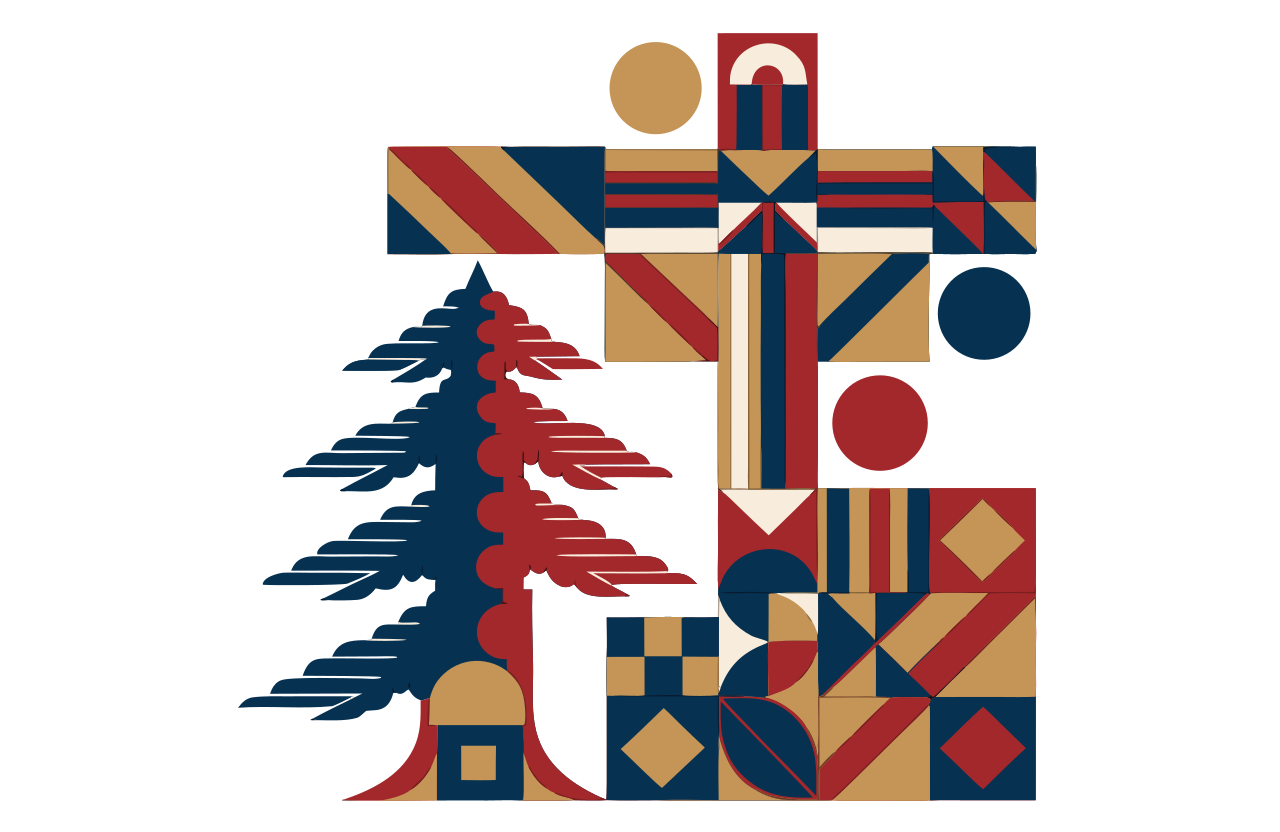
The cedar tree on the Lebanese flag comes from the famous Cedars of Lebanon, mentioned in the Bible, in the Epic of Gilgamesh.
These were used to build Solomon's Temple.
The Egyptians imported Lebanese cedar for their ships.
It's a symbol that carries an enormous weight of history.
La bandera del Líbano tiene un árbol verde.
The flag of Lebanon has a green tree.
It does.
A cedar, on a white background with two red stripes.
It's one of the most distinctive flags in the world.
But here's what gets me: the Lebanon that flag represents, this idea of a shared home for all these different communities, is under the most severe stress it has faced since the civil war of the 1970s and 80s.
Bueno, la guerra civil fue muy terrible para el Líbano.
Well, the civil war was very terrible for Lebanon.
Fifteen years, from 1975 to 1990.
Something like 120,000 people killed, a million displaced.
And the city of Beirut literally divided by a front line, the Green Line, into Christian east and Muslim west.
I've talked to Lebanese people who grew up during that period and what strikes you is the sheer normalization of violence.
Schools open, schools close, you study when you can, you run when you hear shooting.
Es que la gente en el Líbano es muy fuerte.
The thing is, people in Lebanon are very strong.
Resilient is almost an understatement.
Beirut rebuilt itself after the civil war.
Then it was devastated again by the 2006 war with Israel.
Then the 2020 port explosion, which was one of the largest non-nuclear explosions in history, killed over 200 people and destroyed the port district.
And now this.
The Lebanese government says there are 1.2 million displaced people in the country right now.
Mira, 1.2 millones es un número muy grande.
Look, 1.2 million is a very big number.
In a country of four million people, that's roughly one in three.
Think about what that does to a culture.
Your restaurants are closed.
Your schools are evacuated.
Your neighborhoods, the ones that define who you are, the Christian quarter, the Armenian quarter in Bourj Hammoud, the old Druze villages in the Shouf mountains, they're emptying out.
A ver, los armenios también viven en el Líbano.
Let's see, Armenians also live in Lebanon.
They do.
And that's another extraordinary layer of this story.
The Armenian community in Lebanon arrived mostly after the Armenian Genocide of 1915.
The Ottoman Empire killed somewhere between 600,000 and 1.5 million Armenians.
Survivors fled to the surrounding Arab lands, including what became Lebanon.
And Lebanon took them in.
Gave them citizenship eventually.
You've been to Beirut, right?
Sí, Beirut es una ciudad muy especial para mí.
Yes, Beirut is a very special city for me.
What was your impression?
The first time you went?
La verdad es que la gente habla francés, árabe e inglés en la misma frase.
The truth is that people speak French, Arabic, and English in the same sentence.
That code-switching.
Yes.
It's called Arabizi sometimes, this blend of Arabic, French, and English that educated Beirutis move between effortlessly.
And it comes directly from history.
Lebanon was under French mandate from 1920 to 1943.
Before that, Ottoman.
Before that, part of various empires going back to the Assyrians, the Persians, Alexander the Great, Rome.
Every layer left something.
Bueno, el francés es muy importante en la cultura del Líbano.
Well, French is very important in Lebanese culture.
It really is.
The Maronite church had strong ties to France going back centuries.
France considered itself the protector of eastern Christians, which is partly why it got the mandate after World War One.
And the French educational model took deep root.
The American University of Beirut and the French Université Saint-Joseph are both there, and both are genuinely excellent institutions.
Sí, las universidades en el Líbano son muy buenas.
Yes, the universities in Lebanon are very good.
Which makes the cultural loss even more acute.
Look, I've covered a lot of wars.
One thing that takes decades to rebuild, if it ever rebuilds, is intellectual life.
The professors who leave, the students who emigrate, the publishing houses that close.
And Lebanon's brain drain has been catastrophic even before this war.
The 2020 port explosion accelerated it enormously.
Es que muchos jóvenes libaneses viven en otros países ahora.
The thing is, many young Lebanese people live in other countries now.
And here's the cruel paradox.
The Lebanese diaspora has historically been a cultural lifeline.
Money sent home from Brazil, Australia, the Gulf, West Africa.
But when the diaspora becomes the only viable option for educated young Lebanese, you're not just losing people.
You're hollowing out the civic infrastructure that a culture needs to function.
La verdad es que el Líbano necesita paz para vivir bien.
The truth is that Lebanon needs peace to live well.
It does.
And the tragedy is that Lebanon keeps being used as a battlefield by other people's wars.
The PLO was based there.
Syria intervened.
Israel invaded twice, 1982 and 2006.
Iran funds Hezbollah.
The Lebanese themselves, ordinary people who just want their children to go to school, are almost incidental to all of it.
A ver, la gente normal en el Líbano no quiere guerra.
Let's see, ordinary people in Lebanon do not want war.
Of course not.
And the killing of Pierre Mouawad is a precise symbol of that.
He was anti-Hezbollah.
He was part of a party that represents the Christian community's desire for sovereignty, for a Lebanon free of Iranian influence.
And he was killed by Israel, which is also supposedly fighting Iranian influence.
There's a logic to this war that crushes people who are caught in the middle.
Mira, los cristianos libaneses tienen una historia muy larga en ese lugar.
Look, Lebanese Christians have a very long history in that place.
Sixteen centuries, at minimum.
The Maronite church traces itself to Saint Maron, a fourth century monk.
These communities have survived Crusaders, Ottomans, the French, multiple civil wars.
And the cultural memory is long.
You hear this phrase in Lebanon: 'We've seen worse.' It's both a source of strength and an indictment of everything they've been put through.
Bueno, la música libanesa también es muy importante.
Well, Lebanese music is also very important.
Fairuz.
If there's one name that encapsulates Lebanese cultural identity for me, it's Fairuz.
The singer.
She's been called the voice of Lebanon.
She was born in Beirut in 1934, and her music became something that both Christian and Muslim Lebanese communities claimed as their own.
During the civil war, her songs played on both sides of the Green Line.
That's what great art does.
Sí, Fairuz es muy famosa en todo el mundo árabe.
Yes, Fairuz is very famous throughout the Arab world.
In the whole Arab world.
And she's still alive, she's in her nineties.
There's something almost unbearable about the fact that she's lived to see Beirut get to this point again.
I read an interview with her from around 2020, after the port explosion, and even then she said almost nothing publicly.
Her silence had weight.
Es que el arte no puede resolver la guerra.
The thing is, art cannot solve war.
No.
But it can keep a culture alive while everything else falls apart.
And I think that's what we're really talking about today.
The question isn't just who wins this war militarily.
The question is whether Lebanon, as a cultural idea, survives.
Whether this extraordinary experiment in shared living, however imperfect, can hold.
A ver, yo creo que los libaneses no van a olvidar su cultura.
Let's see, I think the Lebanese people will not forget their culture.
I want to believe that too.
The diaspora keeps it alive in São Paulo, in Ivory Coast, in Detroit.
But there's something irreplaceable about a culture in its place.
The food tastes different when you grow the herbs in the same soil.
The church bells mean something different when they're the bells you grew up with.
You can carry a culture in your heart, but you lose something when you can no longer live it on the ground.
La verdad es que el Líbano necesita ayuda internacional.
The truth is that Lebanon needs international help.
It does.
And the world has repeatedly promised that help and repeatedly failed to deliver it in any meaningful way.
After the 2020 port explosion there were enormous pledges of aid, much of which never arrived, or arrived attached to conditions Lebanon's fractured government couldn't meet.
There's a pattern of abandonment here that's hard to ignore.
Mira, el mundo tiene que recordar que el Líbano existe.
Look, the world has to remember that Lebanon exists.
That's it.
That's the sentence.
The world has to remember Lebanon exists.
Not just as a front in a larger war, but as a place with four thousand years of continuous human civilization, with food and music and literature and eighteen different ways of praying that somehow managed, at their best, to sit at the same table.
That's worth remembering.
That's worth protecting.
Bueno, gracias por hablar de esto hoy, Fletcher.
Well, thank you for talking about this today, Fletcher.
Thank you, Octavio.
And to everyone listening, if you take one thing from today: the next time you eat hummus, or hear an oud, or see that cedar on a flag, think about what it represents.
A culture that has survived everything, and is being asked, once again, to survive the unsurvivable.
We'll be back next time.
Keep listening, keep learning.