B1 · Intermediate
16 min
societyurban lifetechnologyeconomicsculturepolitics
La ciudad en venta: el trabajo remoto y el alma de Barcelona y Berlín
The City for Sale: Remote Work and the Soul of Barcelona and Berlin
Fletcher breaks down this story in English. Octavio reacts and expands in Spanish. Follow along with the live transcript, tap any word for its translation. Intermediate level — perfect for intermediate learners expanding their range.


So here's something I've been thinking about since I got back from Barcelona last spring.
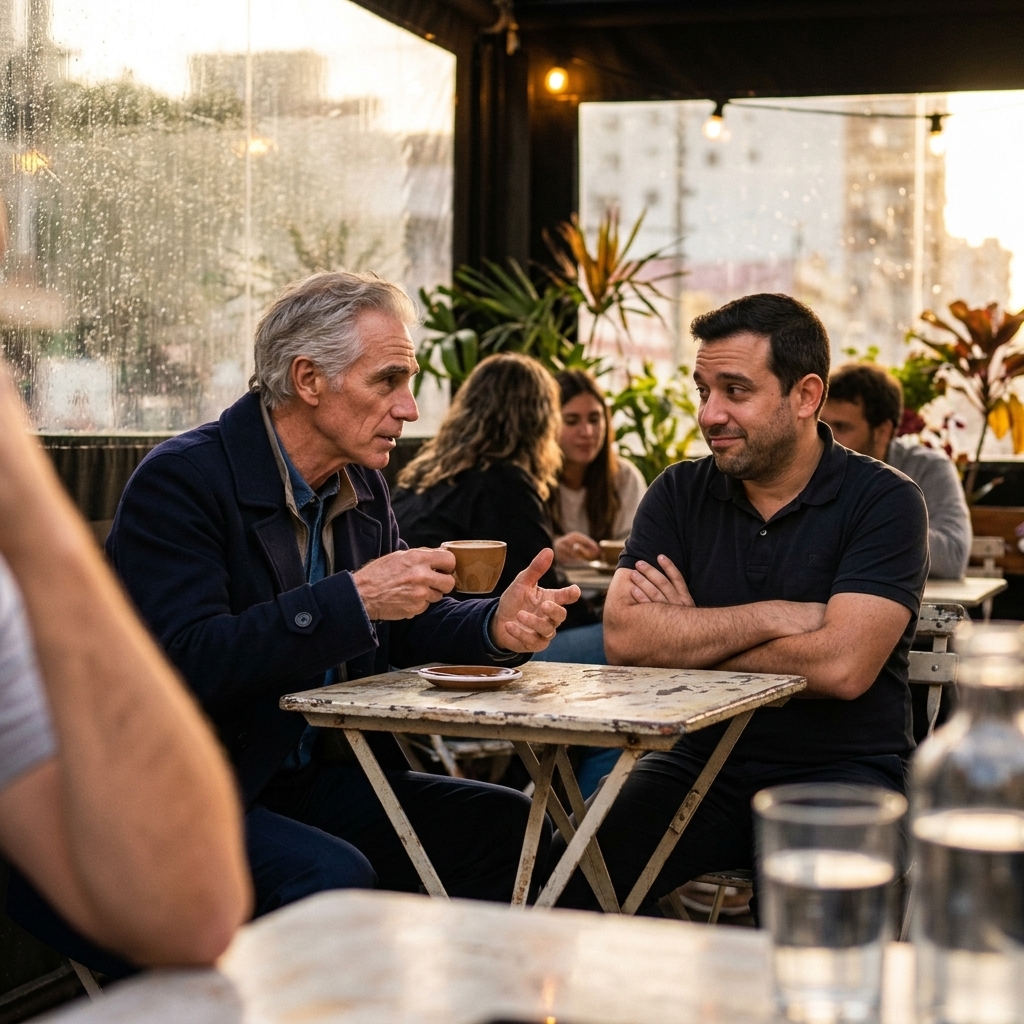
I was walking through El Born, this neighborhood I've loved for twenty years, and I counted eleven different people sitting in cafes with laptops, all of them speaking English or German or Dutch.
Not a single local in sight.
Bueno, eso es muy normal ahora.
Well, that's very normal now.
El Born era un barrio de trabajadores, de gente de Barcelona.
El Born used to be a working-class neighborhood, a neighborhood for people from Barcelona.
Pero en los últimos diez años cambió completamente.
But in the last ten years it changed completely.
Ahora es un barrio para turistas y para nómadas digitales.
Now it's a neighborhood for tourists and digital nomads.
And that transformation, that's what we're getting into today.
Remote work didn't just change how we work.
It changed where we live, and what that does to the cities on the receiving end.
We're using Barcelona and Berlin as our two main cases, but this is really a story about every city that became desirable.
Mira, es importante entender que esto no empezó con la pandemia.
Look, it's important to understand that this didn't start with the pandemic.
Antes de 2020, ya había muchos extranjeros en Barcelona con sus ordenadores.
Before 2020, there were already a lot of foreigners in Barcelona with their laptops.
Pero la pandemia fue como...
But the pandemic was like an accelerator.
un acelerador.
Everything happened much faster.
Todo pasó mucho más rápido.
Right, and the numbers back that up.
Barcelona went from roughly 17,000 registered digital nomads in 2019 to something like 100,000 by 2023.
That's not a trend, that's a rupture.
Sí, y en Berlín fue similar.
Yes, and in Berlin it was similar.
Berlín era famosa porque era barata, creativa, diferente.
Berlin was famous for being cheap, creative, different.
Muchos artistas y músicos vivían allí porque el alquiler era muy bajo.
Many artists and musicians lived there because the rent was very low.
Pero eso cambió mucho.
But that changed a lot.
Let's actually go back a bit, because the history of both cities matters here.
Barcelona and Berlin share something unusual.
Both were, at different points in the twentieth century, cities that were cut off, politically isolated, economically stressed.
And in both cases, that stress produced something culturally extraordinary.
Bueno, en el caso de Barcelona, durante la dictadura de Franco, la ciudad no tenía mucha libertad.
Well, in Barcelona's case, during Franco's dictatorship, the city didn't have much freedom.
La gente no podía hablar catalán en público, no podía expresar su cultura.
People couldn't speak Catalan in public, couldn't express their culture.
Pero cuando llegó la democracia, después de 1975, Barcelona explotó de energía.
But when democracy arrived, after 1975, Barcelona exploded with energy.
The Movida, that whole cultural explosion, and then the 1992 Olympics, which essentially remade the city's infrastructure and self-image.
Barcelona went from being an industrial port city with a complicated political identity to being, almost overnight, one of the most desirable cities in Europe.
Exacto.
Exactly.
Los Juegos Olímpicos fueron un momento muy importante.
The Olympic Games were a very important moment.
Barcelona abrió su frente al mar, construyó nuevos barrios, nuevas carreteras.
Barcelona opened up its waterfront, built new neighborhoods, new roads.
La ciudad se transformó.
The city transformed itself.
Y después de los Juegos, los turistas empezaron a llegar.
And after the Games, tourists started arriving.
Primero pocos, después muchos, después demasiados.
First a few, then many, then too many.
And Berlin has a parallel story, though completely different in texture.
The Wall comes down in 1989, the city is reunified, and suddenly there are vast swaths of East Berlin, formerly state-owned buildings and empty lots, essentially going for nothing.
Artists moved in.
Squatters moved in.
The techno scene happened.
Berghain is literally a former power plant.
A ver, Berlín era una ciudad muy especial.
Look, Berlin was a very special city.
Era pobre pero libre.
It was poor but free.
Los jóvenes europeos fueron allí porque podían vivir con poco dinero y hacer cosas interesantes.
Young Europeans went there because they could live on very little money and do interesting things.
Era diferente de Londres o París, que eran ciudades muy caras.
It was different from London or Paris, which were very expensive cities.
And that cheapness, that scrappy energy, was the magnet.
Which is the first great irony of this whole story.
The thing that made both cities attractive is precisely the thing that gets destroyed when too many people are attracted to them.
Sí, es una contradicción muy grande.
Yes, it's a very big contradiction.
La gente llegó porque era auténtico y barato.
People came because it was authentic and cheap.
Y cuando llegaron muchos, dejó de ser barato.
And when too many came, it stopped being cheap.
Y poco a poco, también dejó de ser auténtico.
And little by little, it also stopped being authentic.
So let's talk about the housing piece, because that's where this gets really concrete and really painful for the people who actually live there.
What does a Barcelona local, someone whose family has been in Gràcia or Poblenou for generations, actually experience when the digital nomads arrive?
Mira, el problema es muy simple.
Look, the problem is very simple.
Un nómada digital gana dinero en euros o en dólares, pero vive en Barcelona.
A digital nomad earns money in euros or dollars, but lives in Barcelona.
Para él, el alquiler es barato porque su salario es de otro país.
For them, the rent is cheap because their salary is from another country.
Pero para una persona de Barcelona, con un salario español, el mismo alquiler es imposible.
For a person from Barcelona, with a Spanish salary, the same rent is impossible.
Right, it's a purchasing power arbitrage.
Someone earning a London or San Francisco salary and paying Barcelona rent is in an almost unfair competition with local earners.
And landlords know this, obviously.
Exacto.
Exactly.
Los propietarios prefieren alquilar a extranjeros porque pagan más y no protestam.
Landlords prefer to rent to foreigners because they pay more and don't complain.
En Barcelona, el alquiler subió más del 60 por ciento en diez años.
In Barcelona, rent went up more than 60 percent in ten years.
Muchos barceloneses tuvieron que salir de sus barrios porque no podían pagar.
Many Barcelona residents had to leave their neighborhoods because they couldn't afford to pay.
Sixty percent.
I mean, that's not a housing market adjusting, that's a displacement event.
You're talking about communities that built those neighborhoods, who gave them their character, being pushed to the periphery.
And the people moving in often don't even know they're part of that process.
Eso es muy importante.
That's very important.
La mayoría de los nómadas digitales no son malas personas.
Most digital nomads aren't bad people.
No llegaron a Barcelona para destruirla.
They didn't come to Barcelona to destroy it.
Llegaron porque es bonita y tiene buen tiempo y buena comida.
They came because it's beautiful and has good weather and good food.
Pero el resultado para los vecinos fue muy negativo.
But the result for the residents was very negative.
And Berlin is almost a textbook case of the same dynamic.
I was there in 2011 and I remember Prenzlauer Berg still had this slightly rough, post-Wall feel.
By 2018 it was strollers and artisanal coffee.
The transformation was total.
La verdad es que en Berlín el proceso fue más lento al principio, pero después fue muy rápido.
The truth is that in Berlin the process was slower at first, but then it was very fast.
Los primeros en llegar fueron artistas y estudiantes europeos.
The first to arrive were European artists and students.
Después llegaron los trabajadores de tecnología, con más dinero.
Then came the tech workers, with more money.
Y cada grupo subió un poco más los precios.
And each group pushed prices up a little more.
There's even a term for this layered displacement.
Sociologists call it secondary gentrification, where the original gentrifiers, who were themselves displacing working-class residents, get displaced in turn by a wealthier wave.
The artists who made Kreuzberg cool got pushed out by the people who came because Kreuzberg was cool.
Es que es casi cómico, si no fuera tan triste.
It's almost comic, if it weren't so sad.
Los artistas que convirtieron Kreuzberg en algo especial ahora no pueden vivir allí.
The artists who made Kreuzberg something special can't live there anymore.
Y los que llegaron después no entienden por qué el barrio era especial.
And the ones who came later don't understand why the neighborhood was special in the first place.
Here's what gets me, though.
Is this actually new?
Cities have always been transformed by migration.
The Irish and Italians transformed New York.
The Turks transformed Berlin in the 1970s.
What makes digital nomads different from any other wave of newcomers?
Bueno, la diferencia es importante.
Well, the difference is important.
Los emigrantes tradicionales llegaron para quedarse, para integrarse, para trabajar en la economía local.
Traditional immigrants came to stay, to integrate, to work in the local economy.
Los nómadas digitales llegan de paso.
Digital nomads arrive temporarily.
No aprenden el idioma, no pagan impuestos allí, no participan en la vida política.
They don't learn the language, don't pay taxes there, don't participate in political life.
Están presentes físicamente pero ausentes socialmente.
They are physically present but socially absent.
No, you're absolutely right about that.
The economic footprint is real, they spend money in cafes and restaurants.
But the civic footprint is essentially zero.
They're consumers of the city rather than participants in it.
Y además, muchos no pagan impuestos en ningún lugar.
And besides, many don't pay taxes anywhere.
Viven en Barcelona pero declaran sus impuestos en otro país, o no los declaran en ningún sitio.
They live in Barcelona but declare their taxes in another country, or don't declare them anywhere.
Eso es un problema muy serio para los servicios públicos de la ciudad.
That's a very serious problem for the city's public services.
Which brings us to the policy response, because both cities have tried to push back, in very different ways.
Barcelona has been arguably the most aggressive of any major European city in trying to reclaim control over this.
Sí, Jaume Collboni, el alcalde de Barcelona, anunció en 2024 que la ciudad no iba a renovar las licencias de los apartamentos turísticos.
Yes, Jaume Collboni, the mayor of Barcelona, announced in 2024 that the city was not going to renew the licenses for tourist apartments.
Más de 10.000 pisos turísticos van a volver al mercado residencial.
More than 10,000 tourist apartments will return to the residential market.
Es una medida muy radical.
It's a very radical measure.
And the platforms, Airbnb especially, fought it hard.
Their argument is essentially that they're facilitating economic activity and individual freedom.
Barcelona's argument is that they're privatizing public good, turning housing into a hotel business at the expense of residents.
La verdad es que es un conflicto de derechos.
The truth is that it's a conflict of rights.
Por un lado, el derecho del propietario a usar su apartamento como quiere.
On one hand, the owner's right to use their apartment however they want.
Por otro lado, el derecho de los ciudadanos a vivir en su ciudad.
On the other hand, citizens' right to live in their city.
Barcelona decidió que el segundo derecho es más importante.
Barcelona decided that the second right is more important.
What about Berlin?
Because Berlin has tried a lot of different things and the results have been, let's say, mixed.
A ver, Berlín intentó controlar los alquileres con una ley muy estricta en 2020.
Look, Berlin tried to control rents with a very strict law in 2020.
Se llamaba el Mietendeckel, el techo de alquileres.
It was called the Mietendeckel, the rent cap.
Pero el Tribunal Constitucional anuló la ley en 2021.
But the Constitutional Court struck down the law in 2021.
Y cuando quitaron la ley, los alquileres subieron inmediatamente otra vez.
And when they removed the law, rents immediately went up again.
The extraordinary thing is that even when cities try to act, the structural forces are so powerful.
You cap rents and landlords take their properties off the market.
You restrict tourist apartments and they convert to medium-term stays to get around the rules.
The platforms are faster and more creative than the regulators.
Exacto.
Exactly.
Y también hay un problema político.
And there's also a political problem.
Muchos propietarios son votantes, y no quieren que el gobierno controle sus propiedades.
Many property owners are voters, and they don't want the government controlling their properties.
En Alemania, el derecho a la propiedad privada es muy fuerte, culturalmente y legalmente.
In Germany, the right to private property is very strong, both culturally and legally.
There's also a deeper cultural question here about what a city is actually for.
Is it primarily a place for the people who live there long-term?
Or is it a global resource, something that belongs in some sense to everyone who wants to experience it?
Para mí, la respuesta es clara.
For me, the answer is clear.
Una ciudad no es un parque temático.
A city is not a theme park.
Es un lugar donde la gente nace, trabaja, se casa, muere.
It's a place where people are born, work, get married, die.
Tiene una historia y una cultura.
It has a history and a culture.
No es un producto para consumir.
It's not a product to be consumed.
Look, I have some sympathy for that view, but I also think it's complicated.
My daughter lives in Madrid now, married to a Spaniard.
She's an outsider who became an insider.
Where's the line between a legitimate newcomer and a disruptive one?
Is it about how long you stay?
Whether you learn the language?
Whether you pay local taxes?
Mira, tu hija vive en Madrid, habla español, paga impuestos en España.
Look, your daughter lives in Madrid, speaks Spanish, pays taxes in Spain.
Eso es diferente.
That's different.
Un nómada digital vive seis meses en Barcelona, no aprende catalán ni español, no paga impuestos allí, y después se va a Lisboa o a Bali.
A digital nomad lives six months in Barcelona, doesn't learn Catalan or Spanish, doesn't pay taxes there, and then leaves for Lisbon or Bali.
No hay compromiso con el lugar.
There's no commitment to the place.
So commitment is the key variable.
That's actually a really useful framework.
The problem isn't that people move, it's that the new model of mobility is specifically designed to avoid commitment, to stay light, to remain perpetually available for the next destination.
Bueno, y ahora España tiene una visa para nómadas digitales.
Well, and now Spain has a visa for digital nomads.
Es oficial desde 2023.
It's been official since 2023.
El gobierno pensó que era una buena idea para atraer trabajadores con dinero.
The government thought it was a good idea to attract workers with money.
Pero muchos barceloneses estaban muy enfadados.
But many Barcelona residents were very angry.
Dijeron: ya tenemos demasiados, y ahora los invitáis oficialmente.
They said: we already have too many, and now you're officially inviting them.
Which captures the central contradiction of the whole policy landscape.
National governments want the economic activity and the tax revenue from higher earners, even if only temporarily.
City governments are left dealing with the social consequences.
Barcelona's city hall and Spain's national government are basically pulling in opposite directions.
Sí, es que es un problema de escala.
Yes, it's a problem of scale.
El gobierno nacional piensa en la economía del país.
The national government thinks about the country's economy.
El ayuntamiento de Barcelona piensa en los vecinos del barrio de Gràcia.
Barcelona's city council thinks about the residents of the Gràcia neighborhood.
Son dos problemas diferentes, y a veces las soluciones son contradictorias.
They are two different problems, and sometimes the solutions contradict each other.
So where does this end?
Because you look at the trajectory and it's hard to be optimistic.
Remote work isn't going away.
The platforms aren't going away.
Global inequality in salaries means purchasing power arbitrage is always going to make some cities artificially affordable for outsiders and unaffordable for locals.
Is there a version of this that works?
La verdad es que no sé si hay una solución perfecta.
The truth is I don't know if there's a perfect solution.
Pero creo que las ciudades tienen que proteger a sus habitantes primero.
But I think cities have to protect their residents first.
Tal vez con más vivienda pública, con mejores controles de alquiler, con impuestos especiales para los que no pagan impuestos locales.
Maybe with more public housing, with better rent controls, with special taxes for those who don't pay local taxes.
No es imposible, pero requiere mucha voluntad política.
It's not impossible, but it requires a lot of political will.
The thing is, I think the cities that figure this out first, the ones that find a way to stay open and global without sacrificing the residents who give them their soul, those cities are going to be the genuinely great ones.
Barcelona and Berlin are the experiment.
We're watching it happen in real time, and the results are going to matter far beyond those two cities.
Sí.
Yes.
Y para las personas que viven en esas ciudades, no es un experimento.
And for the people who live in those cities, it's not an experiment.
Es su vida, su barrio, su familia.
It's their life, their neighborhood, their family.
Por eso el tema es tan importante y tan urgente.
That's why this topic is so important and so urgent.
Gracias por escuchar, y nos vemos en el próximo episodio.
Thanks for listening, and we'll see you in the next episode.