B1 · Intermediate
14 min
foreign investmentpolitical corruptionbalkans developmenttourism economy
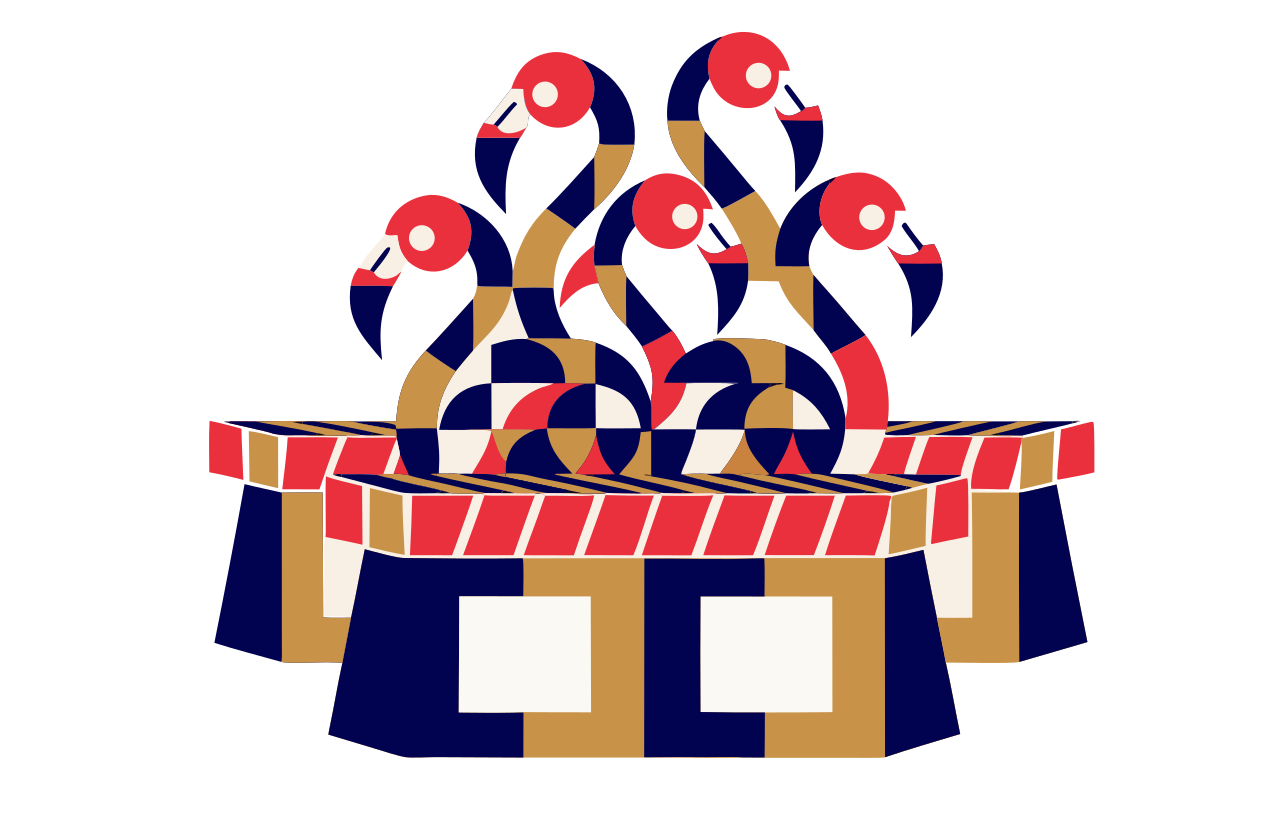
Flamingos on the Barricades
La isla que vendieron sin preguntarle a nadie
In Albania, thousands are taking to the streets against a luxury resort planned for Sazan Island, a former military site, with ties to American investors and very recognizable political connections. Fletcher and Octavio dig into what happens when a small country chases foreign investment and ends up selling something it probably shouldn't.
En Albania, miles de personas protestan contra un proyecto de resort de lujo en la isla de Sazan, una antigua base militar, con vínculos a inversores americanos con conexiones políticas muy conocidas. Fletcher y Octavio exploran qué pasa cuando un país pobre quiere atraer inversión extranjera y termina vendiendo algo que no debería estar en venta.


6 essential B1-level terms from this episode, with translations and example sentences in Spanish.
| Spanish | English | Example |
|---|---|---|
| transparencia | transparency | El gobierno necesita más transparencia en los contratos con inversores extranjeros. |
| inversor | investor | El inversor americano quiere construir un resort de lujo en la isla. |
| manifestantes | protesters / demonstrators | Los manifestantes salieron a la calle para protestar contra el proyecto. |
| parecer | to seem / to appear | El acuerdo puede ser bueno, pero parece corrupto porque no hay información pública. |
| terreno | land / plot of land | El gobierno dio el terreno de la isla a una empresa privada. |
| emigrar | to emigrate | Muchos jóvenes albaneses emigraron a Alemania en busca de trabajo. |
There's a pattern I've seen in a dozen countries, and when I read about Albania this week, I recognized it immediately: a government hands a spectacular piece of public land to a private developer, calls it economic progress, and then acts surprised when people get furious.
Sí, y en este caso el lugar es una isla.
Yes, and in this case the place is an island.
La isla de Sazan, en la costa albanesa.
Sazan Island, on the Albanian coast.
Fue una base militar durante muchos años, primero con los soviéticos, luego con el gobierno albanés.
It was a military base for many years, first with the Soviets, then with the Albanian government.
Ahora el gobierno quiere convertirla en un resort de lujo.
Now the government wants to turn it into a luxury resort.
And not just any investor.
The name attached to this project is Jared Kushner, through his investment fund Affinity Partners.
Which, depending on your politics, either means serious international capital or it means the former president's son-in-law is doing deals in the Balkans.
Mira, los dos son verdad al mismo tiempo.
Look, both things are true at the same time.
Kushner tiene dinero real, y también tiene conexiones políticas muy importantes.
Kushner has real money, and he also has very important political connections.
Eso es exactamente el problema para mucha gente en Albania.
That's exactly the problem for many people in Albania.
Right.
And the protests, the ones that turned into street clashes with police this week, they've been given this name: the Flamingo Revolution.
Which is either poetic or absurd, I can't decide which.
Es poético.
It's poetic.
Los flamencos son aves muy importantes en Albania, un símbolo del país.
Flamingos are very important birds in Albania, a symbol of the country.
Y Sazan es una isla donde viven muchos animales silvestres.
And Sazan is an island where many wild animals live.
Los manifestantes eligieron ese nombre para decir: este lugar pertenece a la naturaleza, no a los ricos.
The protesters chose that name to say: this place belongs to nature, not to the wealthy.
That framing is doing a lot of work.
Because the argument isn't just about birds, it's about who controls what's left of the public commons in a country that's been fighting over property rights for thirty years.
Exactamente.
Exactly.
Albania fue comunista hasta 1991.
Albania was communist until 1991.
Durante el comunismo, toda la tierra era del Estado.
During communism, all land belonged to the State.
Cuando llegó la democracia, el problema de la propiedad privada fue enorme.
When democracy arrived, the problem of private property was enormous.
¿Quién es el dueño de qué?
Who owns what?
Esa pregunta todavía no tiene respuesta clara en muchos lugares.
That question still doesn't have a clear answer in many places.
I covered the collapse of communism in parts of Eastern Europe, and the land question was always the most explosive one.
You could sort of agree on elections, on courts, on constitutions.
But land, that's where people felt it in their bones.
Y Albania tuvo una transición muy difícil.
And Albania had a very difficult transition.
En 1997, el país casi entró en guerra civil después de una crisis económica enorme.
In 1997, the country nearly descended into civil war after a massive economic crisis.
Muchas familias perdieron todos sus ahorros.
Many families lost all their savings.
La confianza en el gobierno todavía no es muy alta.
Trust in the government is still not very high.
The 1997 collapse.
That was the pyramid scheme crisis, right?
The entire economy was essentially running on fraudulent investment schemes, they fell apart, people who had put in everything lost everything, and the country just, it disintegrated for a while.
Sí, exactamente.
Yes, exactly.
Dos mil personas murieron.
Two thousand people died.
El gobierno cayó.
The government fell.
Fue un desastre total.
It was a complete disaster.
Cuando piensas en esa historia, entiendes mejor por qué los albaneses son muy sensibles cuando ven que el gobierno da terreno público a inversores ricos sin mucha transparencia.
When you think about that history, you better understand why Albanians are very sensitive when they see the government giving public land to wealthy investors without much transparency.
So the current prime minister, Edi Rama, has been pushing this project.
And Rama is an interesting figure, he's been in power since 2013, he's positioned himself as a modernizer, a man who can attract Western investment and drag Albania into the European mainstream.
Rama es pintor, escritor, exjugador de baloncesto.
Rama is a painter, a writer, a former basketball player.
Es una persona muy original para ser político.
He's a very unusual person to be a politician.
Y en muchos aspectos hizo cosas buenas para Albania: las calles son más seguras, la economía creció.
And in many respects he did good things for Albania: the streets are safer, the economy grew.
Pero sus críticos dicen que el poder está muy concentrado en sus manos.
But his critics say that power is very concentrated in his hands.
That's a familiar tension in developing democracies: the strongish leader who actually gets things done versus the democratic accountability that keeps leaders honest.
And tourism development is where that tension shows up most visibly, because the stakes are so concrete.
El turismo en Albania creció muchísimo en los últimos años.
Tourism in Albania grew enormously in recent years.
El país tiene playas bonitas, montañas, historia antigua griega y romana.
The country has beautiful beaches, mountains, ancient Greek and Roman history.
Y los precios son más baratos que en Grecia o Croacia.
And prices are cheaper than in Greece or Croatia.
Muchos europeos jóvenes lo descubrieron recientemente.
Many young Europeans discovered it recently.
Albania is one of those places that feels about ten years behind the tourism curve in the best possible way.
When I passed through Saranda a few years back for a piece on the Adriatic coast, it had this quality of somewhere not yet finished being discovered.
Y el gobierno quiere cambiar eso rápidamente.
And the government wants to change that quickly.
Quiere resorts de lujo, hoteles grandes, inversión extranjera.
It wants luxury resorts, large hotels, foreign investment.
La idea es simple: si viene Kushner con su dinero, otros inversores ricos también van a venir.
The idea is simple: if Kushner comes with his money, other wealthy investors will come too.
The anchor investor logic.
You get one name, one project, and it signals to the market that the place is open, stable, worth the risk.
I've seen governments chase that play in Southeast Asia, in the Gulf, in West Africa.
Sí, pero hay un problema grande con Sazan específicamente.
Yes, but there is a big problem with Sazan specifically.
Es una isla militar con mucha historia.
It's a military island with a lot of history.
Todavía hay materiales peligrosos de la época soviética.
There are still dangerous materials from the Soviet era.
No es una isla normal, es un lugar muy especial y muy delicado.
It's not a normal island;
Hazardous materials.
I hadn't seen that detail spelled out clearly.
You mean weapons storage, unexploded ordnance, that kind of thing?
Exacto.
Exactly.
Sazan fue una base submarina soviética importante.
Sazan was an important Soviet submarine base.
Había submarinos, armas, combustible nuclear.
There were submarines, weapons, nuclear fuel.
Los expertos dicen que la isla necesita una limpieza muy cuidadosa antes de cualquier construcción.
Experts say the island needs very careful cleanup before any construction.
Eso cuesta mucho dinero y mucho tiempo.
That costs a lot of money and a lot of time.
A Soviet submarine base turned luxury resort.
That's either visionary or completely insane, and I'm genuinely not sure which.
The remediation costs alone could swallow a project whole.
Claro, y los manifestantes preguntan: ¿quién va a pagar esa limpieza?
Of course, and the protesters ask: who is going to pay for that cleanup?
Si el gobierno albanés paga con dinero público, y después Kushner construye su hotel y gana mucho dinero, ¿eso es justo para los ciudadanos?
If the Albanian government pays with public money, and then Kushner builds his hotel and makes a lot of money, is that fair to the citizens?
That question, that exact question, privatizing the gains and socializing the costs, is the oldest complaint in the political economy playbook.
And it never gets less valid just because it's familiar.
Y aquí hay otra cuestión importante: los contratos entre el gobierno y los inversores no son públicos.
And here there is another important issue: the contracts between the government and the investors are not public.
Los albaneses no saben exactamente qué prometió el gobierno, qué condiciones tiene el acuerdo, cuánto dinero va a recibir el Estado.
Albanians don't know exactly what the government promised, what conditions the deal has, how much money the State will receive.
Opacity in investment contracts with political connections.
That's not just an Albanian problem, but Albania has very specific reasons to be more sensitive to it than most.
The EU accession process is supposed to address exactly this, transparency, rule of law, all of it.
Albania quiere entrar en la Unión Europea.
Albania wants to join the European Union.
Las negociaciones empezaron pero van muy lentas.
The negotiations started but are going very slowly.
Bruselas pide más transparencia, menos corrupción, más independencia judicial.
Brussels asks for more transparency, less corruption, more judicial independence.
Y este proyecto de Sazan es exactamente el tipo de cosa que los europeos miran con preocupación.
And this Sazan project is exactly the type of thing that Europeans look at with concern.
So Rama is caught in a bind.
The investment is supposed to accelerate modernization, which is supposed to help EU accession, but the way the deal was structured might actually damage the accession case.
That's a real strategic miscalculation if true.
Puede ser.
It could be.
Pero también es verdad que Albania necesita inversión extranjera desesperadamente.
But it's also true that Albania desperately needs foreign investment.
Muchos jóvenes albaneses emigraron a Alemania, a Italia, a otros países de Europa.
Many young Albanians emigrated to Germany, to Italy, to other European countries.
El país perdió mucha población y muchos trabajadores jóvenes.
The country lost a lot of population and many young workers.
Eso es un problema económico muy serio.
That is a very serious economic problem.
The brain drain is brutal in the Western Balkans.
I've read figures suggesting Albania has lost somewhere between a quarter and a third of its population since 1990 to emigration.
When your young people leave and send remittances home, you're essentially exporting your future.
Exactamente.
Exactly.
Entonces el gobierno dice: necesitamos crear empleos aquí, en Albania.
So the government says: we need to create jobs here, in Albania.
Un resort grande necesita muchos empleados: cocineros, limpiadores, recepcionistas, guías turísticos.
A large resort needs many employees: cooks, cleaners, receptionists, tour guides.
Eso es trabajo real para albaneses.
That is real work for Albanians.
And that argument has genuine weight.
Tourism employment is real, it's distributed across skill levels, it doesn't require a university degree.
But there's a difference between building a tourism economy and handing a historically significant island to a politically connected foreign billionaire on terms nobody can inspect.
Y los manifestantes dicen que hay otras formas de desarrollar el turismo.
And the protesters say there are other ways to develop tourism.
No necesitan vender una isla con historia militar y natural tan importante.
They don't need to sell an island with such important military and natural history.
Hay muchos otros lugares en Albania donde se puede construir.
There are many other places in Albania where you can build.
The protests turned into clashes with police this week.
What does that tell us about how the government is reading this?
Que el gobierno tiene miedo.
That the government is afraid.
Cuando la policía ataca a manifestantes pacíficos, normalmente es porque el gobierno no quiere escuchar la conversación.
When police attack peaceful protesters, it's usually because the government doesn't want to have the conversation.
En Albania, las protestas grandes son muy raras.
In Albania, large protests are very rare.
Esto es algo especial.
This is something special.
Rare protests in a country with a complicated history of what happens to people who protest.
That's not a trivial thing.
Albanians lived under one of the most isolated and repressive communist regimes in Europe.
Enver Hoxha's Albania was in a category of its own.
Hoxha era un dictador terrible.
Hoxha was a terrible dictator.
Albania no tenía contacto con casi ningún país del mundo, ni siquiera con la Unión Soviética al final.
Albania had almost no contact with any country in the world, not even with the Soviet Union by the end.
Construyeron más de 170.000 búnkeres en todo el país porque Hoxha tenía miedo de una invasión.
They built more than 170,000 bunkers across the country because Hoxha was afraid of an invasion.
Cuando murió en 1985, los albaneses no sabían casi nada del mundo exterior.
When he died in 1985, Albanians knew almost nothing of the outside world.
170,000 bunkers for a country the size of Maryland.
I knew the number but every time I hear it, it lands differently.
That's a bunker for every 17 people.
The psychology behind a state that does that to itself is something.
Y ahora, cuarenta años después, las personas que crecieron en ese país ven a un gobierno albanés que da una isla histórica a un americano rico sin explicaciones claras.
And now, forty years later, the people who grew up in that country see an Albanian government giving a historic island to a wealthy American without clear explanations.
Puedo entender por qué eso les molesta mucho.
I can understand why that makes them very angry.
It's a collision of two very different ideas about what development should look like.
One side says: we need capital, we need names, we need to signal to the world that Albania is open.
The other side says: after everything this country went through, its land should not be a product.
Y el problema con Kushner específicamente es que él no es solo un inversor.
And the problem with Kushner specifically is that he's not just an investor.
Tiene una familia política muy famosa.
He has a very famous political family.
Eso hace que el proyecto parezca político, aunque económicamente puede ser bueno.
That makes the project seem political, even if economically it might be good.
Es difícil separar las dos cosas.
It's difficult to separate the two things.
The what I'm going to say now might sound obvious, but I think it matters: the problem isn't necessarily that Kushner's money is bad.
The problem is that when politically connected money moves into a small country with weak institutions, the institutions are the ones that tend to bend.
Exactamente.
Exactly.
Y cuando las instituciones se doblan una vez, es más fácil que se doblen otra vez.
And when institutions bend once, it's easier for them to bend again.
Eso es el verdadero peligro para Albania, no solo este proyecto específico.
That is the real danger for Albania, not just this specific project.
There's something you said earlier that I want to pull on a little.
You said the project makes the deal look political.
You used the verb "parecer," it seems or looks.
And I've noticed you use that differently from "ser," is.
That's actually a real distinction in Spanish, right?
I always muddle those.
Claro, es una distinción muy importante.
Of course, it's a very important distinction.
"Ser" describe algo permanente o fundamental.
'Ser' describes something permanent or fundamental.
"Parecer" describe la impresión, cómo ves algo desde fuera.
'Parecer' describes the impression, how you see something from the outside.
Por ejemplo: este proyecto puede ser bueno económicamente, pero parece corrupto porque no hay transparencia.
For example: this project may be economically good, but it seems corrupt because there is no transparency.
So "es corrupto" means it actually is corrupt, full stop.
And "parece corrupto" means it gives off that appearance, regardless of what's actually true underneath.
That's a distinction English handles clumsily, we'd have to say 'seems' or 'appears' and it sounds hedged in a way that 'parecer' doesn't.
Sí, y en política esta diferencia es esencial.
Yes, and in politics this difference is essential.
Un político puede decir: "mi gobierno no es corrupto, pero entiendo que parece corrupto para muchas personas." Eso es una frase muy diferente de simplemente negar la corrupción.
A politician can say: 'my government is not corrupt, but I understand that it seems corrupt to many people.' That is a very different sentence from simply denying corruption.
Reconoce la percepción sin admitir la realidad.
It acknowledges the perception without admitting the reality.
Politicians the world over have built entire careers on that exact gap between parecer and ser.
I'll be filing that one away.
Though knowing me, I'll use it in the wrong tense at dinner in Madrid and you'll never let me hear the end of it.
Fletcher, la última vez que intentaste usar una frase nueva en español, le dijiste a mi madre que estabas muy embarazado.
Fletcher, the last time you tried to use a new phrase in Spanish, you told my mother you were very pregnant.
Creo que parecer y ser pueden esperar.
I think parecer and ser can wait.