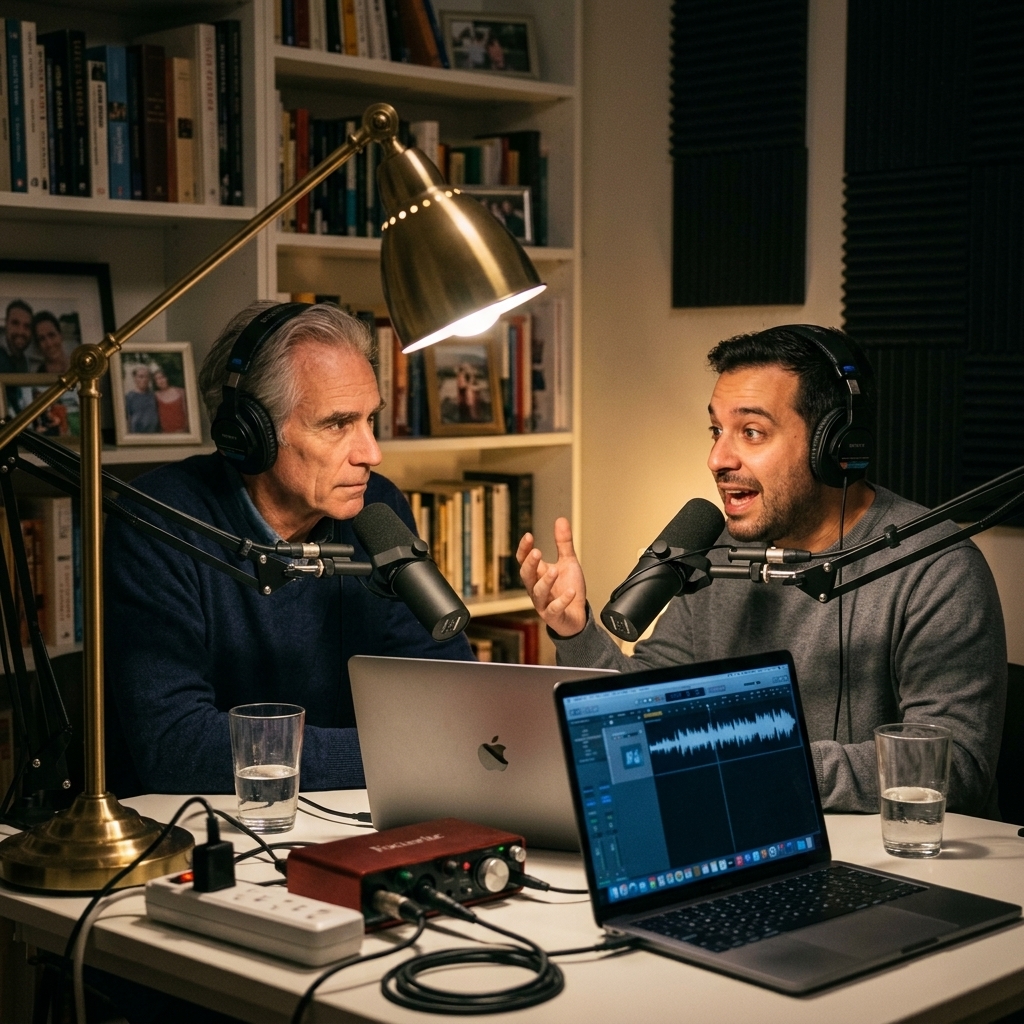
Fletcher EN
So the International Organization for Migration released a report this week, and the number that jumped out at me was 990.
That is how many people have died in the Mediterranean Sea so far in 2026, and we are only in April.
Octavio ES
Bueno, es un número muy difícil de leer.
Well, it is a very difficult number to read.
Casi mil personas.
Almost a thousand people.
Y el informe dice que es uno de los comienzos de año más mortales desde 2014.
And the report says it is one of the deadliest starts to a year since 2014.
Fletcher EN
2014.
Which, for people who follow this issue, is a significant reference point.
That was the year the scale of this crisis really became undeniable in Europe.
Octavio ES
Sí, y en 2015 fue todavía peor.
Yes, and in 2015 it was even worse.
Más de un millón de personas cruzaron el Mediterráneo ese año.
More than a million people crossed the Mediterranean that year.
Fue un momento histórico para Europa.
It was a historic moment for Europe.
Fletcher EN
Here's what gets me about this story, though.
We tend to frame it as a political crisis, a border crisis.
And it is those things.
But I want to talk about the part that is less often discussed, which is climate.
Octavio ES
Mira, es que el clima y la migración están muy conectados.
Look, the thing is that climate and migration are very closely connected.
En muchos países de África y Oriente Medio, la gente no puede vivir de la agricultura porque hay sequías muy largas.
In many countries in Africa and the Middle East, people cannot live from farming because there are very long droughts.
Fletcher EN
Right.
And this is not a theoretical future scenario.
This is happening now.
The Sahel region of West Africa, for example, has lost enormous amounts of arable land in the last two decades.
Octavio ES
En el Sahel, el desierto crece cada año.
In the Sahel, the desert grows every year.
Los agricultores perdieron sus tierras.
Farmers lost their land.
Entonces buscaron trabajo en las ciudades, pero no había trabajo.
So they looked for work in the cities, but there was no work.
Y después muchos decidieron ir a Europa.
And then many decided to go to Europe.
Fletcher EN
So when we see a boat capsizing off the coast of Libya, what we are often looking at is the end of a very long chain of events that started with a failed harvest three years earlier, a thousand kilometers away.
Octavio ES
La verdad es que sí.
The truth is yes.
La gente no sale de su país porque quiere.
People do not leave their country because they want to.
Sale porque no tiene otra opción.
They leave because they have no other option.
Es una decisión muy difícil y muy peligrosa.
It is a very difficult and very dangerous decision.
Fletcher EN
I spent time in the Sahel years ago, covering the food crisis in Mali.
And what struck me was how the traditional patterns, the seasonal migration of herders, had completely broken down.
The rains were no longer predictable.
Octavio ES
A ver, los agricultores en África usaban el conocimiento de sus abuelos para saber cuándo plantar.
Let us think about this: farmers in Africa used the knowledge of their grandparents to know when to plant.
Pero ahora ese conocimiento no funciona porque el clima cambió demasiado rápido.
But now that knowledge does not work because the climate changed too quickly.
Fletcher EN
The extraordinary thing is that this disruption, this loss of generational agricultural knowledge, is itself one of the most underreported consequences of climate change.
Octavio ES
Bueno, y no es solo África.
Well, and it is not only Africa.
En Siria, antes de la guerra civil, hubo una sequía muy terrible entre 2006 y 2010.
In Syria, before the civil war, there was a terrible drought between 2006 and 2010.
Millones de personas dejaron sus pueblos y fueron a las ciudades.
Millions of people left their villages and went to the cities.
Fletcher EN
And some researchers argue that the concentration of desperate, unemployed young men in Syrian cities was one of the social conditions that made the 2011 uprising possible.
Climate feeding politics feeding war.
Octavio ES
Es que la conexión es real.
The thing is the connection is real.
No digo que la sequía causó la guerra, pero contribuyó.
I am not saying the drought caused the war, but it contributed.
Y después de la guerra, millones de sirios cruzaron el Mediterráneo.
And after the war, millions of Syrians crossed the Mediterranean.
Todo está conectado.
Everything is connected.
Fletcher EN
Look, let us talk about the specific routes people take, because it helps explain why the death toll is what it is.
The central Mediterranean route, from Libya and Tunisia toward Italy, is the deadliest stretch of water in the world for migrants.
Octavio ES
Mira, los barcos que usan son muy pequeños y viejos.
Look, the boats they use are very small and old.
No son barcos seguros.
They are not safe boats.
Los traficantes ponen ochenta o cien personas en un barco que es para quince.
The traffickers put eighty or a hundred people in a boat that is meant for fifteen.
Y cuando hay mal tiempo, el barco se hunde.
And when the weather is bad, the boat sinks.
Fletcher EN
And the traffickers, I should say, are extraordinarily good at extracting money from people who have almost nothing.
They charge thousands of dollars per person.
It is a multi-billion dollar industry built entirely on desperation.
Octavio ES
Sí, y muchas familias vendieron todo para pagar el viaje de un hijo.
Yes, and many families sold everything to pay for a son's journey.
Una vaca, una casa, todo.
A cow, a house, everything.
Y después ese hijo murió en el mar.
And then that son died in the sea.
Es una tragedia enorme.
It is an enormous tragedy.
Fletcher EN
I mean, the IOM report mentions over 180 people feared dead or missing just in the latest shipwrecks since March 28th.
That is not a statistic.
Each one of those people had a family, a story, a reason for being on that boat.
Octavio ES
La verdad es que cuando leemos el número 990, es difícil imaginarlo.
The truth is that when we read the number 990, it is hard to imagine it.
Pero si pensamos en novecientas noventa personas individualmente, con sus familias y sus sueños, el dolor es diferente.
But if we think about nine hundred and ninety individual people, with their families and their dreams, the pain is different.
Fletcher EN
So let us go deeper on the climate dimension, because I think this is the part that is going to become much more significant in the coming decades.
How many climate migrants are we actually talking about, globally?
Octavio ES
Bueno, el Banco Mundial publicó un informe que dijo que, sin acción climática, más de 216 millones de personas van a moverse dentro de sus países para el año 2050.
Well, the World Bank published a report that said that, without climate action, more than 216 million people will move within their countries by the year 2050.
Y muchos de ellos después van a cruzar fronteras internacionales.
And many of them will then cross international borders.
Fletcher EN
216 million.
And that is internal displacement.
The number who ultimately reach the Mediterranean, or the border between Mexico and the US, or the English Channel, would be a fraction of that.
But still an enormous fraction.
Octavio ES
A ver, las zonas más afectadas van a ser el África subsahariana, el sur de Asia y América Central.
Let us consider this: the most affected zones are going to be sub-Saharan Africa, South Asia, and Central America.
En esas regiones, el calor y la sequía van a hacer imposible la vida agrícola en muchas partes.
In those regions, heat and drought are going to make agricultural life impossible in many areas.
Fletcher EN
Right, and there is also the sea level question.
Low-lying coastal areas in Bangladesh, in the Pacific Islands, in parts of West Africa.
These places face a future where their land is simply underwater.
Octavio ES
Es que hay islas en el Pacífico, como Tuvalu o Kiribati, que ya están perdiendo tierra.
The thing is there are islands in the Pacific, like Tuvalu or Kiribati, that are already losing land.
El agua del mar sube y cubre las playas, los campos, los pueblos.
The seawater rises and covers the beaches, the fields, the villages.
Sus ciudadanos son los primeros refugiados del clima.
Their citizens are the first climate refugees.
Fletcher EN
And here is where I think the legal and political dimension becomes really interesting.
Because there is currently no international legal status for a climate refugee.
If you flee war, you can claim asylum under the 1951 Refugee Convention.
If you flee a drought, legally, you are just an economic migrant.
Octavio ES
Mira, esa distinción es muy importante.
Look, that distinction is very important.
Un refugiado tiene derechos legales internacionales.
A refugee has international legal rights.
Un migrante económico, en muchos países, puede ser deportado.
An economic migrant, in many countries, can be deported.
Pero si tu campo no tiene agua porque el clima cambió, ¿eres refugiado o migrante económico?
But if your field has no water because the climate changed, are you a refugee or an economic migrant?
Fletcher EN
No, you are absolutely right about that.
And the 1951 convention was written in a very specific Cold War context, designed for people fleeing political persecution.
It was not designed for a world where the planet itself is pushing people out.
Octavio ES
La verdad es que necesitamos un nuevo sistema legal.
The truth is we need a new legal system.
Varios países, especialmente en Europa, debatieron este tema.
Several countries, especially in Europe, debated this topic.
Pero los gobiernos tienen miedo de las consecuencias políticas de reconocer oficialmente a los refugiados climáticos.
But governments are afraid of the political consequences of officially recognizing climate refugees.
Fletcher EN
Because acknowledging climate refugees means acknowledging that your country's emissions contributed to the conditions that created them.
There is an implied moral and potentially financial liability in that recognition.
Octavio ES
Exacto.
Exactly.
Los países ricos emitieron más gases de efecto invernadero durante 200 años.
Rich countries emitted more greenhouse gases for 200 years.
Los países pobres sufrieron más las consecuencias.
Poor countries suffered the consequences more.
Es una injusticia muy grande.
It is a very great injustice.
Fletcher EN
The thing is, Europe is also experiencing this tension very acutely right now.
The political backlash against migration has reshaped the continent's politics.
And that creates a brutal irony, because the countries that did the most to cause climate change are now the ones most resistant to accepting those displaced by it.
Octavio ES
Sí, y en España también sentimos esto.
Yes, and in Spain we feel this too.
Las islas Canarias recibieron a más de 46.000 personas en un año reciente.
The Canary Islands received more than 46,000 people in one recent year.
Es mucha presión para unos territorios pequeños.
That is a lot of pressure for small territories.
La conversación política fue muy difícil.
The political conversation was very difficult.
Fletcher EN
The Canaries are remarkable because geographically they are much closer to Morocco and Mauritania than to mainland Spain.
They are, in a sense, the first piece of the European Union that people from West Africa reach.
Octavio ES
Bueno, y la ruta del Atlántico, desde Mauritania o Senegal hasta las Canarias, es también muy peligrosa.
Well, and the Atlantic route, from Mauritania or Senegal to the Canaries, is also very dangerous.
Los barcos viajan durante días en el océano.
The boats travel for days in the ocean.
Muchas personas murieron también en esa ruta.
Many people also died on that route.
Fletcher EN
So what does this all add up to?
We started with 990 deaths in the Mediterranean in 2026, and we have worked our way through climate, geopolitics, failed agriculture, legal systems that are not fit for purpose.
What is the thing you would want listeners to take away from all of this?
Octavio ES
Mira, para mí lo más importante es esto: el Mediterráneo no es el problema.
Look, for me the most important thing is this: the Mediterranean is not the problem.
Es el síntoma.
It is the symptom.
El problema está en el origen, en el cambio climático, en la pobreza y en la falta de oportunidades.
The problem is at the origin, in climate change, in poverty and in the lack of opportunities.
Si no atacamos el origen, los números van a ser peores cada año.
If we do not address the origin, the numbers are going to get worse every year.
Fletcher EN
That is, I think, exactly the right frame.
990 deaths.
One number.
But behind it, the entire story of what we have done to the planet, and what the planet is doing in return.
That is our episode.
Gracias, Octavio.
Octavio ES
Gracias a ti, Fletcher.
Thank you, Fletcher.
Y a todos los oyentes, hasta la próxima semana.
And to all our listeners, until next week.