B1 · Intermediate
13 min
culturecrimemediasociety
El crimen verdadero: América y la fascinación con los asesinos
True Crime: America and Its Obsession with Killers
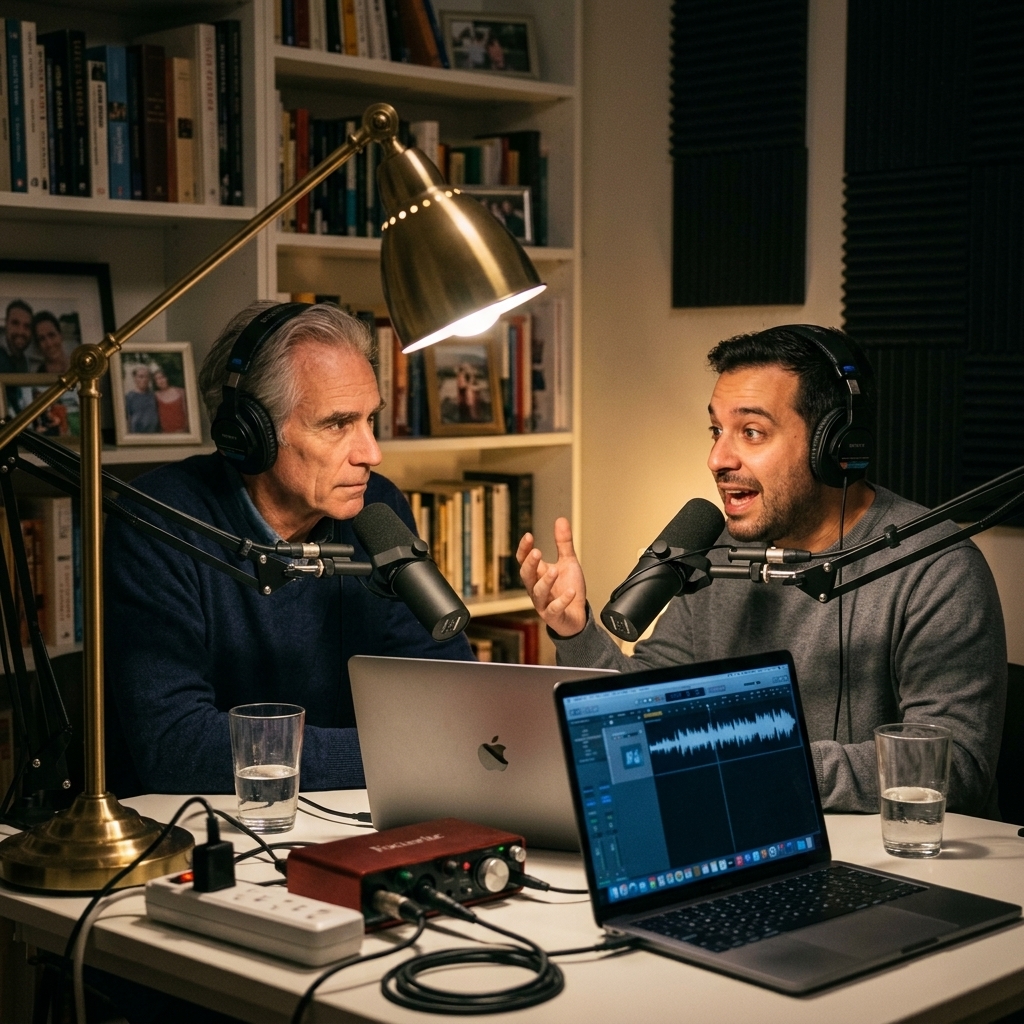
Fletcher breaks down this story in English. Octavio reacts and expands in Spanish. Follow along with the live transcript, tap any word for its translation. Intermediate level — perfect for intermediate learners expanding their range.


So, this week a man named Rex Heuermann stood up in a courtroom in New York and admitted to killing eight women.
Eight.
Over almost two decades.
And the case has a name that sounds like a Netflix title already: the Gilgo Beach murders.
Bueno, mira, este caso es muy famoso en los Estados Unidos.
Well, look, this case is very well known in the United States.
Las víctimas eran mujeres jóvenes.
The victims were young women.
La policía encontró sus cuerpos en una playa cerca de Nueva York en 2010 y 2011.
Police found their bodies on a beach near New York in 2010 and 2011.
Pero el asesino no llegó al tribunal hasta 2023.
But the killer didn't come to trial until 2023.
Right.
And what makes this culturally interesting, I think, is not just the crime itself.
It's what happened around it.
This case became a phenomenon.
Podcasts, documentaries, Reddit threads with thousands of amateur detectives.
America consumed this story for years.
Es que en América hay una cultura muy especial con el crimen.
The thing is, in America there's a very special culture around crime.
Se llama 'true crime'.
It's called 'true crime.' There are podcasts, TV series, books.
Hay podcasts, series de televisión, libros.
Many people listen to stories about killers while they exercise or cook.
Mucha gente escucha historias de asesinos cuando hace ejercicio o cocina.
Which, when you say it out loud, sounds slightly alarming.
You're making dinner, chopping vegetables, and you're listening to someone describe, in detail, how a body was found.
And this is mainstream.
This is completely normal in America.
A ver, en España también existe esto, pero no con la misma intensidad.
Look, in Spain this exists too, but not with the same intensity.
Aquí hay programas de televisión sobre crímenes, sí.
There are crime TV programs here, yes.
Pero en América parece una industria enorme.
But in America it seems like a massive industry.
It is an industry.
The podcast 'My Favorite Murder' had fifty million downloads.
Netflix's 'Making a Murderer' came out in 2015 and basically broke the internet for a week.
There are true crime conventions now, where fans meet and discuss cases like they're comparing baseball stats.
Bueno, el caso Gilgo Beach es diferente porque las víctimas eran mujeres que trabajaban como prostitutas.
The Gilgo Beach case is different because the victims were women who worked as prostitutes.
La sociedad no habló mucho de ellas al principio.
Society didn't talk much about them at first.
No eran famosas.
They weren't famous.
Eran personas marginadas.
They were marginalized people.
And that's the thing that cuts right to the heart of this, doesn't it.
There's a term in criminology and journalism: 'missing white woman syndrome.' The idea that when a young, conventionally attractive white woman disappears, the media covers it obsessively.
When marginalized women disappear, silence.
Sí, exactamente.
Yes, exactly.
Estas mujeres desaparecieron durante muchos años y la policía no hizo mucho.
These women disappeared for many years and the police didn't do much.
Cuando la gente encontró los cuerpos, el mundo dijo: 'ah, estas mujeres existían.' Era muy triste.
When people found the bodies, the world said: 'oh, these women existed.' It was very sad.
The extraordinary thing is that Heuermann was hiding in plain sight.
He was an architect.
He had an office in Midtown Manhattan, one of the most expensive addresses on earth.
He went to work every day for two decades after these murders.
And nobody knew.
Mira, este es el elemento que la gente encuentra fascinante.
Look, this is the element people find fascinating.
El hombre era normal en su vida diaria.
The man was normal in his daily life.
Tenía familia, trabajo, vecinos.
He had a family, a job, neighbors.
Pero en secreto era un asesino.
But secretly he was a killer.
La cultura del 'true crime' ama esta idea del monstruo invisible.
True crime culture loves this idea of the invisible monster.
I want to push on that for a second, because I think there's something specifically American about this.
The idea that evil hides behind the suburban facade, behind the white picket fence.
That's a very American anxiety.
La verdad es que entiendo lo que dices.
Honestly, I understand what you're saying.
En España, los crímenes más famosos también tienen este elemento.
In Spain, the most famous crimes also have this element.
Un hombre normal, con una familia normal, y después descubres algo terrible.
A normal man, with a normal family, and then you discover something terrible.
El caso Bretón, por ejemplo, un padre que mató a sus hijos.
The Bretón case, for example, a father who killed his children.
Right.
So it's not purely American.
But the scale of the industry around it, the monetization of it, the way it becomes entertainment, that does feel distinctly American to me.
Sí, sí.
Yes.
En España vemos los documentales, pero no tenemos festivales de 'true crime'.
In Spain we watch the documentaries, but we don't have true crime festivals.
No hay productos especiales, camisetas, tazas con el nombre del caso.
There are no special products, t-shirts, mugs with the case name.
En América, el crimen se convierte en una marca.
In America, crime becomes a brand.
A brand.
That's a sharp way to put it.
And look, I spent years covering violence as a foreign correspondent.
Real violence, messy violence, violence without a satisfying resolution.
And I have to be honest, the packaged version, the narrative arc, the 'justice was done' ending, it bears very little resemblance to what I saw.
Es que creo que la gente usa el 'true crime' para sentir seguridad.
I think people use true crime to feel safe.
Escuchas la historia, el criminal va a la cárcel, y piensas: 'el mundo tiene orden.' Pero en la realidad, muchos crímenes no tienen solución.
You hear the story, the criminal goes to prison, and you think: 'the world has order.' But in reality, many crimes are never solved.
That's a really interesting psychological argument.
The story gives shape to something shapeless.
It creates a beginning, middle, end, where real tragedy doesn't have those things.
Bueno, y también hay otro elemento.
And there's another element too.
Muchas personas que escuchan el 'true crime' son mujeres.
Many people who listen to true crime are women.
Los estudios dicen que el 70% de la audiencia es femenina.
Studies say 70% of the audience is female.
Y muchos criminales en estos casos son hombres que mataron a mujeres.
And many criminals in these cases are men who killed women.
Which is something that's been written about a lot.
The theory being that women consume these stories as a kind of education.
Learning the warning signs.
Understanding how predators operate.
There's a survivalist logic underneath the entertainment.
Sí, lo escuché.
Yes, I've heard that.
Algunas mujeres dicen: 'escucho estos podcasts porque quiero saber cómo protegerme.' Es una razón muy diferente de la simple curiosidad o el entretenimiento.
Some women say: 'I listen to these podcasts because I want to know how to protect myself.' That's a very different reason from simple curiosity or entertainment.
Here's what gets me, though.
The Gilgo Beach victims didn't get that audience attention while they were alive.
They were marginalized, they were in a precarious profession, and when they disappeared nobody made a podcast about finding them.
The attention came posthumously, and only because a case became famous.
La verdad es que esto es una crítica muy importante.
Honestly, this is a very important criticism.
A veces el 'true crime' habla mucho del criminal y muy poco de las víctimas.
Sometimes true crime talks a lot about the criminal and very little about the victims.
¿Quiénes eran estas ocho mujeres?
Who were these eight women?
¿Qué les gustaba?
What did they like?
¿Qué querían en la vida?
What did they want in life?
Exactly.
And some journalists and documentarians have started pushing back on this.
There's a movement now within true crime to center the victims, not the perpetrator.
To refuse to glamorize the killer.
Mira, es un cambio importante.
Look, that's an important shift.
Porque históricamente, los asesinos más famosos de América tienen nombres muy conocidos.
Because historically, America's most famous killers have very well-known names.
Ted Bundy, Jeffrey Dahmer, John Wayne Gacy.
Ted Bundy, Jeffrey Dahmer, John Wayne Gacy.
Todo el mundo conoce sus nombres.
Everyone knows their names.
Pero muy pocas personas conocen los nombres de sus víctimas.
But very few people know the names of their victims.
Ted Bundy had women writing him love letters in prison.
There were people who thought he was charming, even attractive.
When Netflix released a documentary about him in 2019, the presenter had to literally tell the audience, quote, 'Don't lose sight of the fact that he was extremely dangerous.' Because apparently some viewers needed reminding.
Es que esto es perturbador.
This is disturbing.
Un hombre que mató a muchas personas y la gente lo ve como una especie de...
A man who killed many people and people see him as a kind of movie star.
estrella de cine.
It's a very strange thing about American culture.
Es una cosa muy extraña de la cultura americana.
It's not entirely new, though.
Jesse James, Billy the Kid, Bonnie and Clyde.
America has a long tradition of romanticizing outlaws.
There's something in the national mythology about the individual who defies the rules, even violently, that produces a kind of fascination.
A ver, en España también tuvimos bandoleros, hombres que robaban y vivían fuera de la ley.
In Spain we also had bandoleros, men who stole and lived outside the law.
Y también son figuras románticas en la cultura popular.
And they are also romantic figures in popular culture.
Creo que es algo humano, no solo americano.
I think it's something human, not just American.
No, you're absolutely right about that.
The romanticization of the outlaw is pretty universal.
But what is different about the American moment right now is the sheer volume.
Hundreds of podcasts, dozens of Netflix series, a whole genre of fiction.
It's become its own economy.
Bueno, y ahora en todo el mundo tenemos series de crimen.
And now all over the world we have crime series.
España, Francia, Alemania, Corea del Sur.
Spain, France, Germany, South Korea.
'Mindhunter', que es americana, fue un éxito enorme en Europa.
'Mindhunter,' which is American, was a huge success in Europe.
'Squid Game' no era de crimen exactamente, pero tenía violencia y la gente la vio en todos los países.
'Squid Game' wasn't exactly crime, but it had violence and people watched it in every country.
So America exported the genre, and now it's global.
Though I'd argue the Spanish crime tradition is its own thing entirely.
I mean, you have a whole literary genre, the 'novela negra,' that predates the American podcast era by decades.
Sí, exactamente.
Yes, exactly.
Manuel Vázquez Montalbán escribió novelas de detectives muy famosas.
Manuel Vázquez Montalbán wrote very famous detective novels.
El detective Pepe Carvalho vivía en Barcelona y cada novela era también una crítica de la sociedad española.
The detective Pepe Carvalho lived in Barcelona and each novel was also a critique of Spanish society.
El crimen era el contexto, pero el tema real era la política, la corrupción, la vida en España después de Franco.
Crime was the context, but the real subject was politics, corruption, life in Spain after Franco.
That's the thing about crime fiction at its best, right.
It's never really about the crime.
It's about the society that produced the crime.
Chandler's Los Angeles.
Simenon's Paris.
Vázquez Montalbán's Barcelona.
The murder is just a way in.
La verdad es que el caso de Gilgo Beach también dice algo sobre la sociedad americana.
Honestly, the Gilgo Beach case also says something about American society.
Las víctimas eran mujeres vulnerables.
The victims were vulnerable women.
El asesino era un hombre con dinero y una vida normal.
The killer was a man with money and a normal life.
La policía tardó mucho tiempo en encontrarlo.
The police took a very long time to find him.
Esto no es solo una historia de crimen.
This isn't just a crime story.
Es una historia sobre el poder.
It's a story about power.
And that's the question I keep coming back to.
Does the true crime industry help us see that, or does it obscure it?
Does it point the lens at the social conditions that allow killers to operate, or does it just give us a monster to feel safe about once he's locked away?
Mira, creo que depende del producto.
Look, I think it depends on the product.
Hay periodistas que hacen un trabajo muy serio.
There are journalists who do very serious work.
Investigan, hablan con las familias, critican la policía.
They investigate, they talk to families, they criticize the police.
Pero hay otros que solo quieren crear emoción y ganar dinero.
But others just want to create excitement and make money.
The ethical line between journalism and exploitation in this space is genuinely blurry.
I've had those conversations myself, covering conflict.
When does reporting on violence serve the public, and when does it just feed an appetite for something dark?
I don't think there's a clean answer.
Es que yo creo que la pregunta más importante es esta: ¿qué piensan las familias de las víctimas?
I think the most important question is this: what do the victims' families think?
Algunas familias apoyan los documentales porque creen que ayudan a encontrar la verdad.
Some families support the documentaries because they believe they help find the truth.
Otras familias odian los documentales porque sienten que usaron el dolor de su familia para entretener a extraños.
Other families hate the documentaries because they feel their family's pain was used to entertain strangers.
Look, Heuermann is going to spend the rest of his life in prison.
He'll be sentenced in June.
And in some ways that's the end of the legal story.
But the cultural story, the question of how we consume violence, how we decide whose lives are worth grieving, that doesn't go to prison with him.
Bueno, y para terminar, creo que hay algo positivo también.
And to finish, I think there's something positive too.
Cuando la gente aprende los nombres de las ocho víctimas, cuando entiende quiénes eran, eso es bueno.
When people learn the names of the eight victims, when they understand who they were, that's good.
La atención puede ser una forma de respeto, si se hace bien.
Attention can be a form of respect, if it's done well.
I'll take that as the note to end on.
The extraordinary thing about this case, beyond all the cultural noise around it, is that eight women who were invisible in life finally have names that people know.
That's something.
It's not enough, but it's something.
Thanks for listening to Twilingua.