
C1 · Advanced
15 min
media historyjournalismamerican culturegeopoliticstelevision
The Screen That Never Went Dark: Ted Turner and the World He Made
La pantalla encendida: Ted Turner y el mundo que creó
Ted Turner, founder of CNN, died this week at 87. Octavio and Fletcher explore how an eccentric businessman from Atlanta permanently changed journalism, politics, and the way the world understands war.
Ted Turner, fundador de CNN, murió esta semana a los 87 años. Octavio y Fletcher exploran cómo un empresario excéntrico de Atlanta cambió para siempre el periodismo, la política y la forma en que el mundo entiende la guerra.

8 essential C1-level terms from this episode, with translations and example sentences in Spanish.
| Spanish | English | Example |
|---|---|---|
| en directo | live (broadcasting); on air in real time | El canal retransmitió la rueda de prensa del presidente en directo desde Madrid. |
| el efecto CNN | the CNN effect; the influence of real-time media coverage on political decisions | Los politólogos llevan décadas debatiendo si el efecto CNN realmente cambia las decisiones de los gobiernos o simplemente acelera las que ya estaban tomadas. |
| en tiempo real | in real time | Las redes sociales permiten seguir cualquier crisis en tiempo real, aunque no siempre con información verificada. |
| transmitir | to broadcast; to transmit; to stream | CNN fue la única cadena que transmitió desde Bagdad durante los primeros bombardeos de la Guerra del Golfo. |
| la polarización | polarization | Muchos investigadores atribuyen el aumento de la polarización política al modelo de los canales de noticias de veinticuatro horas. |
| el terrateniente | landowner; large-scale property owner | Durante décadas, Turner fue el mayor terrateniente privado de Estados Unidos, con millones de acres dedicados a la cría de bisontes. |
| contradictorio | contradictory; self-contradicting | Era un hombre profundamente contradictorio: creó el canal de noticias más influyente del mundo y al mismo tiempo odiaba lo que las noticias le hacían a la gente. |
| la deliberación | deliberation; careful consideration before a decision | La cobertura en tiempo real redujo el espacio para la deliberación política en momentos de crisis. |
Ted Turner died this week.
Eighty-seven years old.
And I've been sitting with that all morning, because whatever you think of what CNN became, what he did in 1980 was genuinely one of the strangest and most consequential bets in the history of journalism.
La verdad es que cuando lo leí esta mañana, me quedé un momento parado.
Honestly, when I read it this morning, I stopped for a moment.
Turner era una figura que pertenece a esa categoría de personas que cambian el mundo casi por accidente, porque tenían demasiado dinero y una idea que todo el mundo pensaba que era una locura.
Turner belongs to that category of people who change the world almost by accident, because they had too much money and an idea everyone thought was crazy.
A continuous news channel.
Twenty-four hours a day, seven days a week.
In 1980.
When the three broadcast networks basically divided up the news between them and decided what mattered, at what time, and for how long.
Y hay que entender de dónde venía Turner para apreciar lo absurdo del proyecto.
And you have to understand where Turner came from to appreciate how absurd the project was.
Su padre era un hombre de vallas publicitarias, un empresario del sur profundo de Estados Unidos.
His father was a billboard man, a businessman from the Deep South.
Ted heredó ese negocio cuando tenía veinticuatro años, después de que su padre se suicidara.
Ted inherited that business when he was twenty-four, after his father took his own life.
No era un periodista.
He wasn't a journalist.
No era un hombre de medios en el sentido tradicional.
He wasn't a media man in the traditional sense.
Era alguien que vendía espacio en carteles de carretera.
He was someone who sold space on roadside signs.
Right, and then he pivots from billboards to a struggling UHF television station in Atlanta, turns that into a national cable superstation, and then decides the logical next step is to reinvent how the entire world receives news.
The audacity of that arc is almost hard to process.
Lo que la gente olvida es que cuando lanzó CNN en junio de 1980, prácticamente nadie en la industria lo tomaba en serio.
What people forget is that when he launched CNN in June 1980, almost nobody in the industry took him seriously.
Los ejecutivos de NBC y CBS lo llamaban 'Chicken Noodle News'.
The executives at NBC and CBS called it 'Chicken Noodle News.' Chicken Noodle News, Fletcher.
Chicken Noodle News, Fletcher.
They called it that because they thought his reporters were amateurs, that the channel was a bad joke.
Le llamaban así porque pensaban que sus reporteros eran aficionados, que el canal era una broma de mal gusto.
I was in journalism school when CNN launched, more or less.
And even there, among people who cared about this stuff, the assumption was that it couldn't work.
The logic was: news happens in bursts.
You cover it, you broadcast it, you move on.
You don't need a whole channel.
Claro, porque nadie había pensado todavía en lo que pasa cuando las noticias no se detienen.
Right, because nobody had yet thought about what happens when the news doesn't stop.
Cuando hay una crisis que dura días, semanas.
When there's a crisis that lasts days, weeks.
Cuando el mundo quiere saber qué está ocurriendo en este momento, no lo que ocurrió a las siete de la tarde.
When the world wants to know what's happening right now, not what happened at seven in the evening.
And then the Gulf War happens.
January 1991.
And suddenly CNN is not a punchline anymore.
Eso es el momento.
That's the moment.
Bernard Shaw, Peter Arnett y John Holliman en el hotel Al-Rashid de Bagdad, transmitiendo en directo mientras caían las bombas a su alrededor.
Bernard Shaw, Peter Arnett, and John Holliman at the Al-Rashid Hotel in Baghdad, broadcasting live while bombs fell around them.
El resto de las cadenas habían evacuado a sus periodistas.
The other networks had evacuated their journalists.
CNN se quedó.
CNN stayed.
Y el mundo entero se pegó a la pantalla.
And the entire world glued itself to the screen.
I've talked to people who were in the Pentagon that night, watching CNN.
Not because it was the most reliable source, but because it was the only one transmitting.
There were generals in the situation room watching the same channel as everyone else at home.
Y eso es precisamente lo que los politólogos empezaron a llamar 'el efecto CNN'.
And that's exactly what political scientists started calling 'the CNN effect.' The idea that real-time coverage of a conflict can influence, actually change, political decisions.
La idea de que la cobertura en tiempo real de un conflicto puede influir, de hecho cambiar, las decisiones políticas.
Governments started making decisions with one eye on the screen, because they knew public opinion was reacting in real time.
Los gobiernos empezaron a tomar decisiones teniendo en cuenta lo que aparecía en pantalla, porque sabían que la opinión pública reaccionaba en tiempo real.
Which is something I felt personally, filing from places like Sarajevo or Mogadishu in the early nineties.
There was a before and an after.
Before CNN, you could write a piece that took three days to publish and the diplomats had that breathing room.
After, the image of a market bombing or a refugee column could move faster than any diplomatic cable.
Hay un término que usó el politólogo Steven Livingston para describir exactamente eso: la presión del tiempo real sobre la deliberación política.
There's a term the political scientist Steven Livingston used to describe exactly that: the pressure of real time on political deliberation.
Antes, los gobiernos podían procesar una crisis con cierta distancia.
Before, governments could process a crisis with some distance.
Con CNN, esa distancia desapareció.
With CNN, that distance vanished.
La pantalla no esperaba.
The screen didn't wait.
And it cut both ways.
Sometimes that pressure produced good outcomes, things that might have been ignored got attention.
But it also produced panicked decisions, interventions driven by images rather than strategy.
Somalia being the obvious case.
Exactamente.
Exactly.
La intervención humanitaria en Somalia en 1992 fue impulsada en gran medida por las imágenes de hambruna que CNN difundió al mundo.
The humanitarian intervention in Somalia in 1992 was driven largely by the famine images CNN broadcast to the world.
Y luego vino 'La batalla de Mogadiscio' en 1993, y las imágenes del soldado americano arrastrado por las calles hicieron que Clinton retirara las tropas.
And then came the Battle of Mogadishu in 1993, and images of an American soldier being dragged through the streets made Clinton pull out the troops.
El mismo mecanismo, dos consecuencias completamente distintas.
The same mechanism, two completely different consequences.
Turner himself understood the power he'd created, and it made him genuinely uncomfortable at times.
He was not a hawk.
He founded CNN partly because he thought that if people could see conflicts in real time, they'd want less war, not more.
Eso dice mucho de él como persona.
That says a lot about him as a person.
Era un hombre profundamente contradictorio.
He was a deeply contradictory man.
Por un lado, creó la máquina que convirtió la guerra en espectáculo.
On one hand, he built the machine that turned war into spectacle.
Por otro, donó mil millones de dólares a las Naciones Unidas en 1997, en ese momento la mayor donación privada a una organización internacional en la historia.
On the other, he donated a billion dollars to the United Nations in 1997, at that point the largest private donation to an international organization in history.
Mil millones.
A billion.
No a una fundación propia.
Not to his own foundation.
A la ONU.
To the UN.
He did it partly because he was furious that the U.S.
was in arrears with its UN dues, and he wanted to embarrass the government into paying.
That's such a Turner move.
Philanthropy as provocation.
Y al mismo tiempo era propietario de dos millones de acres de tierra en el oeste americano, el mayor terrateniente privado de Estados Unidos durante años, dedicado a criar bisontes.
And at the same time he owned two million acres of land in the American West, the largest private landowner in the United States for years, dedicated to raising bison.
Bisontes, Fletcher.
Bison, Fletcher.
Un hombre que vivía como un cowboy del siglo XIX mientras reinventaba el periodismo del siglo XX.
A man who lived like a nineteenth-century cowboy while reinventing twentieth-century journalism.
He also won the America's Cup in 1977 sailing his own yacht, got married to Jane Fonda, and once said he wanted CNN to be the last thing broadcasting before the world ended.
That was a direct quote.
He had a plan for it.
Sí, es verdad, eso es real.
Yes, that's real.
Tenía preparado un vídeo para el fin del mundo, con una banda tocando 'Nearer My God to Thee', que es el himno que según la leyenda tocaba la orquesta del Titanic.
He had a video prepared for the end of the world, with a band playing 'Nearer My God to Thee,' which is the hymn the Titanic's orchestra was supposedly playing.
Qué manera de pensar en tu propio legado.
What a way to think about your own legacy.
Now, here's where the story turns darker.
Because Turner built this thing, and then he lost it.
Completely.
La fusión con Time Warner en 1996, y luego la fusión con AOL en 2001.
The merger with Time Warner in 1996, and then the merger with AOL in 2001.
Eso fue uno de los mayores desastres corporativos de la historia moderna.
That was one of the greatest corporate disasters in modern history.
Turner pasó de ser el dueño de su empresa a ser un ejecutivo dentro de una burocracia gigantesca que no entendía lo que había construido ni por qué importaba.
Turner went from being the owner of his company to being an executive inside a giant bureaucracy that neither understood what he'd built nor why it mattered.
He lost something like eight billion dollars in the AOL-Time Warner collapse.
And more than the money, he lost control.
He had no say over CNN anymore.
He watched it change, and by all accounts it was painful for him.
Porque CNN después de Turner tomó un camino que él nunca habría elegido.
Because CNN after Turner took a path he never would have chosen.
Se convirtió en un canal de opinión con noticias de fondo, no un canal de noticias con algo de opinión.
It became an opinion channel with news in the background, not a news channel with some opinion.
Esa diferencia puede parecer pequeña pero es enorme.
That difference may seem small but it's enormous.
La arquitectura del periodismo cambió: lo importante ya no era la información sino el debate, el espectáculo, la confrontación.
The architecture of journalism changed: what mattered was no longer information but debate, spectacle, confrontation.
And that model infected the whole industry.
When Fox News launched in 1996, and then MSNBC, they weren't really competing on facts.
They were competing on emotion.
They figured out that the twenty-four-hour format, which Turner invented for one reason, could be hijacked for a completely different purpose.
Y aquí hay una ironía que me parece brutal: la herramienta que Turner creó para acercar a la gente, para que el mundo entendiera lo que pasaba en otros lugares, se convirtió en una de las principales fuentes de polarización en el mundo anglosajón.
And here's an irony I find brutal: the tool Turner created to bring people together, to help the world understand what was happening in other places, became one of the main sources of polarization in the English-speaking world.
No fue su intención, pero su invento hizo posible ese mundo.
It wasn't his intention, but his invention made that world possible.
The infrastructure of misinformation runs on CNN's original wiring.
That's a hard thing to sit with.
Mira, desde la perspectiva española, yo recuerdo perfectamente el impacto que tuvo CNN en los medios europeos.
Look, from the Spanish perspective, I remember perfectly the impact CNN had on European media.
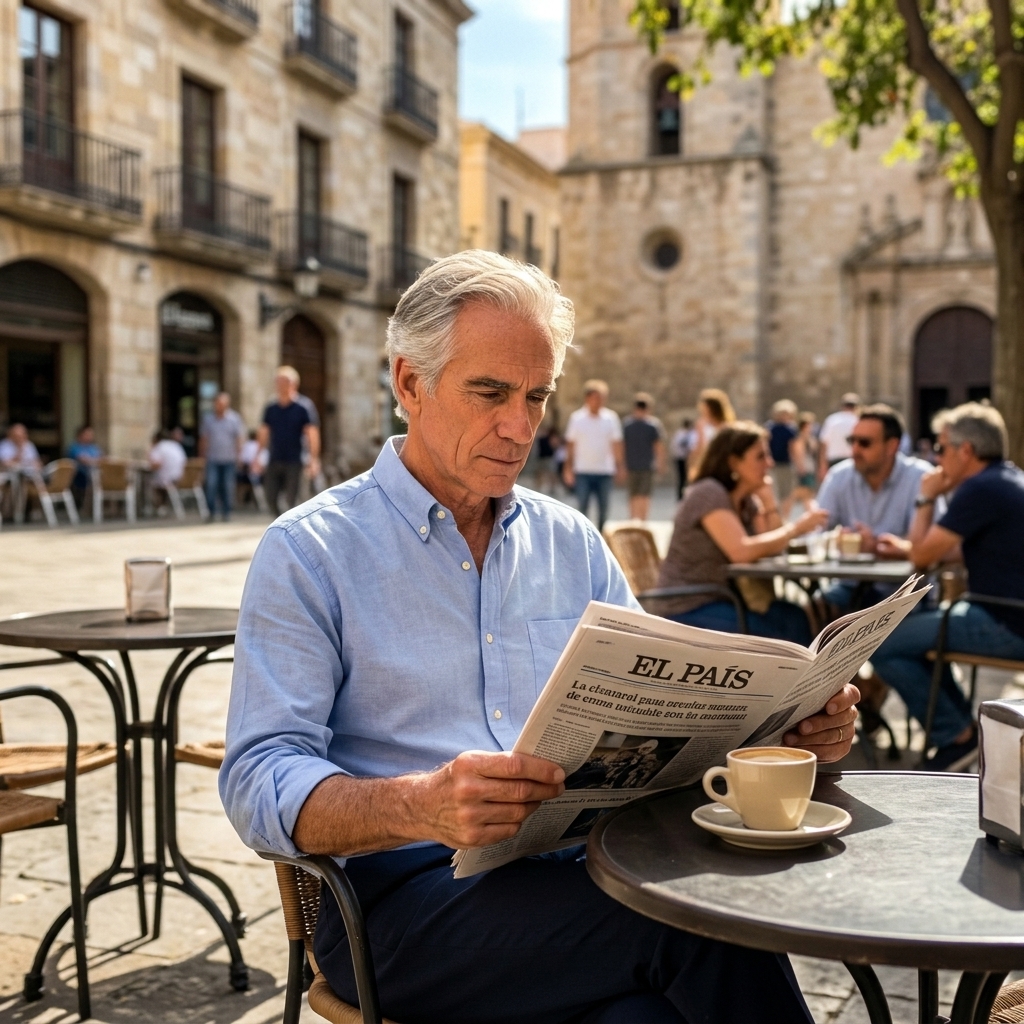
En El País, cuando yo llegué en los años noventa, había una discusión seria sobre cómo responder.
At El País, when I arrived in the nineties, there was a serious discussion about how to respond.
¿Nos digitalizamos más rápido?
Do we digitize faster?
¿Cambiamos el ciclo de edición?
Do we change the editing cycle?
¿Creamos nuestra propia versión de noticias continuas?
Do we create our own version of continuous news?
What did you conclude?
Because I think European newspapers handled the CNN pressure differently from American ones, and I'm curious whether that's held up.
La conclusión, al menos en los periódicos serios, fue que no podíamos competir en velocidad con una cadena de televisión, así que teníamos que competir en profundidad.
The conclusion, at least at serious newspapers, was that we couldn't compete with a television network on speed, so we had to compete on depth.
En análisis.
On analysis.
En cosas que la pantalla no podía darte en ese momento.
On things the screen couldn't give you in that moment.
Y eso, paradójicamente, nos salvó durante un tiempo.
And that, paradoxically, saved us for a while.
Aunque luego llegó internet y volvimos a tener el mismo problema, pero multiplicado.
Though then the internet arrived and we had the same problem again, but multiplied.
That's exactly the fork in the road I watched American newspapers miss.
The ones that survived are the ones that made that same bet you're describing, depth over speed.
The ones that tried to out-CNN CNN are mostly gone.
Hay algo que me parece importante subrayar al hablar del legado de Turner, y es que CNN también creó algo que no existía antes: la clase de periodista que trabaja en directo, que informa mientras los hechos ocurren, sin tener tiempo de verificar ni de contextualizar.
There's something important to underline when talking about Turner's legacy, which is that CNN also created something that didn't exist before: the kind of journalist who works live, who reports while events are happening, without time to verify or contextualize.
Esa figura, el reportero en directo, es una creación de Turner.
That figure, the live reporter, is a creation of Turner.
Con todas sus virtudes y todos sus peligros.
With all its virtues and all its dangers.
I've been that person, and Octavio is right that it changes you.
When you're reporting live, you're thinking differently than when you're writing.
Your editor is the clock, not a person.
And the relationship to certainty is completely different.
Y los espectadores, con el tiempo, aprendieron a aceptar esa incertidumbre como parte del formato.
And viewers, over time, learned to accept that uncertainty as part of the format.
'Estamos recibiendo informaciones no confirmadas de que...' se convirtió en una frase habitual.
'We are receiving unconfirmed reports that...' became a standard phrase.
Lo cual es interesante porque antes esa frase habría sido impublicable en cualquier medio serio.
Which is interesting because before, that phrase would have been unpublishable in any serious outlet.
Turner died of Lewy body dementia.
He was diagnosed years ago and he talked about it openly, which was unusual for someone of his generation and his background.
A man who spent his whole life at full volume, quieted that way.
There's something there.
Cuando pienso en cómo murió y en lo que dejó, me pregunto qué habría pensado Turner de la CNN de hoy.
When I think about how he died and what he left behind, I wonder what Turner would have thought of today's CNN.
Del mundo mediático de hoy.
Of today's media landscape.
Y creo que habría estado furioso y fascinado al mismo tiempo.
And I think he would have been furious and fascinated at the same time.
Era ese tipo de hombre.
He was that kind of man.
Furious that it became what it became, and fascinated that it became anything at all.
That seems right.
Okay.
There's something I want to ask you about, because you used it a couple of times just now and I caught it.
A ver, ¿qué he dicho ahora?
Go on, what did I say?
You said 'en directo' for 'live.' But I've also heard 'en vivo' plenty of times in Latin American coverage.
Are those the same thing?
Because in English we just have 'live' and that's it, which suddenly seems very convenient.
Son prácticamente sinónimos, sí, pero con matices geográficos claros.
They're practically synonyms, yes, but with clear geographical nuances.
En España decimos 'en directo' casi siempre.
In Spain we almost always say 'en directo.' In Mexico, Argentina, Colombia, 'en vivo' is the norm.
En México, en Argentina, en Colombia, lo más habitual es 'en vivo'.
Both express exactly the same thing: that something is being broadcast at the moment it happens, without editing, without a filter.
Los dos expresan exactamente lo mismo: que algo se está transmitiendo en el momento en que ocurre, sin edición, sin filtro.
But if you say 'en directo' in Buenos Aires, they understand you perfectly;
Pero si dices 'en directo' en Buenos Aires, te entienden perfectamente;
you just sound a bit Spanish.
simplemente suenas un poco español.
Which is exactly what Turner was obsessed with.
That unedited, unfiltered transmission.
It's almost poetic that the language for it splits along the same lines as the culture wars about how news should work.
No había pensado en eso, pero tienes razón.
I hadn't thought of it that way, but you're right.
'En directo' tiene algo de lineal, de flecha que va directa.
'En directo' has something linear about it, an arrow going straight.
'En vivo' tiene algo más orgánico, más vivo, casi biológico.
'En vivo' has something more organic, more alive, almost biological.
Y los dos capturan algo diferente de la misma experiencia.
And both capture something different about the same experience.
Que es, al final, lo que hacen los buenos idiomas.
Which is, in the end, what good languages do.
So the next time you're watching something live, you've got options.
'En directo' if you're feeling Castilian, 'en vivo' if you're feeling cosmopolitan.
Either way you'll sound like you know what you're talking about, which is more than I can say for most of my Spanish.
Mucho más de lo que puedes decir.
Much more than you can say.
Aunque si algún día lo dices en directo, en directo de verdad, avísame.
Although if you ever say it live, actually live, let me know.
Quiero estar ahí para verlo.
I want to be there to see it.