Fletcher EN
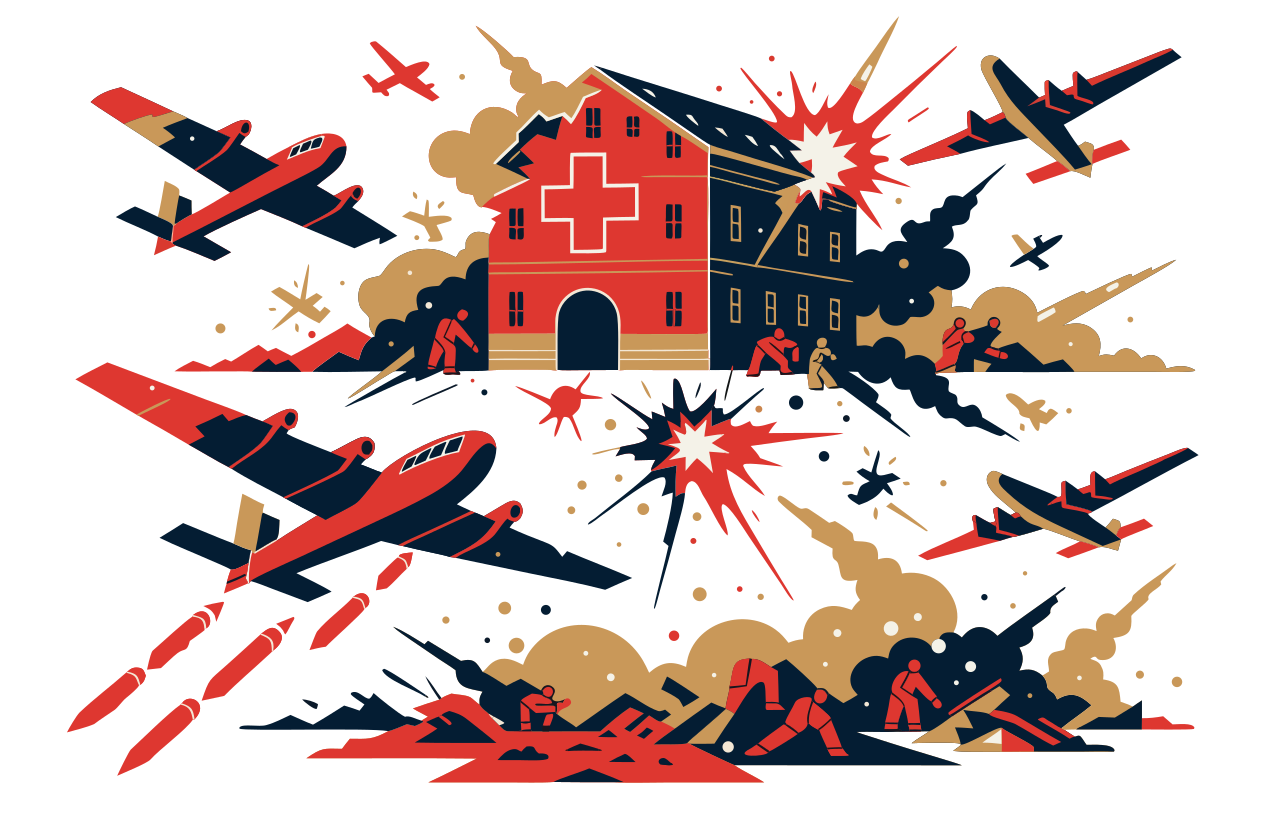
Three paramedics.
That's the number I keep getting stuck on.
Not the five dead, not the drone strikes, not the ceasefire violation.
Three paramedics, hit while they were doing a job that international law is supposed to protect.
Octavio ES
Lo que describe esta noticia no es un accidente.
What this news describes is not an accident.
Hay un patrón que se repite en el Líbano desde hace meses: ataques en zonas donde ya se supone que hay un alto el fuego, y entre las víctimas siempre aparecen trabajadores sanitarios.
There is a pattern that has been repeating in Lebanon for months: strikes in areas where a ceasefire is supposedly already in place, and health workers always appear among the victims.
La Cruz Roja Libanesa lleva tiempo documentando esto.
The Lebanese Red Cross has been documenting this for some time.
Fletcher EN
For people who haven't been following the Lebanon situation closely, the ceasefire between Israel and Hezbollah has technically been in place since late 2024.
But strikes in the south have continued, and this week five more people died.
The injured included three paramedics who were responding.
Octavio ES
Y eso es lo que quiero que entendamos hoy, porque este tipo de ataque no nació con esta guerra.
And that is what I want us to understand today, because this type of attack was not born with this war.
Lo que estamos viendo en el Líbano forma parte de un fenómeno mucho más amplio y, francamente, mucho más alarmante de lo que suelen reconocer los medios de comunicación.
What we are seeing in Lebanon is part of a much broader phenomenon and, frankly, a much more alarming one than the media usually acknowledges.
Fletcher EN
Walk me through it.
Because I covered conflicts where this came up and I never fully understood whether what I was seeing was genuine strategic targeting or something more chaotic.
The targeting of medical personnel, I mean.
Octavio ES
Bueno, primero hay que entender qué dice la ley.
Well, first we have to understand what the law says.
Los Convenios de Ginebra de 1949, que prácticamente todos los países del mundo han ratificado, establecen con claridad que el personal médico, los vehículos sanitarios y los hospitales no pueden ser atacados bajo ninguna circunstancia.
The Geneva Conventions of 1949, which virtually every country in the world has ratified, establish clearly that medical personnel, medical vehicles, and hospitals cannot be attacked under any circumstances.
Esto se aplica tanto en conflictos entre estados como en conflictos internos.
This applies both to conflicts between states and to internal conflicts.
Fletcher EN
Right, and that framework dates back even further than 1949.
The original Geneva Convention was 1864.
This is one of the oldest principles of modern warfare.
The red cross on a white background was invented specifically so combatants could identify who not to shoot.
Octavio ES
Exactamente.
Exactly.
Y sin embargo, según los datos de la Organización Mundial de la Salud, entre 2016 y 2023 se registraron más de cuatro mil ataques a instalaciones sanitarias y trabajadores de la salud en zonas de conflicto en todo el mundo.
And yet, according to World Health Organization data, between 2016 and 2023 more than four thousand attacks on health facilities and health workers in conflict zones were recorded worldwide.
Cuatro mil.
Four thousand.
En Siria, Yemen, Ucrania, Etiopía, Sudán, el Líbano.
In Syria, Yemen, Ukraine, Ethiopia, Sudan, Lebanon.
No son excepciones;
These are not exceptions;
es la norma.
it is the norm.
Fletcher EN
Four thousand.
I knew the number was high but I was not prepared for that.
That is not a failure of enforcement.
That is a collapse of the entire concept.
Octavio ES
Hay que distinguir entre dos tipos de ataques.
We have to distinguish between two types of attacks.
Por un lado, los que son claramente deliberados: bombardear un hospital conocido, disparar contra una ambulancia marcada, matar a un médico identificable.
On one hand, those that are clearly deliberate: bombing a known hospital, firing at a marked ambulance, killing an identifiable doctor.
Por otro, los que los militares llaman 'daños colaterales', es decir, que el objetivo era otro pero el hospital estaba cerca.
On the other, what militaries call 'collateral damage', meaning the target was something else but the hospital was nearby.
La OMS los registra todos, pero la responsabilidad legal varía enormemente.
The WHO records all of them, but legal accountability varies enormously.
Fletcher EN
And that distinction becomes a very convenient escape hatch.
I watched that happen in real time in more than one country.
The moment something goes wrong, suddenly everything was collateral.
The language of war is very good at making intent disappear.
Octavio ES
Mira, el caso de Siria es el más documentado.
Look, the case of Syria is the best documented.
Entre 2011 y 2020, Médicos Sin Fronteras registró más de seiscientos ataques a instalaciones de salud, muchos de los cuales ocurrieron en lugares que habían sido comunicados de forma confidencial al gobierno ruso y al gobierno sirio precisamente para garantizar su protección.
Between 2011 and 2020, Doctors Without Borders recorded more than six hundred attacks on health facilities, many of which occurred in places that had been confidentially communicated to the Russian and Syrian governments precisely to ensure their protection.
La información fue usada para guiar los ataques, no para evitarlos.
The information was used to guide the strikes, not to avoid them.
Fletcher EN
That detail about Syria is one of the darkest things I know about that war.
You register your hospital coordinates with the parties to the conflict, specifically following the protocol designed to protect you, and that information becomes a targeting list.
The betrayal of that is almost incomprehensible.
Octavio ES
Y eso nos lleva directamente al Líbano.
And that leads us directly to Lebanon.
El sistema de salud libanés ya estaba en una situación crítica antes de este conflicto.
The Lebanese health system was already in a critical state before this conflict.
La explosión del puerto de Beirut en 2020 destruyó varios hospitales.
The Beirut port explosion in 2020 destroyed several hospitals.
Luego vino la crisis económica, que dejó a muchos médicos y enfermeros sin sueldo durante meses.
Then came the economic crisis, which left many doctors and nurses without a salary for months.
Después comenzaron los ataques del sur.
Then the strikes in the south began.
El sistema sanitario libanés está, literalmente, al borde del colapso.
The Lebanese health system is, literally, on the brink of collapse.
Fletcher EN
I was in Beirut briefly in 2022, doing a piece on the currency crisis, and I remember being told by a doctor at the American University hospital that he was making more money as an Uber driver on weekends than from his medical salary.
A trained physician.
It was one of those details that just lodges in your brain.
Octavio ES
Lo cual significa que cuando un paramédico sale a responder a un ataque con drones en el sur del Líbano, probablemente lo está haciendo con equipamiento viejo, con poca financiación, con un sistema hospitalario detrás de él que no puede garantizar que haya espacio en urgencias.
Which means that when a paramedic goes out to respond to a drone strike in southern Lebanon, he is probably doing so with old equipment, little funding, with a hospital system behind him that cannot guarantee there will be space in the emergency room.
Y encima, corre el riesgo de recibir otro ataque mientras trabaja.
And on top of that, he runs the risk of being struck again while working.
Fletcher EN
There's actually a term for this, a tactic that's been documented in multiple conflicts.
It's sometimes called the double-tap, where a second strike hits the same location shortly after the first, specifically to kill the responders.
It's been documented in Yemen, in Gaza, in Syria.
Whether that happened here this week I don't know, but the pattern is real.
Octavio ES
Es un crimen de guerra según el derecho internacional humanitario.
It is a war crime under international humanitarian law.
Sin ambigüedad posible.
Without possible ambiguity.
Y sin embargo, casi nadie ha sido procesado por ello.
And yet, almost nobody has been prosecuted for it.
Ahí está el problema central: la distancia enorme que existe entre lo que dice la ley y lo que ocurre en la práctica.
That is the central problem: the enormous gap between what the law says and what happens in practice.
Fletcher EN
Why is accountability so rare?
And I want a real answer, not the diplomatic version, because I've heard the diplomatic version many times.
Octavio ES
La respuesta honesta tiene varias capas.
The honest answer has several layers.
Primera: los mecanismos de investigación dependen de que las partes del conflicto cooperen, y raramente lo hacen.
First: investigation mechanisms depend on the parties to the conflict cooperating, and they rarely do.
Segunda: el Tribunal Penal Internacional tiene jurisdicción muy limitada sobre los estados que no han ratificado el Estatuto de Roma, y varios de los actores más importantes en estos conflictos no lo han hecho.
Second: the International Criminal Court has very limited jurisdiction over states that have not ratified the Rome Statute, and several of the most important actors in these conflicts have not done so.
Tercera, y quizás la más importante: el Consejo de Seguridad de la ONU, que podría actuar, está bloqueado por el derecho de veto.
Third, and perhaps most importantly: the UN Security Council, which could act, is blocked by the veto.
Fletcher EN
The veto problem is enormous.
Any permanent member of the Security Council can kill any referral to the ICC.
Russia vetoed Syria investigations for years.
The United States has used the veto to protect Israel from resolutions.
China shields its own allies.
The architecture of international accountability was built with a structural flaw that everyone knew about in 1945 and nobody fixed.
Octavio ES
Y el resultado es que los trabajadores sanitarios en zonas de conflicto lo saben.
And the result is that health workers in conflict zones know it.
Saben que si los atacan, lo más probable es que no pase nada.
They know that if they are attacked, most likely nothing will happen.
Eso tiene un efecto demoledor sobre la moral, sobre el reclutamiento, sobre la capacidad de los sistemas de salud para funcionar en tiempo de guerra.
That has a devastating effect on morale, on recruitment, on the ability of health systems to function in wartime.
¿Por qué ibas a quedarte en un hospital del sur del Líbano sabiendo que tu chaleco de la Cruz Roja no te protege?
Why would you stay in a hospital in southern Lebanon knowing that your Red Cross vest does not protect you?
Fletcher EN
This is what people who haven't been in those environments don't quite grasp.
The protective symbol only works if both sides believe the other side will respect it.
The moment one side stops, the entire system of protection dissolves.
It's a collective agreement that has to be continually renewed by all parties, and once the trust breaks, it breaks fast.
Octavio ES
Fíjate en lo que ocurrió en Gaza en los últimos dos años.
Look at what happened in Gaza over the last two years.
Los equipos de ambulancias de la Media Luna Roja Palestina documentaron decenas de ataques a vehículos claramente marcados.
The Palestinian Red Crescent ambulance teams documented dozens of attacks on clearly marked vehicles.
Y el efecto fue inmediato: cada vez menos voluntarios se presentaban para cubrir los turnos nocturnos.
And the effect was immediate: fewer and fewer volunteers showed up to cover night shifts.
La gente no es estúpida.
People are not stupid.
Si el uniforme no te protege, dejas de ponértelo.
If the uniform does not protect you, you stop wearing it.
Fletcher EN
And that creates a vacuum that's almost impossible to fill in the middle of a conflict.
You can't import trained paramedics from outside when a war is ongoing.
The loss of every single one of those responders has a compounding effect on everyone who needs medical help in that area.
Octavio ES
Hay un concepto médico que me parece útil aquí: el de la 'cadena de supervivencia'.
There is a medical concept that I find useful here: that of the 'chain of survival'.
En medicina de urgencias, se habla de los eslabones que conectan el momento en que alguien sufre una herida grave con el momento en que recibe atención definitiva.
In emergency medicine, one speaks of the links connecting the moment someone suffers a serious injury with the moment they receive definitive care.
Si rompes uno de esos eslabones, da igual que el resto funcionen perfectamente.
If you break one of those links, it does not matter that the rest work perfectly.
Atacar a los paramédicos es romper el primer eslabón.
Attacking paramedics breaks the first link.
Fletcher EN
That's a very clean way to put it.
And it implies something deliberate, doesn't it?
If you want to maximize the damage from a strike, you target the response capacity as well as the initial target.
It becomes a force multiplier for death.
Octavio ES
Exacto.
Exactly.
Y aquí es donde el debate se pone interesante, porque Israel argumenta sistemáticamente que muchas de las infraestructuras sanitarias en el sur del Líbano son también infraestructuras de Hezbolá.
And this is where the debate gets interesting, because Israel systematically argues that many of the health facilities in southern Lebanon are also Hezbollah infrastructure.
Que los ambulatorios sirven también como puntos de comunicación o almacenamiento de armas.
That the clinics also serve as communication points or weapons storage.
No puedo verificar esas afirmaciones, pero tampoco las puedo descartar sin más.
I cannot verify those claims, but I cannot simply dismiss them either.
El problema es que la carga de la prueba, en el derecho internacional, corresponde al atacante.
The problem is that the burden of proof, under international law, belongs to the attacker.
Fletcher EN
That's the key legal point, yes.
The doctrine of proportionality and distinction requires that the attacking party assess in advance whether a target has dual military and civilian use, and that even if it does, the expected civilian harm has to be proportionate to the military advantage gained.
The burden is on the one dropping the bomb, not on the people inside the building.
Octavio ES
Y en la práctica, esa evaluación previa raramente se hace con el rigor que exige la ley, o si se hace, los resultados no se comparten con nadie que pueda verificarlos.
And in practice, that prior assessment is rarely carried out with the rigor the law requires, or if it is, the results are not shared with anyone who can verify them.
Lo que queda es el resultado: cinco muertos, tres paramédicos heridos, y la población del sur del Líbano que sabe, una vez más, que el alto el fuego es un concepto bastante elástico.
What remains is the outcome: five dead, three paramedics wounded, and the population of southern Lebanon knowing, once again, that the ceasefire is quite an elastic concept.
Fletcher EN
I want to step back for a moment and think about the longer arc here, because this isn't just a Lebanon story.
We've seen this same pattern in Yemen, where Saudi-led coalition strikes hit hospitals and WHO-listed medical facilities repeatedly.
We've seen it in Myanmar.
We've seen it in Ethiopia's Tigray conflict.
Is there something about the current era that makes this worse, or has it always been this way?
Octavio ES
Es una pregunta muy buena, y la respuesta honesta es que probablemente las dos cosas son ciertas.
It is a very good question, and the honest answer is that probably both things are true.
Los conflictos asimétricos modernos, aquellos en los que un estado militar avanzado combate contra actores no estatales que se integran en la población civil, crean una situación estructuralmente más peligrosa para la infraestructura sanitaria.
Modern asymmetric conflicts, those in which an advanced military state fights against non-state actors integrated within the civilian population, create a structurally more dangerous situation for health infrastructure.
Pero también es verdad que ahora tenemos más capacidad de documentarlo.
But it is also true that now we have more capacity to document it.
Las cámaras de los teléfonos han cambiado lo que es posible registrar.
Phone cameras have changed what it is possible to record.
Fletcher EN
Documentation is up, accountability is not.
That gap might be the most depressing thing about this whole area.
We have more evidence than ever before of violations happening, and the prosecution rate has barely moved.
Something is fundamentally broken in the chain between witnessing and consequence.
Octavio ES
Aunque hay algún motivo para no ser completamente pesimista.
Although there is some reason not to be completely pessimistic.
El mecanismo SSA, que es el sistema de monitoreo de ataques a instalaciones sanitarias de la OMS, ha mejorado enormemente la calidad de los datos disponibles.
The SSA mechanism, which is the WHO's monitoring system for attacks on health facilities, has enormously improved the quality of available data.
Eso no salva vidas hoy, pero crea registros históricos que, en algunos casos, han sido utilizados décadas después en procesos de justicia transicional.
That does not save lives today, but it creates historical records that, in some cases, have been used decades later in transitional justice processes.
La justicia internacional es lenta.
International justice is slow.
Desesperantemente lenta.
Desperately slow.
Pero no siempre es cero.
But it is not always zero.
Fletcher EN
Decades later is cold comfort if you are a paramedic in Tyre right now deciding whether to put on that vest and respond to the next alert.
The abstraction of future accountability doesn't do much for present courage.
Octavio ES
Tienes razón.
You are right.
Y por eso me parece tan importante que esta semana, cuando leemos que tres paramédicos han resultado heridos en el sur del Líbano, no lo tratemos como una línea más en un boletín de noticias.
And that is why it seems so important to me that this week, when we read that three paramedics have been wounded in southern Lebanon, we do not treat it as just one more line in a news bulletin.
Esos tres paramédicos son el sistema.
Those three paramedics are the system.
Sin ellos, el sur del Líbano no tiene respuesta sanitaria de emergencia.
Without them, southern Lebanon has no emergency health response.
Y sin esa respuesta, cualquier ataque futuro matará a más personas, no por la fuerza del ataque, sino por la ausencia de socorro.
And without that response, any future strike will kill more people, not because of the force of the strike, but because of the absence of aid.
Fletcher EN
Which is a form of cascading harm that never shows up in the immediate casualty counts.
The deaths that happen six hours later because the ambulance didn't come, or the hospital was already overwhelmed, or the paramedic was treating his own wounds.
Those deaths are invisible in the data.
Octavio ES
Invisible, pero real.
Invisible, but real.
En epidemiología hay un concepto llamado 'mortalidad en exceso', que compara las muertes esperadas en una población con las muertes reales durante un período de crisis.
In epidemiology there is a concept called 'excess mortality', which compares expected deaths in a population with actual deaths during a crisis period.
Es la forma más honesta de medir el impacto sanitario de un conflicto, porque captura exactamente eso: las muertes que no habrían ocurrido si el sistema de salud hubiera estado funcionando.
It is the most honest way to measure the health impact of a conflict, because it captures exactly that: the deaths that would not have occurred if the health system had been functioning.
En el Líbano, esos números son, sospecho, mucho más altos de lo que nadie ha calculado oficialmente.
In Lebanon, those numbers are, I suspect, much higher than anyone has officially calculated.
Fletcher EN
We should probably land this somewhere.
The news item this week is three wounded paramedics in southern Lebanon.
But the real story is that this happens everywhere, it has been happening for decades, the law is clear, the enforcement is nearly nonexistent, and every single one of those violations compounds the next one.
I don't have a tidy resolution for that.
Octavio ES
Yo tampoco.
Neither do I.
Pero me parece que la primera responsabilidad es llamarlo por su nombre.
But it seems to me that the first responsibility is to call it by its name.
No 'incidentes', no 'daños colaterales'.
Not 'incidents', not 'collateral damage'.
Ataques a trabajadores sanitarios en zonas de conflicto activo, en violación del derecho internacional humanitario.
Attacks on health workers in active conflict zones, in violation of international humanitarian law.
Si los periodistas, y los ciudadanos, empiezan por nombrar las cosas con precisión, al menos se hace más difícil ignorarlas.
If journalists, and citizens, start by naming things precisely, at least it becomes harder to ignore them.
Fletcher EN
You used a phrase earlier that I want to come back to.
You said 'personal sanitario', which I understood as health workers, but I've also heard 'trabajadores de la salud' used the same way.
Are those interchangeable, or is there a difference I'm missing?
Octavio ES
No son exactamente lo mismo, aunque en el uso cotidiano se confunden.
They are not exactly the same, although in everyday use they get mixed up.
'Personal sanitario' es el término más formal y más amplio en español de España: incluye médicos, enfermeros, técnicos de laboratorio, paramédicos, cualquier persona que trabaje dentro del sistema de salud.
'Personal sanitario' is the most formal and broadest term in Spanish Spanish: it includes doctors, nurses, lab technicians, paramedics, anyone who works within the health system.
'Trabajadores de la salud' es una traducción más directa del inglés 'health workers', y se usa más en contextos internacionales o latinoamericanos.
'Trabajadores de la salud' is a more direct translation of the English 'health workers', and is used more in international or Latin American contexts.
Pero 'sanitario' tiene además otro significado que a los angloparlantes les resulta confuso.
But 'sanitario' also has another meaning that English speakers find confusing.
Fletcher EN
What do you mean by that?
Because in English, 'sanitary' is mostly about cleanliness.
Sanitary conditions.
Sanitary napkins.
It has almost no connection to medicine as a profession.
Octavio ES
Exacto, y ahí está la trampa.
Exactly, and that is the trap.
En español, 'sanitario' puede significar tres cosas distintas según el contexto: primero, todo lo relacionado con el sistema de salud, como en 'personal sanitario';
In Spanish, 'sanitario' can mean three different things depending on context: first, everything related to the health system, as in 'personal sanitario';
segundo, lo relativo a la higiene pública, que es el sentido que comparte con el inglés 'sanitary';
second, relating to public hygiene, which is the sense it shares with the English 'sanitary';
y tercero, en el lenguaje coloquial de España, 'el sanitario' es simplemente el váter, el inodoro.
and third, in colloquial Spanish in Spain, 'el sanitario' is simply the toilet, the lavatory.
Así que si le dices a alguien en Madrid que buscas al 'sanitario', podría señalarte el baño.
So if you tell someone in Madrid you are looking for 'el sanitario', they might point you to the bathroom.
Fletcher EN
That is a genuinely dangerous ambiguity in a hospital.
'Where's the sanitario?' could go very wrong very fast.
Octavio ES
El contexto suele salvarte, como en casi todo en español.
Context usually saves you, as with almost everything in Spanish.
Si estás en urgencias preguntando por el sanitario, nadie va a pensar que necesitas ir al baño, aunque técnicamente podrías estarlo pidiendo.
If you are in the emergency room asking for the sanitario, nobody is going to think you need the bathroom, even though technically you could be asking for it.
La lengua tiene esa generosidad.
The language has that generosity.
Pero para los estudiantes de español, vale la pena saber que 'sanitario' es una de esas palabras que puede significar cosas muy distintas dependiendo de dónde estés y cómo lo uses.
But for Spanish students, it is worth knowing that 'sanitario' is one of those words that can mean very different things depending on where you are and how you use it.
Fletcher EN
File that one under 'words that will save or embarrass you depending on your timing.' Right next to very pregnant.
Gracias, Octavio.
Octavio ES
Siempre, Fletcher.
Always, Fletcher.
Y la próxima vez que estés en un hospital de Madrid, ya sabes: si buscas a un médico, pide el 'médico' o el 'personal sanitario'.
And next time you are in a hospital in Madrid, you know: if you are looking for a doctor, ask for the 'médico' or the 'personal sanitario'.
Si buscas el baño, también puedes pedir el sanitario.
If you are looking for the bathroom, you can also ask for the sanitario.
Los dos son urgentes, según el momento.
Both are urgent, depending on the moment.