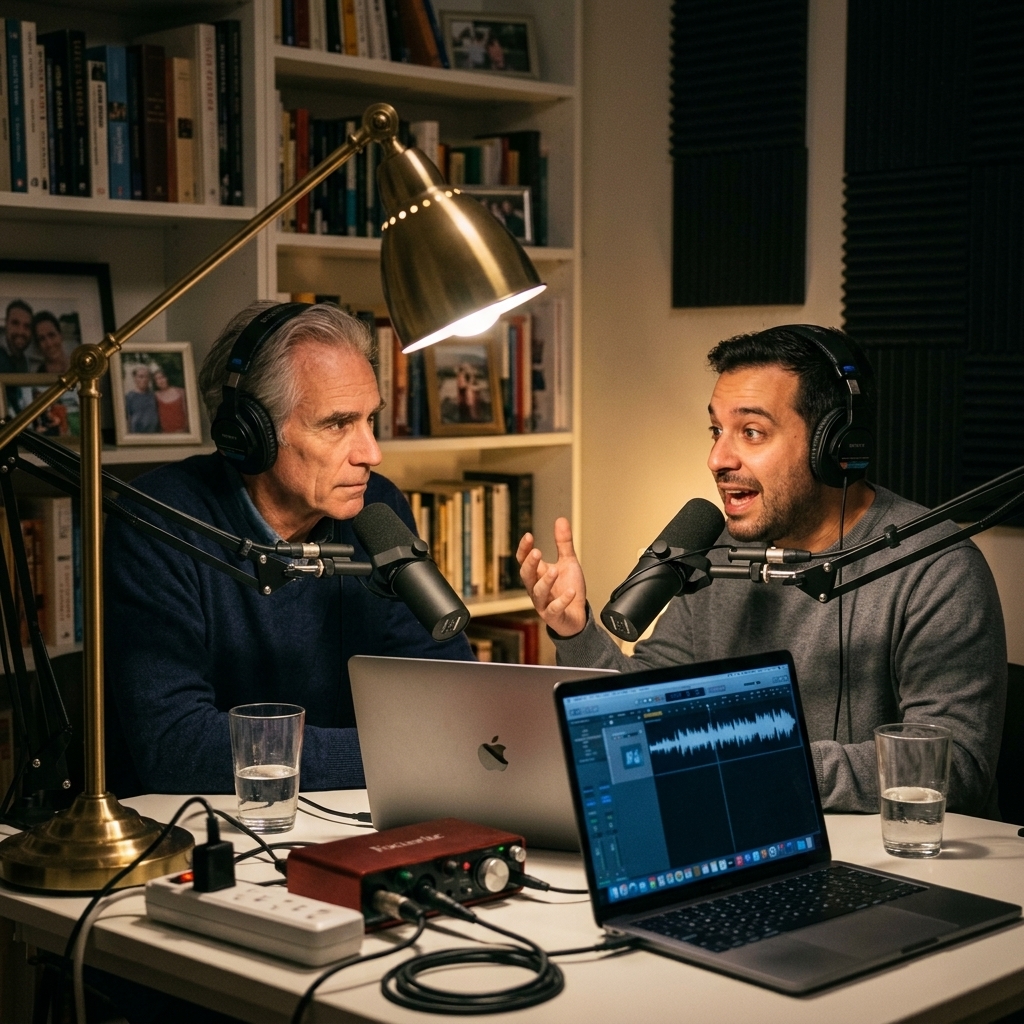
Fletcher EN
A federal judge used the word 'illegal' yesterday to describe something a sitting president did.
Not 'inadvisable.' Not 'constitutionally questionable.' Illegal.
The U.S.
Court of International Trade ruled that Trump's ten percent global tariffs, the ones slapped on essentially every country on earth, cannot stand.
Octavio ES
Y hay que entender lo que eso significa realmente, porque no es un tecnicismo menor.
And you have to understand what that actually means, because it's not a minor technicality.
El tribunal no dijo que los aranceles fueran una mala idea desde el punto de vista económico, que también lo son, sino que el presidente no tenía autoridad legal para imponerlos de esa manera.
The court didn't say the tariffs were a bad idea economically, which they also are, but that the president didn't have the legal authority to impose them in that way.
Es una distinción enorme.
That's an enormous distinction.
Fletcher EN
Right, and that distinction matters because it lands right in the middle of a much older argument: who in America actually controls trade policy?
The president?
Congress?
And the answer, constitutionally, has always been supposed to be Congress.
Octavio ES
Claro, la Constitución de Estados Unidos es bastante clara en esto: el Congreso tiene la potestad de regular el comercio con naciones extranjeras.
Right, the U.S.
Pero a lo largo del siglo veinte, el Congreso fue delegando esa autoridad al ejecutivo a través de distintas leyes, y ahí es donde empieza el lío.
Constitution is quite clear on this: Congress has the power to regulate commerce with foreign nations.
Fletcher EN
The specific law Trump used here was IEEPA, the International Emergency Economic Powers Act.
Passed in 1977.
And his administration argued it gave him essentially unlimited authority to impose tariffs whenever he declared a national emergency.
Octavio ES
Lo cual es una lectura absolutamente creativa de esa ley.
Which is an absolutely creative reading of that law.
La IEEPA se aprobó para situaciones extraordinarias y concretas, para bloquear activos de regímenes hostiles, para responder a amenazas específicas.
The IEEPA was passed for specific and extraordinary situations, to freeze assets of hostile regimes, to respond to concrete threats.
No fue pensada como un cheque en blanco arancelario para cualquier presidente que decida que el déficit comercial constituye una emergencia.
It was not designed as a blank tariff check for any president who decides the trade deficit constitutes a national emergency.
Fletcher EN
And yet that's exactly what the administration did.
They declared a national emergency over the trade deficit, and then used that emergency declaration as the legal foundation for tariffs on every country simultaneously.
Canada, Germany, Vietnam, Japan, all of them.
Octavio ES
Para poner esto en perspectiva histórica: desde que existe la IEEPA, ningún presidente la había utilizado para imponer aranceles generalizados.
To put this in historical perspective: since the IEEPA was created, no president had ever used it to impose widespread tariffs.
Se usó en contextos muy distintos.
It was used in very different contexts.
Reagan la invocó contra Nicaragua.
Reagan invoked it against Nicaragua.
Clinton, contra Haití.
Clinton, against Haiti.
Bush la usó después del once de septiembre para bloquear fondos terroristas.
Bush used it after September 11th to block terrorist funds.
Pero nadie había dado el salto de 'bloquear activos de un régimen' a 'gravar todo el comercio mundial'.
But no one had ever made the leap from 'freeze a regime's assets' to 'tax all global trade.'
Fletcher EN
I covered Reagan's second term from Beirut, and I can tell you that the Washington of that era had very clear lines between executive and congressional authority on trade.
The Uruguay Round, NAFTA, those went through Congress.
There was a process.
This felt like something different from the beginning.
Octavio ES
Y lo era.
And it was.
Fíjate que el argumento de la administración Trump era, en el fondo, que la emergencia nacional le daba poderes casi ilimitados en el ámbito económico.
Notice that the Trump administration's core argument was that the national emergency gave them near-unlimited powers in the economic sphere.
Eso no es una interpretación legal conservadora.
That's not a conservative legal interpretation.
Es una expansión radical del poder ejecutivo que tiene muy poco que ver con lo que el Congreso pretendía en 1977.
It's a radical expansion of executive power that has very little to do with what Congress intended in 1977.
Fletcher EN
Now, to be fair, this isn't the first time a president has pushed the edges of trade authority.
Let's talk about the deeper history here, because it goes back further than IEEPA.
The story of American tariffs is basically the story of Congress slowly, reluctantly, handing its power away.
Octavio ES
Y el punto de inflexión fue el Arancel Smoot-Hawley de 1930.
And the turning point was the Smoot-Hawley Tariff of 1930.
Una catástrofe histórica que el propio Congreso aprobó en plena Gran Depresión, elevando los aranceles a niveles sin precedentes.
A historic catastrophe that Congress itself passed in the depths of the Great Depression, raising tariffs to unprecedented levels.
El resultado fue una guerra comercial global que agravó la depresión y contribuyó, según muchos historiadores, a la inestabilidad política de los años treinta en Europa.
The result was a global trade war that deepened the depression and contributed, according to many historians, to the political instability of the 1930s in Europe.
Fletcher EN
Smoot-Hawley is the cautionary tale every economics professor assigns in week two.
And the lesson Congress drew from it was, essentially: we are not good at this.
We are too susceptible to domestic lobbying, too reactive, too short-sighted.
Let's give the president more flexibility.
Octavio ES
Exactamente.
Exactly.
A partir de los años cuarenta, el Congreso fue aprobando una serie de leyes que delegaban cada vez más poder al ejecutivo en materia de comercio.
From the 1940s onward, Congress passed a series of laws that increasingly delegated power to the executive on trade matters.
La lógica era que el presidente, al tener una visión más amplia de la política exterior, podría negociar tratados comerciales sin ceder a las presiones sectoriales que paralizaban al Congreso.
The logic was that the president, having a broader view of foreign policy, could negotiate trade agreements without yielding to the sectoral pressures that paralyzed Congress.
Es irónico, porque ese proceso de delegación es lo que Trump está explotando ahora.
The irony is that this delegation process is exactly what Trump is now exploiting.
Fletcher EN
The court's ruling essentially says that delegation has limits.
You can give the president a knife;
you can't give him a cannon and call it a knife.
IEEPA authorized targeted economic measures in genuine emergencies, not a sweeping rewrite of global trade relationships.
Octavio ES
Y hay una doctrina jurídica detrás de eso que conviene mencionar: la doctrina de las 'preguntas mayores', que ha cobrado mucha fuerza en el Tribunal Supremo en los últimos años.
And there's a legal doctrine behind that worth mentioning: the 'major questions doctrine,' which has gained significant traction at the Supreme Court in recent years.
La idea es que cuando el Congreso delega autoridad al ejecutivo, no se puede asumir que esa delegación incluye decisiones de consecuencias extraordinarias a menos que el Congreso lo haya dicho de manera explícita y clara.
The idea is that when Congress delegates authority to the executive, you cannot assume that delegation includes decisions of extraordinary consequence unless Congress stated it explicitly and clearly.
Fletcher EN
That doctrine has teeth now.
The conservative supermajority on the Supreme Court has been using it to rein in regulatory agencies, the EPA, OSHA.
And now a trade court is applying the same logic to presidential tariff authority.
That's a significant thread being pulled.
Octavio ES
Lo que resulta paradójico, porque en principio los conservadores apoyan a Trump y también apoyan la doctrina de las preguntas mayores.
Which is paradoxical, because in principle conservatives support Trump and also support the major questions doctrine.
Pero esas dos posiciones están en contradicción directa cuando el presidente invoca poderes de emergencia para reconfigurar el comercio mundial.
But those two positions are in direct contradiction when the president invokes emergency powers to reshape global trade.
No puedes defender ambas cosas a la vez sin hacer malabares intelectuales bastante acrobáticos.
You can't defend both simultaneously without performing some fairly acrobatic intellectual gymnastics.
Fletcher EN
Acrobatic intellectual gymnastics.
That's a generous description.
But let me ask you something, because you've watched American politics from the outside for a long time.
From a European perspective, how do you even explain what a court like the U.S.
Court of International Trade is?
It's not famous outside Washington.
Octavio ES
Es un tribunal especializado, establecido en 1980, con sede en Nueva York, que se ocupa exclusivamente de litigios relacionados con el comercio internacional y las aduanas.
It's a specialized court, established in 1980, based in New York, that deals exclusively with international trade and customs litigation.
No es el Tribunal Supremo, no es un tribunal de apelación federal ordinario.
It's not the Supreme Court, not an ordinary federal appellate court.
Es un tribunal de primera instancia con jurisdicción nacional exclusiva en materia arancelaria.
It's a trial court with exclusive national jurisdiction on tariff matters.
Lo que significa que esta no es la última palabra, ni mucho menos.
Which means this is not the final word, not by a long shot.
Fletcher EN
And that's where things get complicated.
The administration will appeal.
This goes to the Court of Appeals for the Federal Circuit, and ultimately it could reach the Supreme Court.
Given that court's current composition, predicting the outcome is not straightforward.
Octavio ES
No lo es.
It's not.
Pero hay algo más que me parece fundamental: mientras dure el proceso de apelación, ¿qué pasa con los aranceles?
But there's something I find more fundamental: during the appeals process, what happens to the tariffs?
¿Siguen vigentes?
Do they stay in effect?
Porque si el tribunal ha dictaminado que son ilegales pero siguen aplicándose durante años de litigios, el daño económico ya está hecho.
Because if the court ruled them illegal but they continue to be applied for years of litigation, the economic damage is already done.
Los mercados ya se han reconfigurado, las cadenas de suministro ya se han movido.
Markets have already reconfigured, supply chains have already moved.
El derecho va siempre por detrás de la realidad económica.
The law always lags behind economic reality.
Fletcher EN
You're right, and that's a point that gets lost in the legal coverage.
A tariff isn't like a speech or an executive order you can simply undo.
Companies have already restructured.
Contracts have been renegotiated.
Some factories that moved from China to Mexico or Vietnam, that move doesn't just reverse because a judge says so.
Octavio ES
Y eso conecta con algo más profundo sobre cómo funciona el poder en la práctica.
And that connects to something deeper about how power works in practice.
Una cosa es ganar un caso en los tribunales y otra muy distinta es deshacer las consecuencias de una política que estuvo vigente durante meses o años.
Winning a court case is one thing;
El derecho puede declarar algo ilegal, pero no puede devolver el tiempo.
undoing the consequences of a policy that was in effect for months or years is quite another.
Fletcher EN
I want to zoom out to the international picture for a second.
Because the countries on the receiving end of these tariffs, the Europeans, the Japanese, the Canadians, they responded.
They imposed retaliatory tariffs.
Does this ruling affect any of that?
Octavio ES
Directamente no, porque los aranceles de represalia son decisiones soberanas de otros países, fuera de la jurisdicción de los tribunales estadounidenses.
Not directly, because retaliatory tariffs are sovereign decisions by other countries, outside the jurisdiction of U.S.
Pero indirectamente, sí crea una apertura política.
courts.
Si los aranceles de Trump son declarados ilegales y eventualmente eliminados, los socios comerciales necesitan una salida diplomática para retirar los suyos sin que parezca una capitulación.
But indirectly, yes, it creates a political opening.
Un fallo judicial les da esa cobertura.
If Trump's tariffs are declared illegal and eventually eliminated, trading partners need a diplomatic off-ramp to withdraw their own without it looking like a capitulation.
Fletcher EN
That framing is useful.
Nobody wants to be seen blinking first.
But if the judge blinked for you, technically you're just complying with a court order.
Octavio ES
Exacto.
Exactly.
Y ahí entra la dimensión de la OMC, la Organización Mundial del Comercio, que lleva años en una posición incómoda con respecto a los aranceles unilaterales de Trump.
And that's where the WTO dimension comes in, the World Trade Organization, which has been in an uncomfortable position for years regarding Trump's unilateral tariffs.
La OMC tiene sus propios mecanismos de resolución de disputas, pero son lentos y, francamente, la administración Trump los ha ignorado en gran medida.
The WTO has its own dispute settlement mechanisms, but they're slow and, frankly, the Trump administration has largely ignored them.
Este fallo nacional podría reforzar, o al menos no debilitar, la posición de los que argumentan que Estados Unidos tiene que volver al marco multilateral.
This domestic ruling could reinforce, or at least not weaken, the position of those arguing that the U.S.
Fletcher EN
I spent time in Geneva in the early nineties covering the Uruguay Round, the negotiations that created the WTO.
And the American officials I talked to back then were genuinely proud of it.
They thought they were building something durable.
The idea that twenty years later a U.S.
administration would treat it as an inconvenience would have seemed unthinkable.
Octavio ES
No tan impensable para los europeos, que siempre hemos tenido dudas sobre si Estados Unidos iba a mantenerse comprometido con las instituciones que ayudó a crear.
Not so unthinkable to Europeans, who have always had doubts about whether the U.S.
Hay un patrón histórico de que Estados Unidos construye la arquitectura internacional y luego se reserva el derecho de ignorarla cuando le conviene.
would remain committed to the institutions it helped create.
No es exclusivo de Trump;
There's a historical pattern of the U.S.
Trump solo lo hace con menos disimulo.
building the international architecture and then reserving the right to ignore it when convenient.
Fletcher EN
That's a fair criticism and I'm not going to argue with it.
But I think what makes this ruling different is that the pushback is coming from inside the American legal system itself, not from Brussels or Geneva.
Domestic courts have a legitimacy that international institutions simply don't have in the American political conversation.
Octavio ES
Ahí tienes razón.
There you're right.
Y eso importa porque cambia la naturaleza política del debate.
And that matters because it changes the political nature of the debate.
Cuando la OMC critica a Estados Unidos, el mensaje fácil para los populistas es 'burocracia extranjera'.
When the WTO criticizes the U.S., the easy populist message is 'foreign bureaucracy.' When it's said by a federal judge appointed by a Republican president, that's harder to dismiss.
Cuando lo dice un juez federal nombrado por un presidente republicano, eso es más difícil de desestimar.
Not impossible, but harder.
No imposible, pero más difícil.
Fletcher EN
The broader question this raises for me, and maybe this is the journalist in me, is about the precedent.
If this administration loses in court and the tariffs fall, the next administration that wants to use emergency powers for something Congress never explicitly authorized will have this precedent hanging over them.
That cuts both ways politically.
Octavio ES
Sí, pero hay que ser honesto: los precedentes judiciales en Estados Unidos no siempre tienen el peso que deberían.
Yes, but let's be honest: judicial precedents in the U.S.
La doctrina de la deferencia judicial hacia el ejecutivo en materia de seguridad nacional y política exterior ha sido muy flexible históricamente.
don't always carry the weight they should.
Lo que un tribunal afirma hoy puede ser revisado o matizado mañana.
The doctrine of judicial deference to the executive on national security and foreign policy matters has been historically very flexible.
El derecho constitucional estadounidense es mucho más vivo y disputado de lo que parece desde fuera.
What one court affirms today can be revised or qualified tomorrow.
Fletcher EN
True.
And in the meantime, the world has to operate inside this uncertainty.
Companies making sourcing decisions, finance ministers planning budgets, they can't wait for the Supreme Court's final word.
This legal limbo has a real economic cost.
Octavio ES
La incertidumbre es, en sí misma, una forma de política comercial.
Uncertainty is, in itself, a form of trade policy.
Cuando no sabes si el arancel va a estar mañana o no, tomas decisiones más conservadoras, inviertes menos, diversificas más.
When you don't know whether the tariff will be there tomorrow or not, you make more conservative decisions, invest less, diversify more.
Eso frena el crecimiento incluso antes de que un solo arancel sea pagado.
That slows growth even before a single tariff dollar is paid.
Es algo que los modelos económicos convencionales capturan mal, porque modelan los aranceles como un impuesto fijo y no como una nube de incertidumbre permanente.
It's something conventional economic models capture poorly, because they model tariffs as a fixed tax rather than as a permanent cloud of uncertainty.
Fletcher EN
The Trump administration's response so far has been what you'd expect: they say the ruling is wrong, they'll appeal, the tariffs remain in effect for now.
But the political optics are genuinely complicated.
They've built their economic argument on these tariffs.
Calling them illegal undermines the whole framing.
Octavio ES
Y hay algo que no debería pasarse por alto: el hecho de que este fallo llegue en un momento en que ya hay negociaciones comerciales en marcha con varios países.
And there's something that shouldn't be overlooked: the fact that this ruling arrives at a moment when trade negotiations are already underway with several countries.
La Casa Blanca estaba usando los aranceles como palanca negociadora.
The White House was using the tariffs as a negotiating lever.
Si esa palanca puede ser declarada ilegal, ¿con qué negocian?
If that lever can be declared illegal, what do they negotiate with?
Pierde fuerza el argumento de 'podemos mantenernos así indefinidamente'.
The argument that 'we can hold this position indefinitely' loses force.
Fletcher EN
Leverage depends entirely on credibility.
If the other side thinks your threat might evaporate in court, they have every incentive to wait you out.
And some of these countries, Japan, the EU, they have the institutional patience to do exactly that.
Octavio ES
Europa desde luego.
Europe certainly does.
La Comisión Europea tiene una capacidad de espera notable.
The European Commission has a remarkable capacity to wait.
No porque sean especialmente valientes, sino porque el proceso de toma de decisiones europeo es tan lento que la paciencia es una condición estructural, no una virtud.
Not because they're especially brave, but because the European decision-making process is so slow that patience is a structural condition, not a virtue.
Fletcher EN
That's almost a compliment.
Look, the bottom line here seems to be: this ruling matters, it could shape the legal landscape for executive trade authority for decades, but it's far from over, and the practical effects depend entirely on what happens on appeal.
Octavio ES
Y dependen también de quién esté en la Casa Blanca cuando llegue la decisión final.
And they also depend on who is in the White House when the final decision arrives.
Si Trump sigue, intentará encontrar un camino alternativo.
If Trump is still there, he'll try to find an alternative path.
Si hay un presidente diferente, puede que ni siquiera llegue al Supremo porque la política habrá cambiado.
If there's a different president, it may never reach the Supreme Court because policy will have changed.
El derecho y la política en Estados Unidos están más entrelazados de lo que cualquier constitución debería permitir, en mi opinión.
Law and politics in the U.S.
Fletcher EN
You'd get no argument from me on that.
Actually, speaking of things being intertwined, there was a construction you used a little while back that I want to ask you about.
You said 'podría reforzar, o al menos no debilitar.' That little 'al menos' phrase sitting in the middle of a negative clause like that.
Is that a common construction?
Octavio ES
Sí, y es muy útil en español cuando quieres matizar sin retractarte.
Yes, and it's very useful in Spanish when you want to qualify something without backing down.
'Al menos' marca el mínimo aceptable dentro de una escala.
'Al menos' marks the acceptable minimum on a scale.
No estoy diciendo que algo sea bueno, solo que no llega a ser malo.
I'm not saying something is good, only that it doesn't reach being bad.
Podrías decir, por ejemplo: 'Su español no ha mejorado, o al menos no ha empeorado.' Tiene un toque de resignación diplomática.
You could say, for example: 'His Spanish hasn't improved, or at least it hasn't gotten worse.' It has a touch of diplomatic resignation.
Fletcher EN
That example felt targeted.
But it's a good construction.
English has something similar with 'if nothing else,' as in 'the ruling matters, if nothing else, as a signal.' But 'al menos' sits tighter in a sentence.
It doesn't need the full phrase.
Octavio ES
Correcto.
Correct.
También tiene una variante más coloquial: 'por lo menos', que es intercambiable en la mayoría de los contextos.
It also has a more colloquial variant: 'por lo menos,' which is interchangeable in most contexts.
Y luego está 'siquiera', que es más enfático y a menudo aparece con negación: 'ni siquiera'.
And then there's 'siquiera,' which is more emphatic and often appears with negation: 'ni siquiera.' That one carries a different emotional weight, almost a grievance.
Ahí ya hay un peso emocional distinto, casi una queja.
'He didn't even call.' The 'ni siquiera' adds a charge of disbelief or disappointment that 'al menos' doesn't have.
'Ni siquiera llegó a llamar.' El 'ni siquiera' añade una carga de incredulidad o decepción que 'al menos' no tiene.
Fletcher EN
So 'al menos' is the measured, analytical version, and 'ni siquiera' is when you're genuinely annoyed.
I need to remember that distinction for the next family dinner in Madrid where I accidentally say something I shouldn't.
Octavio ES
O puedes usar 'ni siquiera sé cómo llegué a este punto', que sería la frase exacta de tu suegro cuando intentes hablar de política española.
Or you could use 'ni siquiera sé cómo llegué a este punto,' which would be the exact phrase your father-in-law uses when you try to talk Spanish politics.
Al menos lo intentas, Fletcher.
At least you try, Fletcher.
Al menos lo intentas.
At least you try.