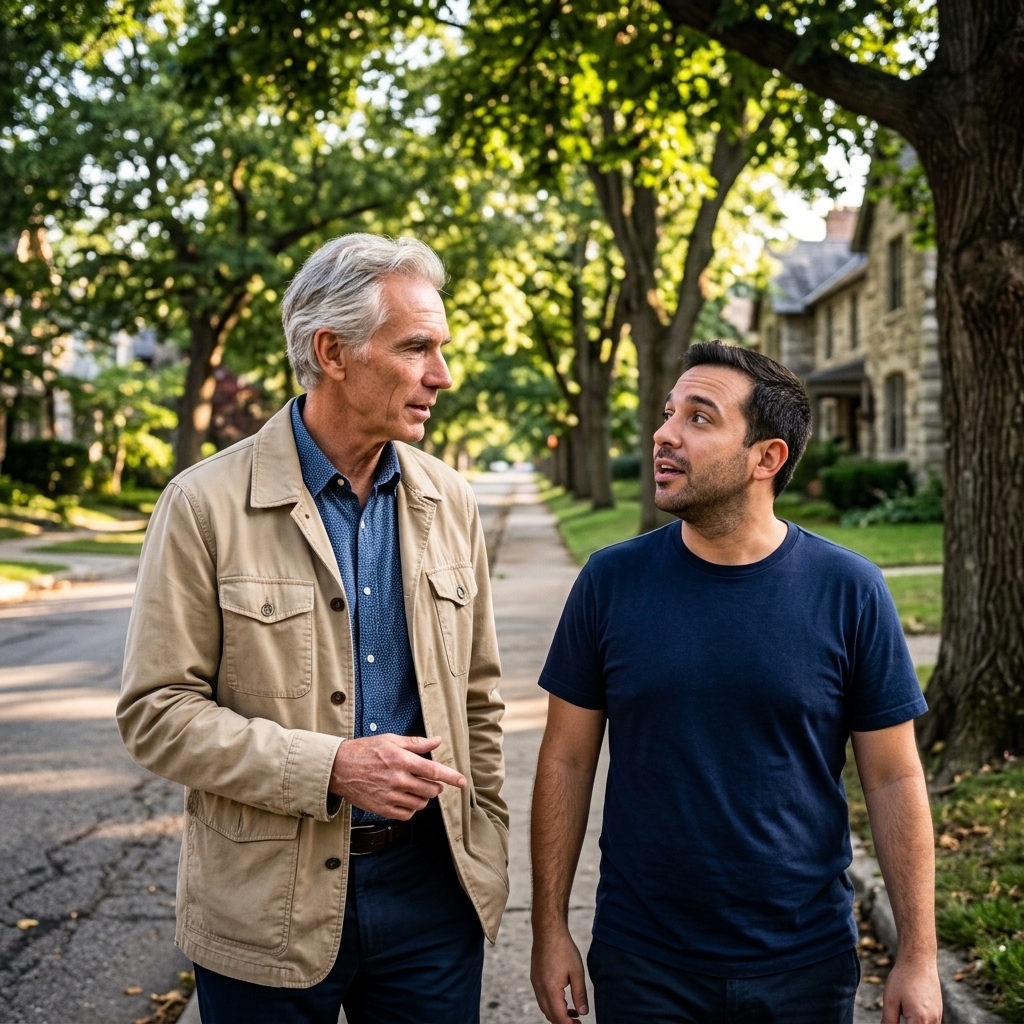
Fletcher EN
So I want to start with a number.
The World Bank estimates that by 2050, somewhere between 216 and 250 million people could be internally displaced by climate change alone.
Not war, not political persecution.
Just the planet becoming unlivable in the places they were born.
Octavio ES
Bueno, y ese número, Fletcher, es solo los desplazados internos.
And that number, Fletcher, only counts internally displaced people.
Si contamos a los que cruzarán fronteras internacionales, la cifra se dispara de una manera que ningún sistema político actual está preparado para gestionar.
If we include those who will cross international borders, the figure shoots up in a way that no current political system is equipped to manage.
Estamos hablando de la mayor reconfiguración de poblaciones humanas desde la Segunda Guerra Mundial, y la mayoría de los gobiernos todavía lo tratan como un problema del futuro.
We're talking about the largest reshaping of human populations since the Second World War, and most governments still treat it as a future problem.
Fletcher EN
Right, and here's the thing that keeps nagging at me.
It's already happening.
This isn't a projection about 2050.
The Sahel, coastal Bangladesh, parts of Central America.
People are moving right now, and we're still having the argument about whether climate migration is a real category.
Octavio ES
Es que ahí está el primer problema, y es un problema que tiene consecuencias jurídicas enormes.
That's exactly the first problem, and it has enormous legal consequences.
La Convención de Ginebra de 1951 reconoce como refugiado a quien huye de persecución, de guerra, de violencia organizada.
The 1951 Geneva Convention recognizes as a refugee someone fleeing persecution, war, or organized violence.
Pero no existe ningún instrumento legal internacional que proteja a alguien que huye porque su delta fluvial se ha inundado permanentemente o porque tres cosechas seguidas han fracasado por la sequía.
But there is no international legal instrument that protects someone fleeing because their river delta has permanently flooded or because three consecutive harvests have failed due to drought.
Fletcher EN
So there's no such thing, legally speaking, as a climate refugee.
Which means millions of people are moving across borders in a legal gray zone.
They're not refugees, they're not economic migrants in any traditional sense.
They're just, what, stateless people in motion?
Octavio ES
Mira, la terminología importa porque determina los derechos.
Terminology matters because it determines rights.
Un refugiado tiene derechos reconocidos: no devolución, acceso a servicios, posibilidad de asilo.
A refugee has recognized rights: non-refoulement, access to services, the possibility of asylum.
Un migrante económico, según la retórica política dominante en Europa y en Estados Unidos, es alguien que viene a quitarte el trabajo.
An economic migrant, according to dominant political rhetoric in Europe and the US, is someone coming to take your job.
El desplazado climático no encaja en ninguna de las dos categorías y eso lo deja completamente desprotegido.
The climate displaced person fits neither category, and that leaves them completely unprotected.
Fletcher EN
I spent time in the Horn of Africa back in the mid-nineties and what you saw, even then, was how famine and drought and conflict were completely tangled together.
You couldn't separate them.
The climate destabilized agriculture, agriculture collapsed, then came the fighting over what was left.
The idea that we can draw clean lines between climate migrants and conflict migrants seems almost naive.
Octavio ES
No, no, tienes toda la razón, y hay investigación académica sólida que respalda exactamente eso.
You're absolutely right, and there's solid academic research backing exactly that.
Hay un estudio muy citado sobre Siria que argumenta que la sequía entre 2007 y 2010, la peor en 900 años según los registros, provocó el desplazamiento de cerca de 1,5 millones de campesinos hacia las ciudades, lo que contribuyó a las tensiones sociales que precedieron a la guerra civil.
There's a widely cited study on Syria arguing that the drought between 2007 and 2010, the worst in 900 years according to records, displaced around 1.5 million farmers to cities, contributing to social tensions that preceded the civil war.
El clima no causó la guerra, pero le puso el combustible.
Climate didn't cause the war, but it provided the fuel.
Fletcher EN
The extraordinary thing is that the Pentagon has been saying this for years.
The US military started calling climate change a threat multiplier back in 2014.
They weren't talking about polar bears.
They were talking about failed states, resource wars, mass population movements creating ungovernable spaces.
Octavio ES
A ver, y ahí es donde la geopolítica se vuelve especialmente incómoda, porque entramos en la pregunta de la responsabilidad histórica.
And that's where the geopolitics gets especially uncomfortable, because we enter the question of historical responsibility.
Los países que más han contribuido históricamente a las emisiones de gases de efecto invernadero son, básicamente, las economías industrializadas de Europa occidental y América del Norte.
The countries that have contributed most historically to greenhouse gas emissions are, basically, the industrialized economies of Western Europe and North America.
Y los países que van a sufrir las consecuencias más devastadoras son, en general, los que menos han emitido.
And the countries that will suffer the most devastating consequences are, generally, those that have emitted the least.
Fletcher EN
Look, that asymmetry is genuinely staggering when you lay it out.
Bangladesh contributes less than 0.3 percent of global emissions.
It stands to lose a third of its landmass to sea level rise.
That's not bad luck.
That is a specific historical injustice with specific authors.
Octavio ES
La verdad es que en las negociaciones climáticas internacionales esto se llama el principio de responsabilidades comunes pero diferenciadas, que es una forma muy diplomática de decir que el que más ha contaminado debería pagar más.
In international climate negotiations this is called the principle of common but differentiated responsibilities, which is a very diplomatic way of saying that whoever polluted most should pay most.
Pero en la práctica, los compromisos financieros que los países ricos han hecho hacia los más vulnerables han sido sistemáticamente incumplidos.
But in practice, the financial commitments rich countries have made to the most vulnerable have been systematically unmet.
El famoso fondo de 100.000 millones de dólares anuales prometido en Copenhague en 2009 tardó años en materializarse y sigue siendo insuficiente.
The famous 100 billion dollar annual fund promised in Copenhagen in 2009 took years to materialize and remains insufficient.
Fletcher EN
I mean, the gap between the rhetoric and the reality is almost vertiginous.
And then you layer on top of that the political moment we're in, where the countries that would need to be most generous are the ones experiencing the sharpest political backlash against immigration of any kind.
Octavio ES
Bueno, y aquí España es un ejemplo particularmente revelador.
Spain is a particularly revealing example.
Somos un país mediterráneo, frontera sur de Europa, y enfrentamos una doble vulnerabilidad.
We're a Mediterranean country, Europe's southern border, facing a double vulnerability.
Por un lado, recibimos flujos migratorios importantes desde el Sahel y desde el Magreb, regiones que ya están experimentando una desertificación acelerada.
On one hand, we receive significant migratory flows from the Sahel and the Maghreb, regions already experiencing accelerated desertification.
Por otro lado, nosotros mismos somos vulnerables: el sureste peninsular, Murcia, Almería, está sufriendo un proceso de aridificación que algunos climatólogos comparan con el norte de África.
On the other hand, we ourselves are vulnerable: the southeastern peninsula, Murcia, Almería, is undergoing an aridification process that some climatologists compare to North Africa.
Fletcher EN
So Spain is simultaneously a destination country and a country that in some scenarios becomes a source country.
That's a profound shift in how southern Europeans have to think about themselves in this story.
Octavio ES
Exacto, y eso conecta con algo más profundo sobre la historia europea.
Exactly, and that connects to something deeper about European history.
Hubo décadas en el siglo XX en las que los españoles, los portugueses, los italianos emigraban masivamente hacia el norte de Europa y hacia América.
There were decades in the 20th century when Spaniards, Portuguese, and Italians emigrated massively to northern Europe and the Americas.
Mi propia familia, Fletcher, tiene historia de emigración.
My own family has a history of emigration.
Mi abuelo se fue a Suiza en los años sesenta.
My grandfather went to Switzerland in the 1960s.
Esa memoria debería hacernos más humildes cuando hablamos de fronteras y de quién tiene derecho a moverse.
That memory should make us more humble when we talk about borders and who has the right to move.
Fletcher EN
Right, so let's get specific about regions because I think the abstraction is part of what makes this hard to grasp.
The Sahel first.
We're talking about a band across Africa just south of the Sahara.
What's actually happening there on the ground?
Octavio ES
Mira, en el Sahel lo que estás viendo es una confluencia catastrófica de factores.
In the Sahel you're seeing a catastrophic confluence of factors.
El lago Chad, que fue en algún momento uno de los mayores lagos de África, ha perdido aproximadamente el 90 por ciento de su superficie desde los años sesenta.
Lake Chad, once one of Africa's largest lakes, has lost roughly 90 percent of its surface area since the 1960s.
Eso ha destruido economías enteras basadas en la pesca y la agricultura de ribera.
That has destroyed entire economies built around fishing and riverside agriculture.
Los agricultores y los pastores compiten por tierras cada vez más escasas.
Farmers and herders compete for increasingly scarce land.
Ese conflicto por recursos ha alimentado a grupos armados como Boko Haram, que reclutan precisamente entre los jóvenes que han perdido sus medios de vida.
That resource conflict has fueled armed groups like Boko Haram, which recruit precisely among young people who have lost their livelihoods.
Fletcher EN
So the climate story becomes a security story becomes a migration story.
And by the time it reaches a European border, it looks like an immigration crisis and the original cause, the lake that disappeared, gets completely lost in the political conversation.
Octavio ES
Es que esa desconexión narrativa es, en sí misma, políticamente conveniente para ciertos actores.
That narrative disconnection is, in itself, politically convenient for certain actors.
Si logras que el debate público se centre en las personas que llegan en patera al Mediterráneo, no tienes que hablar de por qué llegaron, ni de quién lleva décadas extrayendo los recursos naturales de esas regiones, ni de qué empresas compraron las tierras agrícolas que antes sustentaban a esas comunidades.
If you can keep the public debate focused on the people arriving by boat in the Mediterranean, you don't have to talk about why they came, or who has spent decades extracting natural resources from those regions, or which companies bought the agricultural land that used to sustain those communities.
Fletcher EN
Central America is another case I think about a lot.
The so-called Dry Corridor, Guatemala, Honduras, El Salvador.
I have a colleague who did a long piece on this, and what she found was that farmers who had been growing maize on the same land for three generations simply couldn't anymore.
The rains stopped coming when they were supposed to.
Octavio ES
La verdad es que el caso centroamericano es fascinante y trágico a la vez porque desmonta uno de los grandes mitos sobre la migración hacia Estados Unidos.
The Central American case is both fascinating and tragic because it dismantles one of the great myths about migration toward the United States.
Durante décadas, el discurso político estadounidense ha retratado esa migración casi exclusivamente como un problema de violencia de pandillas o de corrupción estatal.
For decades, US political discourse portrayed that migration almost exclusively as a problem of gang violence or state corruption.
Y esas cosas son reales.
Those things are real.
Pero si hablas con los migrantes, una proporción enorme te dirá que sus cosechas fallaron, que el café ya no crece a esas alturas, que el agua escasea.
But if you talk to the migrants, a huge proportion will tell you their harvests failed, that coffee no longer grows at those altitudes, that water is scarce.
Fletcher EN
And then there are the Pacific Island nations, which are in a category entirely their own.
Because we're not talking about degraded livelihoods or failed harvests.
We're talking about countries that will literally cease to exist as territory.
Kiribati, Tuvalu, the Marshall Islands.
Where do you even begin with the legal and moral implications of a nation drowning?
Octavio ES
A ver, ese es el escenario más filosóficamente perturbador de todo este debate.
That is the most philosophically disturbing scenario in this entire debate.
Porque la soberanía estatal, en el derecho internacional, está vinculada a un territorio.
Because state sovereignty, in international law, is tied to a territory.
¿Qué ocurre con la soberanía cuando el territorio desaparece bajo el agua?
What happens to sovereignty when the territory disappears beneath the water?
¿Sigue existiendo Kiribati como Estado si sus ciudadanos viven dispersos en Nueva Zelanda y Australia?
Does Kiribati continue to exist as a state if its citizens live scattered across New Zealand and Australia?
¿Conservan su identidad, su lengua, su cultura?
Do they retain their identity, their language, their culture?
Hay académicos de derecho internacional que llevan años intentando responder esas preguntas y no hay consenso.
International law scholars have spent years trying to answer those questions and there is no consensus.
Fletcher EN
The president of Kiribati actually bought land in Fiji years ago as a contingency plan.
For his people.
He called it migration with dignity.
And I remember reading that and thinking, what a phrase.
What a quiet, devastating phrase.
Octavio ES
Bueno, y esa frase encierra toda la dignidad y toda la impotencia de la situación.
That phrase contains all the dignity and all the helplessness of the situation.
Porque lo que están diciendo es: vamos a tener que irnos, sabemos que vamos a tener que irnos, y lo único que podemos hacer es intentar que sea en nuestros propios términos y no de manera caótica.
What they're saying is: we're going to have to leave, we know we have to leave, and all we can do is try to make it happen on our own terms rather than chaotically.
Es una rendición planificada ante una injusticia que ellos no han causado.
It is a planned surrender in the face of an injustice they did not cause.
Fletcher EN
There's a debate, though, that I want to put to you because I think it's genuinely difficult.
Some researchers argue that framing everything as inevitable migration actually undermines investment in adaptation.
The argument being: if we tell people they have to leave, they leave, instead of building sea walls or developing drought-resistant crops or managed retreat strategies that might buy decades.
Octavio ES
Es una objeción legítima, pero creo que tiene un fallo fundamental, que es que pone la carga de la solución sobre las poblaciones más vulnerables.
It's a legitimate objection, but I think it has a fundamental flaw, which is that it places the burden of the solution on the most vulnerable populations.
Decirle a un agricultor en el Sahel que desarrolle cultivos resistentes a la sequía, cuando no tiene acceso a semillas mejoradas, ni a financiación, ni a infraestructura de riego, es una crueldad disfrazada de pragmatismo.
Telling a farmer in the Sahel to develop drought-resistant crops, when they have no access to improved seeds, no financing, no irrigation infrastructure, is cruelty disguised as pragmatism.
La adaptación requiere inversión masiva que solo puede venir de los países con capacidad económica.
Adaptation requires massive investment that can only come from economically capable countries.
Fletcher EN
No, you're absolutely right about that.
And I'd add that the adaptation versus migration framing presents a false choice.
In practice, communities that get adaptation support early have more time to make orderly decisions about if and when to move.
Whereas communities that get nothing face sudden, chaotic displacement.
So adaptation funding is also migration management, in a sense.
Octavio ES
Mira, y ahí está uno de los argumentos que más me interesa, que es el argumento del interés propio para los países ricos.
And there's one argument that interests me most, which is the self-interest argument for rich countries.
No hace falta apelar a la solidaridad ni a la justicia climática, que son argumentos correctos pero políticamente débiles en este momento.
You don't need to appeal to solidarity or climate justice, which are correct but politically weak arguments right now.
Basta con señalar que la migración desordenada, la desestabilización de regiones enteras, el fortalecimiento de grupos armados, todo eso tiene un coste para Europa y para Estados Unidos que supera con creces lo que costaría una inversión seria en adaptación.
You just need to point out that disordered migration, the destabilization of entire regions, the strengthening of armed groups, all of that has a cost for Europe and the United States that far exceeds what serious investment in adaptation would cost.
Fletcher EN
The political problem, of course, is that the payoff from that investment is diffuse and long-term, and the political incentive structure rewards short-term visible action.
Building a wall is visible.
Funding climate-resilient agriculture in Guatemala is not.
Octavio ES
Es que eso me lleva al que quizás es el debate más difícil de todos, que es quién toma las decisiones sobre adónde van estas personas.
That leads me to perhaps the hardest debate of all, which is who decides where these people go.
Porque hay una tensión profunda entre, por un lado, el derecho de los Estados a controlar sus fronteras, que es un principio fundamental del orden internacional, y por otro lado, la realidad de que ese principio se convierte en una sentencia de muerte para poblaciones que no tienen opciones.
Because there's a deep tension between, on one hand, the right of states to control their borders, a fundamental principle of the international order, and on the other hand, the reality that this principle becomes a death sentence for populations with no options.
Fletcher EN
Here's what gets me about the border sovereignty argument.
It functions as a kind of moral laundering.
Rich countries can emit for two centuries, destabilize the climate, watch the consequences play out in the world's poorest places, and then say, very regretfully, that they cannot accept the people produced by those consequences because, well, sovereignty.
Octavio ES
La verdad es que los movimientos políticos de extrema derecha en Europa han comprendido perfectamente que la migración climática es el terreno donde se va a librar la batalla ideológica de las próximas décadas.
The far-right political movements in Europe have understood perfectly that climate migration is the terrain where the ideological battle of the coming decades will be fought.
No por casualidad, el negacionismo climático y el nativismo antiinmigrante son casi siempre posturas del mismo espacio político.
It's no coincidence that climate denial and anti-immigrant nativism almost always occupy the same political space.
Negar el cambio climático es también una forma de negar la obligación moral que genera.
Denying climate change is also a way of denying the moral obligation it creates.
Fletcher EN
I want to ask you about something that comes up in every conversation about this topic and it's the question of numbers.
Because the projections vary wildly.
Some say 200 million by 2050.
Others say over a billion.
How do we think about that uncertainty without it becoming an excuse for inaction?
Octavio ES
A ver, la incertidumbre en los modelos climáticos existe y es real, pero funciona en ambas direcciones: los escenarios pueden ser mejores de lo previsto o peores.
The uncertainty in climate models exists and is real, but it works in both directions: scenarios can be better or worse than predicted.
Y la historia reciente sugiere que las peores consecuencias del cambio climático tienden a materializarse antes de lo que los modelos más conservadores predicen.
And recent history suggests that the worst climate consequences tend to materialize sooner than the most conservative models predict.
El Ártico se está calentando cuatro veces más rápido que el promedio global.
The Arctic is warming four times faster than the global average.
Eso no estaba en las proyecciones de hace quince años.
That wasn't in the projections from fifteen years ago.
Fletcher EN
So the uncertainty is asymmetric.
The range of outcomes skews bad.
And the responsible thing, when you're dealing with an asymmetric risk of this magnitude, is to plan for the worse end of the range, not anchor to the comfortable middle.
Octavio ES
Bueno, y hay precedentes históricos que deberían hacernos reflexionar sobre lo que ocurre cuando no planificamos.
There are historical precedents that should make us reflect on what happens when we don't plan.
La Partición de la India en 1947 desplazó a entre 10 y 20 millones de personas en cuestión de meses, en circunstancias caóticas, con un coste humano devastador.
The 1947 Partition of India displaced between 10 and 20 million people in a matter of months, chaotically, with a devastating human cost.
Nadie había planificado realmente cómo gestionar ese movimiento de población.
Nobody had really planned how to manage that population movement.
El resultado fue una de las peores crisis humanitarias del siglo XX.
The result was one of the worst humanitarian crises of the 20th century.
Ahora multiplicamos eso por diez y lo distribuimos en décadas, pero sin un marco coordinado.
Now multiply that by ten, distribute it over decades, but with no coordinated framework.
Fletcher EN
The Partition comparison is striking.
Because there you also had a political class that refused to plan seriously because planning for partition seemed like accepting it, seemed like giving up on unity.
And so when it happened it happened violently and without preparation.
There's a similar logic at work here.
Planning for mass climate migration feels like giving up on solving climate change.
Octavio ES
Es que son cosas que tienen que ocurrir simultáneamente, y la incapacidad política para sostener dos ideas a la vez es uno de los grandes obstáculos de nuestra época.
These things have to happen simultaneously, and the political incapacity to hold two ideas at once is one of the great obstacles of our era.
Reducir emisiones y planificar la adaptación y gestionar la migración.
Reducing emissions and planning for adaptation and managing migration.
No son alternativas.
These are not alternatives.
Son tres respuestas necesarias a la misma crisis en tres horizontes temporales distintos.
They are three necessary responses to the same crisis on three different time horizons.
Fletcher EN
I want to ask you something a bit more speculative.
Because there are scholars who argue that climate migration, if managed well, could actually be an opportunity.
That receiving aging, depopulating countries in Europe actually need migrants.
That there's a version of this where the population movements of the next fifty years are part of a managed demographic rebalancing.
Is that naive?
Octavio ES
No es ingenuo como análisis demográfico, porque los números son los que son: España tiene una de las tasas de natalidad más bajas del mundo, el sistema de pensiones necesita trabajadores cotizantes, y hay sectores enteros de la economía que dependen de mano de obra que los españoles ya no quieren o no pueden proporcionar.
It's not naive as demographic analysis, because the numbers are what they are: Spain has one of the lowest birth rates in the world, the pension system needs contributing workers, and entire sectors of the economy depend on labor that Spaniards no longer want or can provide.
Lo que es ingenuo es pensar que la política va a dar ese paso hacia adelante sin una transformación profunda en el discurso público sobre la identidad y la pertenencia.
What's naive is thinking that politics will take that step forward without a profound transformation in public discourse about identity and belonging.
Fletcher EN
So the economic logic points one way and the political logic points the other.
And the question is which one wins.
And historically, in moments of fear and scarcity, the political logic tends to win.
Which is exactly why thinking seriously about managed climate migration now, before the acute crisis hits, is so important.
Octavio ES
Mira, hay una iniciativa que me parece que apunta en la dirección correcta aunque todavía sea muy pequeña.
There's an initiative that I think points in the right direction, even if it's still very small.
Nueva Zelanda introdujo en 2017 una categoría específica de visado para migrantes del Pacífico vulnerables al cambio climático.
New Zealand introduced in 2017 a specific visa category for Pacific migrants vulnerable to climate change.
No es un sistema completo, tiene límites claros, pero reconoce el principio de que hay una responsabilidad diferenciada.
It's not a complete system, it has clear limits, but it recognizes the principle that there is a differentiated responsibility.
Es el tipo de innovación jurídica e institucional que necesitamos a escala global y que por ahora solo existe en destellos aislados.
It's the kind of legal and institutional innovation we need at a global scale, and which for now only exists in isolated flashes.
Fletcher EN
And it matters symbolically, too.
Because once one country recognizes the category, it becomes harder for others to pretend the category doesn't exist.
Law evolves that way, through precedent, through one jurisdiction making explicit what others leave tacit.
Octavio ES
Es que en el fondo, lo que este debate revela es que el orden internacional que construimos después de 1945 fue diseñado para gestionar conflictos entre Estados, no consecuencias sistémicas de la actividad económica global.
At bottom, what this debate reveals is that the international order we built after 1945 was designed to manage conflicts between states, not systemic consequences of global economic activity.
El calentamiento climático es una externalidad negativa sin precedentes históricos en cuanto a escala y complejidad, y nuestras instituciones multilaterales simplemente no fueron concebidas para abordar algo así.
Climate warming is a negative externality without historical precedent in scale and complexity, and our multilateral institutions simply were not conceived to address something like this.
Fletcher EN
So the institutions are the wrong shape for the problem.
And reforming them is precisely the kind of slow, unglamorous, politically unrewarding work that doesn't generate headlines but is probably the most important thing happening, or not happening, in international affairs right now.
Octavio ES
Bueno, y quiero terminar con algo que me parece que a veces se pierde en los debates sobre política climática, que es la humanidad concreta de lo que estamos hablando.
I want to end with something that I think gets lost in climate policy debates, which is the concrete humanity of what we're discussing.
Detrás de cada proyección estadística hay una persona que tiene una relación con un lugar, con una tierra, con un idioma, con una forma de cocinar, con una forma de enterrar a sus muertos.
Behind every statistical projection there is a person who has a relationship with a place, with a land, with a language, with a way of cooking, with a way of burying their dead.
La migración climática no es solo un problema de logística.
Climate migration is not just a logistics problem.
Es una pérdida cultural de proporciones que todavía no sabemos medir.
It is a cultural loss of proportions we still don't know how to measure.
Fletcher EN
That's the thing that I think the policy frameworks consistently struggle to capture.
The UNHCR can count bodies, can count border crossings.
It cannot count the loss of a language spoken by the last forty families on an island that no longer exists.
That kind of loss is real and it is permanent and we don't have the vocabulary yet for what it means.
Octavio ES
La verdad es que quizás esa sea la razón más poderosa para que los oyentes de este podcast, que están aprendiendo otro idioma, piensen en este tema de manera distinta.
Perhaps that's the most powerful reason for our listeners, who are learning another language, to think about this topic differently.
Aprender una lengua es comprender que el mundo se ve diferente desde dentro de otro sistema de pensamiento, desde otra cultura.
Learning a language is understanding that the world looks different from inside another system of thought, another culture.
Si eso te parece valioso, entonces puedes entender lo que se pierde cuando una cultura desaparece porque el mar se tragó su tierra.
If that seems valuable to you, then you can understand what is lost when a culture disappears because the sea swallowed its land.
Fletcher EN
That's a genuinely beautiful way to bring it home, Octavio.
And I think it's right.
The curiosity that makes someone want to learn a language is exactly the kind of curiosity we need more of in how we think about people who are unlike us and displaced from places we've never heard of.
Octavio ES
Bueno, Fletcher, por una vez estamos completamente de acuerdo.
Fletcher, for once we are in complete agreement.
Eso casi nunca pasa, así que lo voy a disfrutar mientras dura.
That almost never happens, so I'm going to enjoy it while it lasts.
Fletcher EN
Don't get used to it.
Next episode you'll tell me something about paella and we'll be back to normal.