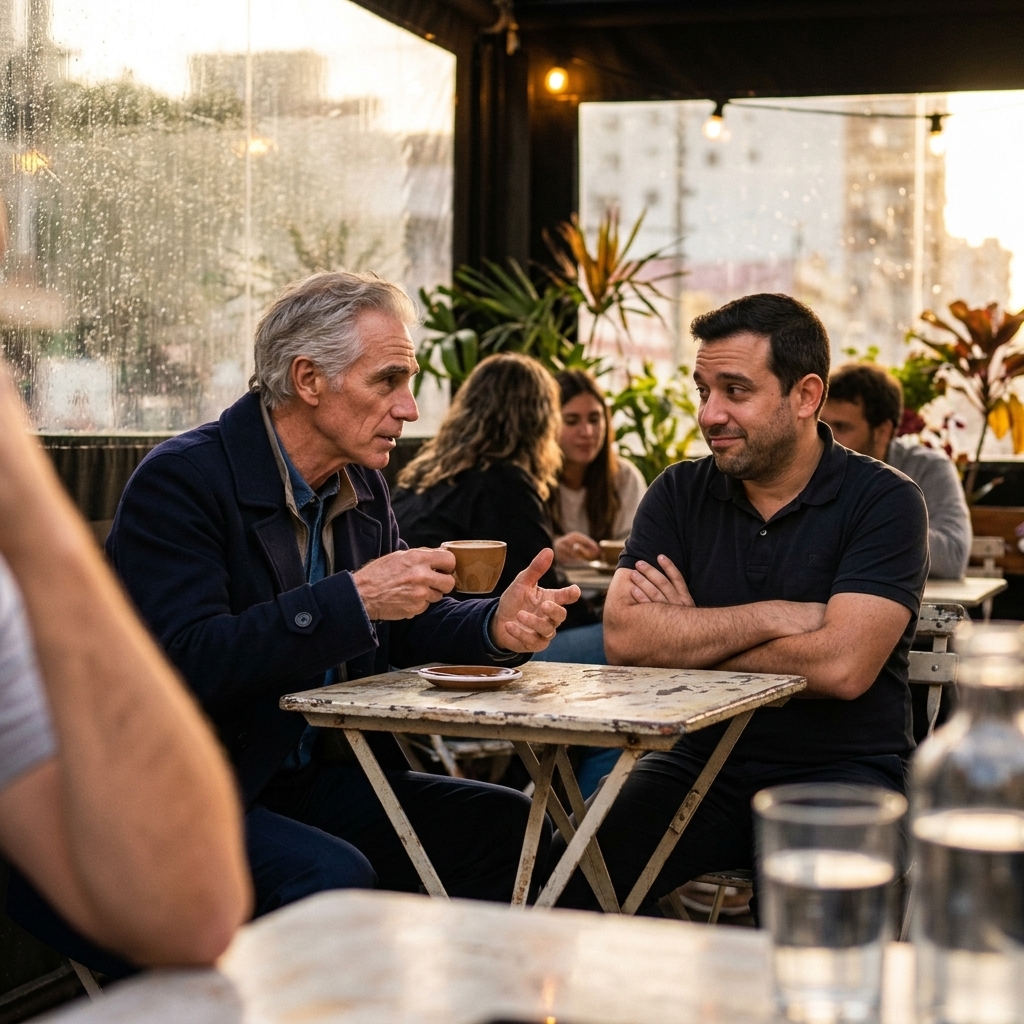
Fletcher EN
So, look, I want to start with a confession.
I read 'One Hundred Years of Solitude' for the first time when I was twenty-three, on a bus from Bogotá to Cartagena, and I genuinely did not understand what I was reading.
But I could not stop.
Octavio ES
Bueno, eso es exactamente lo que García Márquez quería.
Well, that's exactly what García Márquez wanted.
Que el lector sintiera que estaba dentro de un sueño, pero un sueño que tiene su propia lógica, una lógica que no necesita explicación.
For the reader to feel like they were inside a dream, but a dream that has its own logic, a logic that needs no explanation.
Fletcher EN
Right, and that's the thing that trips up a lot of English-speaking readers.
We come from a tradition where if something impossible happens in a novel, someone has to account for it.
There has to be a rational explanation somewhere.
Octavio ES
Mira, esa es una diferencia cultural muy importante.
Look, that's a very important cultural difference.
En la tradición literaria latinoamericana, lo sobrenatural no interrumpe la realidad.
In the Latin American literary tradition, the supernatural doesn't interrupt reality.
Simplemente forma parte de ella, igual que el calor o la lluvia.
It's simply part of it, just like heat or rain.
Fletcher EN
The term 'magical realism' itself actually came before García Márquez.
The German critic Franz Roh used it in the 1920s, talking about painting, not literature.
So where does the literary version really start?
Octavio ES
Sí, el término existía antes, pero García Márquez, junto con escritores como Alejo Carpentier, lo convirtió en algo completamente distinto.
Yes, the term existed before, but García Márquez, together with writers like Alejo Carpentier, turned it into something completely different.
Carpentier hablaba de 'lo real maravilloso', la idea de que América Latina ya es, por su propia historia, un lugar mágico.
Carpentier spoke of 'the marvelous real', the idea that Latin America is already, by its own history, a magical place.
Fletcher EN
And that history is brutal.
I spent time in Colombia in the late nineties, and the weight of the past there is almost physical.
You feel it in ways that are hard to describe.
Octavio ES
La verdad es que para entender a García Márquez tienes que entender lo que ocurrió en Colombia.
The truth is that to understand García Márquez you have to understand what happened in Colombia.
El período que se llama La Violencia, entre 1948 y 1958, fue una guerra civil que mató a más de doscientas mil personas.
The period called La Violencia, between 1948 and 1958, was a civil war that killed more than two hundred thousand people.
Ese es el fondo histórico de 'Cien años de soledad'.
That is the historical backdrop of 'One Hundred Years of Solitude'.
Fletcher EN
Two hundred thousand people.
And this is a conflict that the wider world barely registered.
García Márquez was writing about a catastrophe that history had essentially decided not to remember.
Octavio ES
Exactamente.
Exactly.
Y también estaba la masacre de las bananeras, en 1928, que aparece directamente en la novela.
And there was also the banana workers' massacre of 1928, which appears directly in the novel.
United Fruit Company, trabajadores en huelga, el ejército colombiano.
United Fruit Company, workers on strike, the Colombian army.
García Márquez lo convirtió en una escena donde el gobierno insiste en que no murió nadie, que todo fue un sueño.
García Márquez turned it into a scene where the government insists no one died, that it was all a dream.
Fletcher EN
Which is, and I don't think this is an accident at all, maybe the most political moment in the whole book.
Power erases the massacre by simply denying it happened.
He's saying: this is what power does to truth, and it does it constantly.
Octavio ES
Sí, y eso conecta con algo más grande, que es el Boom latinoamericano.
Yes, and that connects to something bigger, which is the Latin American Boom.
En los años sesenta y setenta, escritores como Vargas Llosa, Carlos Fuentes, Julio Cortázar y García Márquez usaban la ficción para decir verdades políticas que no podían decirse de otra manera.
In the sixties and seventies, writers like Vargas Llosa, Carlos Fuentes, Julio Cortázar, and García Márquez used fiction to tell political truths that couldn't be said any other way.
Fletcher EN
I covered enough authoritarian governments to know exactly what that means.
When the press is controlled, literature becomes the last honest space in a society.
The novel becomes the newspaper.
Octavio ES
Bueno, García Márquez lo sabía mejor que nadie porque él era periodista antes que novelista.
Well, García Márquez knew that better than anyone because he was a journalist before he was a novelist.
Empezó en periódicos en Colombia, escribía crónicas y reportajes.
He started in Colombian newspapers, writing chronicles and features.
Esa mirada de periodista nunca desapareció de su ficción.
That journalist's eye never disappeared from his fiction.
Fletcher EN
So let's talk about the book itself.
'Cien años de soledad', 1967.
That opening line.
'Many years later, as he faced the firing squad, Colonel Aureliano Buendía was to remember that distant afternoon when his father took him to discover ice.' In one sentence you get past, present, future, life, death, and wonder.
Octavio ES
A ver, esa primera frase es una obra maestra técnica.
See, that first sentence is a technical masterpiece.
Empieza en el futuro, vuelve al presente, luego va al pasado.
It starts in the future, returns to the present, then goes to the past.
García Márquez destruye el tiempo lineal desde la primera línea.
García Márquez destroys linear time from the very first line.
Y al mismo tiempo convierte el hielo, algo completamente ordinario, en un milagro.
And at the same time he turns ice, something completely ordinary, into a miracle.
Fletcher EN
The Buendía family, seven generations, and by the end you realize the whole thing is basically a map of Latin American history.
Every generation repeating the mistakes of the last, trapped in cycles they can't see.
Octavio ES
Mira, García Márquez dijo en varias entrevistas que quería escribir sobre la soledad como una condena.
Look, García Márquez said in several interviews that he wanted to write about solitude as a curse.
Los Buendía son incapaces de aprender del pasado porque están atrapados en sus propios ciclos.
The Buendías are incapable of learning from the past because they're trapped in their own cycles.
Es una crítica muy dura a ciertas formas de pensar que él veía en América Latina.
It's a very harsh critique of certain ways of thinking he saw in Latin America.
Fletcher EN
Here's what gets me, though.
He wrote the entire novel in eighteen months in Mexico City.
His wife Mercedes kept the family afloat, sold the car, held off creditors.
He barely left the room.
And when the manuscript was done, they couldn't afford the postage, so they sent half and had to wait.
Octavio ES
La verdad es que Mercedes Barcha nunca recibió suficiente crédito por eso.
The truth is Mercedes Barcha never got enough credit for that.
Pero lo importante es que cuando la novela llegó a Buenos Aires, a la editorial Sudamericana, el editor la leyó en una sola noche y supo inmediatamente que era algo completamente diferente.
But the important thing is that when the novel arrived in Buenos Aires, at the Sudamericana publishing house, the editor read it in one night and knew immediately it was something completely different.
Fletcher EN
So it lands in 1967 and within a few years it's been translated into dozens of languages.
Now I want to push on something, because there's a critique that says magical realism let Latin American writers off the hook politically.
That it aestheticized suffering instead of confronting it head on.
Octavio ES
Es que esa crítica no me parece justa.
That critique doesn't seem fair to me.
García Márquez no usaba la magia para esconder el sufrimiento.
García Márquez didn't use magic to hide suffering.
La usaba para mostrarlo de una manera que golpeaba más fuerte.
He used it to show it in a way that hit harder.
La escena de las bananeras es más impactante precisamente porque el Estado niega que ocurrió.
The banana massacre scene is more devastating precisely because the State denies it happened.
La magia revela la mentira del poder, no la oculta.
The magic reveals the lie of power, it doesn't conceal it.
Fletcher EN
No, you're absolutely right about that.
And the Nobel Prize in 1982, I think that's the moment when the world fully caught up with what he had been doing for twenty years.
Octavio ES
El discurso del Nobel es extraordinario.
The Nobel speech is extraordinary.
Lo tituló 'La soledad de América Latina'.
He titled it 'The Solitude of Latin America'.
No habló solo de literatura.
He didn't just talk about literature.
Habló de la historia de violencia y olvido en el continente, y de la dificultad de que el mundo vea a América Latina como algo más que un lugar exótico o peligroso.
He talked about the history of violence and forgetting on the continent, and about how hard it is for the world to see Latin America as anything more than an exotic or dangerous place.
Fletcher EN
And 'solitude' as he uses it is not loneliness in the personal sense.
It's political isolation.
It's the condition of being unseen by the world, of having your history simply not count.
Octavio ES
Exactamente.
Exactly.
Y ese concepto todavía resuena hoy.
And that concept still resonates today.
Cuando García Márquez dice que América Latina vive en la soledad, está diciendo que el mundo desarrollado no entiende, ni quiere entender, lo que ha pasado allí.
When García Márquez says Latin America lives in solitude, he's saying the developed world doesn't understand, and doesn't want to understand, what has happened there.
Es una acusación muy directa, no una metáfora decorativa.
It's a very direct accusation, not a decorative metaphor.
Fletcher EN
After the Nobel, the influence starts radiating outward into world literature, and this is where it gets genuinely fascinating to me.
Toni Morrison, Salman Rushdie, both acknowledged him directly and publicly.
Octavio ES
Bueno, Toni Morrison es un caso muy interesante.
Well, Toni Morrison is a very interesting case.
Ella decía que en la tradición afroamericana ya existía algo parecido al realismo mágico, esa mezcla de lo cotidiano con lo espiritual.
She said that in the African American tradition something similar to magical realism already existed, that mixture of the everyday with the spiritual.
García Márquez le dio un lenguaje literario para algo que su propia cultura ya sentía de manera profunda.
García Márquez gave her a literary language for something her own culture already felt deeply.
Fletcher EN
And Rushdie.
'Midnight's Children', 1981, one year before the Nobel.
Children born at the exact moment of Indian independence who have supernatural powers.
The parallel structure to García Márquez is obvious, and Rushdie has never denied the influence.
Octavio ES
Mira, lo que García Márquez abrió fue la posibilidad de que literaturas postcoloniales en todo el mundo usaran sus propias tradiciones orales, sus propias formas de entender el tiempo y la muerte, como material literario serio.
Look, what García Márquez opened up was the possibility for postcolonial literatures all over the world to use their own oral traditions, their own ways of understanding time and death, as serious literary material.
Antes de él, el realismo europeo era el estándar que todos debían imitar.
Before him, European realism was the standard everyone had to imitate.
Fletcher EN
Right, and here's the flip side of that.
Because magical realism became so influential, it also became a brand.
Publishers started expecting a certain kind of Latin American story.
Exotic, tropical, a little bit magic, a little bit violent.
And there's a real debate about whether that expectation became its own kind of cage.
Octavio ES
A ver, eso es un problema real y muy serio.
See, that's a real and very serious problem.
En los años ochenta y noventa, muchos editores europeos y norteamericanos solo querían publicar literatura latinoamericana si tenía ese sabor mágico.
In the eighties and nineties, many European and North American publishers only wanted to publish Latin American literature if it had that magical flavor.
Si un escritor latinoamericano escribía una novela urbana y realista, era mucho más difícil que la publicaran fuera de su país.
If a Latin American writer wrote an urban, realistic novel, it was much harder for it to get published outside their country.
Fletcher EN
Isabel Allende is an interesting case here.
'La casa de los espíritus', 1982, clearly working in the García Márquez mode.
Hugely successful internationally.
But there's a whole generation of Latin American critics who find the comparison reductive, even dismissive of Allende's own work.
Octavio ES
Es que el debate sobre Allende es complicado.
The debate about Allende is complicated.
Su novela es muy buena.
Her novel is very good.
Pero algunos críticos latinoamericanos la ven como una versión más suave, más comercial, del realismo mágico.
But some Latin American critics see it as a softer, more commercial version of magical realism.
García Márquez era más oscuro, más político, más incómodo.
García Márquez was darker, more political, more uncomfortable.
No tenía mucho interés en que el lector se sintiera a gusto.
He had little interest in making the reader feel at ease.
Fletcher EN
Let's go back to the journalism for a second, because I think it's genuinely underrated as a key to everything he did.
'Relato de un náufrago', his account of a Colombian sailor stranded at sea.
It reads like a novel but it's reported.
Every detail verified.
Octavio ES
La verdad es que ese libro es una de las mejores demostraciones de su talento.
The truth is that book is one of the best demonstrations of his talent.
García Márquez entrevistó al marinero durante veinte días, tomó notas, y luego escribió la historia en primera persona como si él mismo hubiera estado en el mar.
García Márquez interviewed the sailor for twenty days, took notes, and then wrote the story in first person as if he himself had been at sea.
Cuando se publicó, el gobierno colombiano lo consideró un escándalo político porque revelaba que el barco transportaba contrabando.
When it was published, the Colombian government saw it as a political scandal because it revealed the ship was carrying contraband.
Fletcher EN
So he was a serious journalist doing serious work and it got him in real trouble.
Which brings me to the uncomfortable part of his legacy.
His friendship with Fidel Castro.
He used his fame and his access to advocate for a regime that imprisoned writers and journalists.
That is not a small thing.
Octavio ES
No, no es pequeño.
No, it's not small.
Y es una contradicción muy dolorosa.
And it's a very painful contradiction.
García Márquez creía que Castro era necesario para proteger a Cuba del imperialismo norteamericano.
García Márquez believed Castro was necessary to protect Cuba from North American imperialism.
Pero muchos escritores cubanos que vivieron la represión no le perdonan esa posición.
But many Cuban writers who lived through the repression never forgave him for that position.
La verdad es que su legado literario y su legado político son inseparables y también incompatibles.
The truth is his literary legacy and his political legacy are inseparable and also incompatible.
Fletcher EN
So we're left with this.
A writer of extraordinary genius who changed what literature could do and mean, who gave voice to history that had been silenced, and who also made a very serious moral error and never fully recanted.
I think you have to hold both things at the same time.
Octavio ES
Bueno, mira, eso es exactamente lo que hace la gran literatura.
Well, look, that's exactly what great literature does.
No te deja cómodo.
It doesn't let you get comfortable.
García Márquez murió en 2014, y diez años después seguimos leyéndolo, discutiéndolo, enfadándonos con él.
García Márquez died in 2014, and ten years later we're still reading him, arguing about him, getting angry with him.
Eso es la prueba de que importa.
That's proof that he matters.
Los escritores que no incomodan a nadie no duran.
Writers who make no one uncomfortable don't last.